
Water Stagnation Testing in Liverpool for Empty Commercial Units
Get instant Quote. What if the first step before reoccupation isn’t a water sample? After a commercial unit has stood empty, reduced use can leave water stagnant and change the system’s risk profile. If you’re planning water stagnation testing Liverpool empty commercial units need a system-led approach, not just a result from one tap.
Under the Health and Safety at Work etc. Act 1974 and the Control of Substances Hazardous to Health Regulations 2002, the duty holder remains responsible for managing health risks. Our LCA-registered Legionella risk assessments recognise that every water system in England, Scotland and Wales is unique and must be assessed individually. The Testing Lab PLC provides UK-wide services, with its head office in Doncaster and over 18 years of industry experience. This practical checklist explains how stagnation checks, sampling and risk assessment differ, what site details to gather, and how to choose a clear next step for safe reoccupation.
Key Takeaways
- Vacancy can affect water use, but the risk depends on the system’s condition, layout and configuration, not simply how long the unit has been empty.
- Before arranging water stagnation testing Liverpool empty commercial units, gather occupancy history, system plans, outlet details and existing water-safety records.
- Sampling provides results from selected water points; an LCA-registered Legionella assessment considers the individual system and helps determine appropriate checks.
- Use the assessment findings to plan proportionate next steps before reoccupation, rather than prescribing remedial work without first understanding the system.
Why water stagnation testing matters in empty Liverpool commercial units
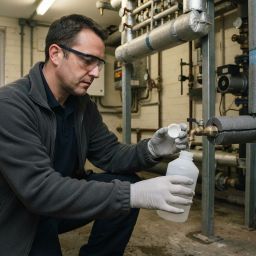
Water stagnation is water left sitting in pipework or other parts of a system because it isn’t being used or replaced regularly. In a vacant Liverpool unit, closed outlets and reduced demand can mean some sections receive little flow. Conditions may then become more favourable for Legionella growth, but vacancy alone doesn’t establish the level of risk. The system’s layout, condition, water use and control measures all matter.
That’s why water stagnation testing Liverpool empty commercial units should be planned around the actual installation, rather than treated as a standard test of one tap. The Water stagnation overview explains the term; for a commercial premises, the practical question is where water may be remaining unused and what controls are appropriate.
In the UK, the Health and Safety at Work etc. Act 1974 and the Control of Substances Hazardous to Health Regulations 2002 provide the legal framework for managing health risks. HSE’s ACOP L8 and HSG274 offer guidance on controlling Legionella, including in hot and cold water systems. An LCA-registered assessment considers the specific site: every water system in England, Scotland and Wales is unique and must be assessed individually. Sampling can contribute evidence, but results alone don’t describe the whole system or establish that it is safely managed.
Which parts of a vacant unit’s water system need attention?
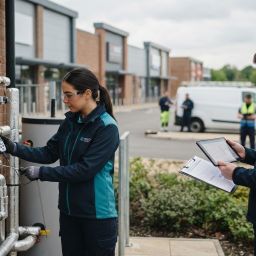
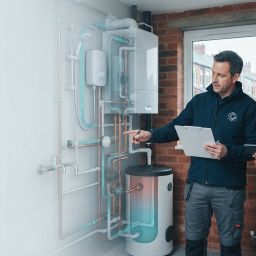
Start by noting the unit’s occupancy history and which areas were rarely used or shut off. Map the outlets, including taps and showers, and identify stored water, such as tanks, where present. Record known periods of disuse, changes to the layout and available water-safety records. This information helps an assessor understand the system; it isn’t a prescription to flush, drain or treat it before its condition and risks have been assessed.
Liverpool empty-unit water-safety checklist before reoccupation
Good preparation starts with evidence, not assumptions. Under the UK framework established by the Health and Safety at Work etc. Act 1974 and the Control of Substances Hazardous to Health Regulations 2002, the duty holder needs to manage health risks at the premises. A clear handover record helps an assessment focus on what changed during vacancy and what needs closer attention.
What should a facilities manager record before arranging checks?
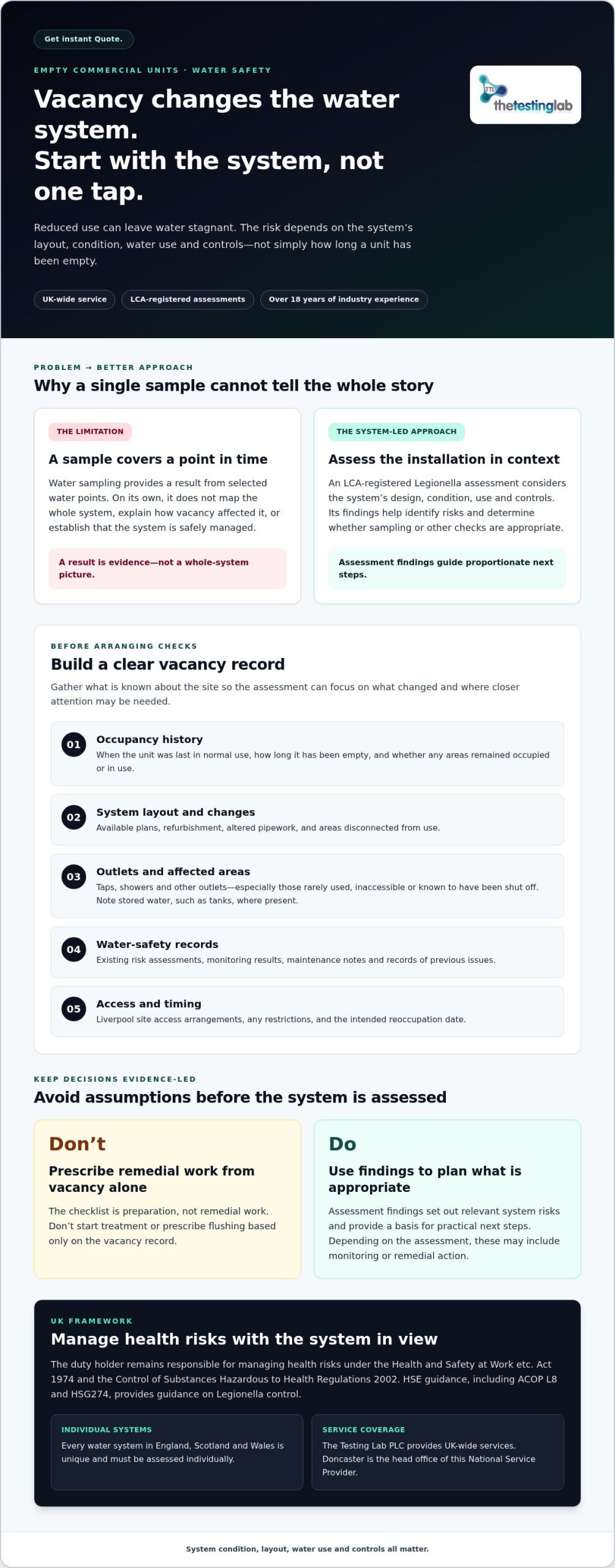
- Occupancy history: Note when the unit was last in normal use, how long it has been empty, and whether any areas stayed occupied or in use.
- System layout: Gather available plans and note changes such as refurbishment, altered pipework or areas disconnected from use.
- Outlets and affected areas: List taps, showers and other outlets, identifying those rarely used, inaccessible or known to have been shut off.
- Water-safety records: Collect existing risk assessments, monitoring results, maintenance notes and records of previous issues.
- Access and timing: Record Liverpool site access arrangements, any access restrictions and the intended reoccupation date.
A vacancy record helps assess the system’s current condition by showing where use stopped, for how long, and what changed while the unit was empty. Gathering this information is not remedial work. Don’t start treatment or prescribe flushing based on the checklist alone; appropriate action should follow an assessment of the system and its risks.
The Testing Lab PLC provides UK-wide services and has over 18 years of industry experience. Doncaster is the head office of this National Service Provider. With your site history and records assembled, you can arrange checks with a clearer picture of the premises and its access needs. Request a quote for water checks as a practical next step.
Arrange LCA-registered Legionella assessment and water testing in Liverpool
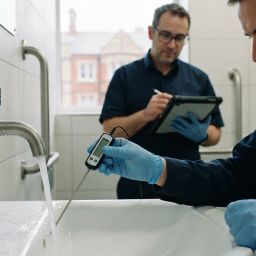
Sampling and assessment answer different questions. A water sample gives a result for the point and time sampled; it doesn’t map the whole system or explain how vacancy affected it. An LCA-registered Legionella assessment considers the system’s design, condition, use and controls, helping identify risks and determine whether sampling or other checks are appropriate. Every water system in England, Scotland and Wales is unique and must be assessed individually.
This system-led approach supports the duty holder’s responsibilities under the Health and Safety at Work etc. Act 1974 and the Control of Substances Hazardous to Health Regulations 2002. HSE guidance, including ACOP L8, provides a framework for Legionella control. For water stagnation testing Liverpool empty commercial units need an assessment that puts any test findings into context rather than treating a sample result as proof that the entire system is safe.
What happens after a commercial water-system assessment?
The findings should set out relevant system risks and provide a basis for practical next steps. Depending on the assessment, these may include monitoring or remedial action, with the appropriate measures guided by the evidence rather than assumed in advance. Sampling can support that process where indicated; it isn’t a substitute for understanding the system. The Legionella Risk Assessments service explains the assessment offering.
The Testing Lab PLC provides UK-wide service coverage and has over 18 years of industry experience. Doncaster is the head office of this National Service Provider. For a Liverpool unit, share the site history, available records and reoccupation plans when arranging an assessment, so the work can be considered in the context of the premises and its intended use.
Make the next step part of your reoccupation plan
For water stagnation testing Liverpool empty commercial units, start with an individual review of the system and use the results to determine appropriate checks or follow-up. The Testing Lab PLC provides LCA-registered Legionella risk assessments across the UK, with over 18 years of industry experience and its head office in Doncaster. Take the next step with a clear view of your premises’ needs: Get an instant quote for water testing and assessment. With a considered plan in place, you can move towards reoccupation with greater confidence.
Frequently Asked Questions
How long does a commercial unit need to be empty before water stagnation becomes a concern?
There’s no fixed vacancy period that determines risk for every property. For water stagnation testing Liverpool empty commercial units, use the vacancy timeline as part of the site history, not as a pass-or-fail threshold. For example, record whether the whole unit was unused or only certain areas, and share any periods of reduced occupancy for the assessment.
Can a water sample alone show whether an empty Liverpool unit is safe?
No. A sample reports on the water tested at a particular time and location, so it can’t establish the condition of every outlet or pipe. Keep the result with details of the sampling point and date. That context helps interpret what the finding relates to and whether further assessment or monitoring is appropriate.
Does every empty commercial unit need Legionella water testing before reoccupation?
No single testing rule fits every vacant unit. LCA-registered assessments recognise that every water system in England, Scotland and Wales is unique and must be assessed individually. A simple system and a site with extensive pipework or stored water may require different checks. An assessment helps determine whether sampling is appropriate before occupation resumes.
Who can arrange water stagnation checks for a Liverpool commercial property?
A property owner, facilities manager or other representative responsible for the site can arrange checks. The Testing Lab PLC supports commercial water-safety work, and the quote request can be made through an Instant Quote or Request a Call Back. Include the property location, known vacancy dates and any system records so the request has useful site context.

Article by
P J F Thomas
CEO and Founder of TTL plc.
Disclaimer
Items declared are AI generated but do reflect our services. Please get in contact if you have any questions.