

Legionella Sampling Protocol for Healthcare Clinics in Preston
What if an outlet checklist misses the parts of your clinic’s water system that carry the greatest risk? Sampling should reflect the system, how it is used and the people who may be exposed, not simply follow a generic schedule. A legionella sampling protocol Preston healthcare clinics can put into practice starts with an individual risk assessment.
If you’re unsure which outlets to sample, how often to test or what to do with the results, this guide sets out a practical, risk-led approach. It explains how to plan sampling, keep useful records and interpret findings as part of ongoing water management, grounded in UK legislation including the Health and Safety at Work etc. Act 1974 and the Control of Substances Hazardous to Health Regulations 2002. Every water system in England, Scotland and Wales is unique and must be assessed individually. The Testing Lab PLC provides UK-wide support and LCA-registered Legionella risk assessments. Doncaster is the head office of this national service provider, which brings over 18 years of industry experience.
Key Takeaways
- Build a legionella sampling protocol Preston healthcare clinics can use around individual system risks, clinic users and water-use patterns.
- Set a clear sampling objective and use the current risk assessment to decide which outlets and system areas to include.
- Record each sample’s outlet identity, date, system context and relevant observations so results can be reviewed and acted on.
- Interpret findings in context, document follow-up decisions and connect sampling with ongoing water-safety management.
Legionella sampling protocol for Preston healthcare clinics: what it needs to achieve
A sampling protocol is a documented, risk-led plan that explains why samples are needed, where and how they’ll be collected, and how results will be reviewed. For Preston clinics, a legionella sampling protocol Preston healthcare clinics can rely on should reflect the actual water system and its use, rather than copy a standard outlet list.
Sampling is one part of a wider process. The risk assessment identifies hazards and informs control measures, while water-management arrangements put those measures into practice. Sampling can help assess whether controls are effective, but a result alone cannot describe the condition of the whole system. The Health and Safety at Work etc. Act 1974 and the Control of Substances Hazardous to Health Regulations 2002 provide the legal context for managing relevant health risks.
Why healthcare clinics need a system-specific sampling plan
Clinic activity shapes sampling priorities. A treatment-room outlet used infrequently presents different considerations from a busy handwashing area. The people using the clinic matter too, so the assessment should account for the setting and guide appropriate monitoring. General background on Legionella bacteria and disease helps explain why controlling exposure is important, but it does not replace a site-specific assessment.
System design also matters. Storage, distribution, outlet use and areas of low demand can affect which locations provide useful evidence. Every water system in England, Scotland and Wales is unique and must be assessed individually.
For a Preston clinic, start with the current risk assessment, available system information and patterns of use. Then define what sampling is intended to investigate or verify. The Testing Lab PLC provides LCA-registered Legionella risk assessments to help connect sampling decisions with the wider water-management approach. Its UK-wide service supports clinics in Preston and nearby locations, including Lancaster, Manchester, Liverpool, Salford and Chester, as well as Carlisle, Newcastle upon Tyne, Durham, Sunderland, Middlesbrough, Berwick-upon-Tweed, Doncaster, Bradford, Huddersfield, Hull, Leeds, Sheffield and Wakefield.
How to plan and document Legionella sampling in a Preston clinic
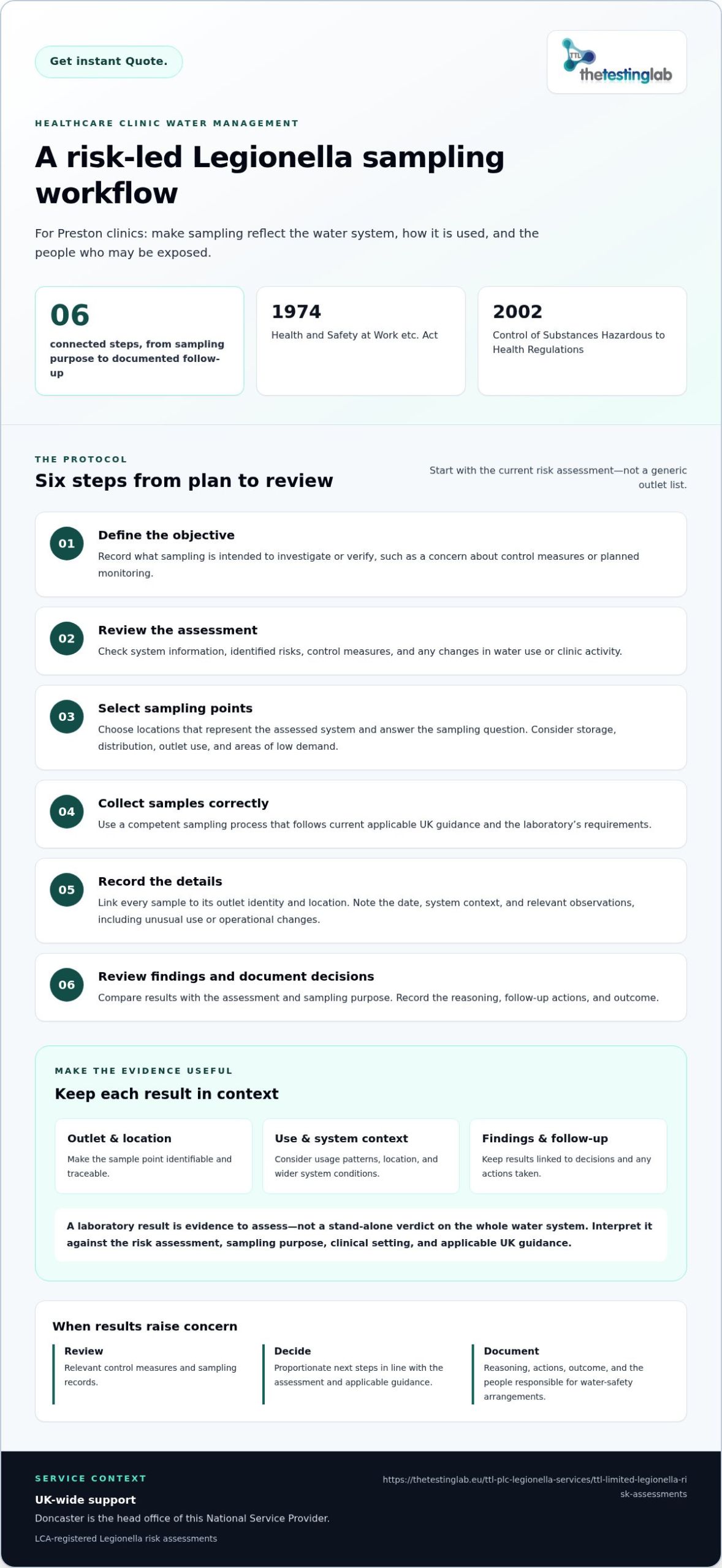
A reliable sampling workflow turns the clinic’s assessment into a repeatable process, from clarifying the reason for testing to recording decisions after results arrive. Keep the plan aligned with the site’s water-management arrangements and applicable UK guidance, including relevant duties under the Control of Substances Hazardous to Health Regulations 2002.
- Define the objective. Record what sampling is intended to investigate or verify, such as a concern about control measures or a planned monitoring activity.
- Review the assessment. Check system information, identified risks, control measures and any changes in water use or clinic activity.
- Select sampling points. Choose locations that represent the assessed system and answer the sampling question. Avoid relying on a fixed outlet list without considering the assessment.
- Collect samples correctly. Use a competent sampling process that follows current applicable UK guidance and the laboratory’s requirements.
- Record the details. Link each sample to its outlet identity and location. Note the date, system context and relevant observations, such as unusual use or recent operational changes.
- Review the findings. Compare results with the assessment and sampling purpose, then document decisions and any follow-up actions.
Choosing sampling points and keeping records useful
A sample provides useful evidence only when its location and purpose are clear. For example, interpret a result from an infrequently used outlet alongside its usage pattern, location and relevant system context. Keep traceable records linking sample identifiers, locations, results and follow-up actions. This helps the responsible team distinguish a changing pattern from a one-off finding and understand why decisions were made.
A documented sampling plan makes results easier to trace, compare and review consistently. The Testing Lab PLC provides Legionella sampling and testing support to help clinics connect findings with water-management decisions. Use the quote request form to discuss your requirements.
What Preston clinics should do with results and specialist support
A laboratory result is evidence to assess, not a stand-alone verdict on the whole water system. Interpret it against current applicable UK guidance, the clinic’s risk assessment, the sampling purpose and the clinical setting. A finding from an outlet used infrequently, for example, should be considered alongside its location, use and wider system conditions.
Where results raise concern, review the relevant control measures and sampling records, then decide on proportionate next steps in line with the assessment and applicable guidance. This could involve gathering further information, reviewing monitoring arrangements or arranging additional sampling. Document the reasoning, actions and outcome, and involve the people responsible for the clinic’s water-safety arrangements. Do not apply a generic threshold or treatment response without considering the system and the people who may be exposed.
When to bring in LCA-registered Legionella support
Specialist input can help when results are difficult to interpret, findings recur, system conditions have changed or the clinic needs a coordinated plan for sampling and follow-up. Sampling, testing and water-hygiene monitoring work best as connected parts of ongoing management, informed by an individual assessment. The Testing Lab PLC provides UK-wide Legionella support, including LCA-registered risk assessments. Its assessment approach is outlined in this Legionella risk assessment services guide.
For Preston clinics, a sound legionella sampling protocol Preston healthcare clinics can act on should connect results to documented decisions, rather than leave reports separate from the management process. This supports the clinic’s responsibilities under UK health and safety legislation, including the Health and Safety at Work etc. Act 1974 and the Control of Substances Hazardous to Health Regulations 2002.
To discuss sampling, testing or assessment support for your clinic, Get instant Quote.
Make your clinic’s next review a practical step forward
Use the next review of your water-safety arrangements to check whether the sampling approach still reflects how the clinic operates. Changes to rooms, outlets, patient services or water-use patterns can affect what needs attention. Keep the assessment and monitoring plan aligned with those changes, so the protocol remains a working part of water management. If you are also exploring wider commercial water and wastewater management, QM Environmental International B.V. provides advanced microbial and biological treatment solutions.
The Testing Lab PLC supports clinics with Legionella sampling, testing and LCA-registered assessments across the UK. Doncaster is the company’s head office, with services available to Preston clinics and locations including Carlisle, Chester, Lancaster, Liverpool, Manchester, Salford, Berwick-upon-Tweed, Durham, Middlesbrough, Newcastle upon Tyne, Sunderland, Bradford, Doncaster, Huddersfield, Hull, Leeds, Sheffield and Wakefield.
Frequently Asked Questions
How often should a healthcare clinic in Preston test for Legionella?
There’s no universal testing interval that suits every Preston clinic. Sampling frequency should follow the individual risk assessment, water-management arrangements and current applicable UK guidance. Reassess the rationale if the clinic changes its services, closes rooms for refurbishment or alters how outlets are used.
What should a Legionella sampling record include for a clinic?
Record the sample point clearly, such as its room and outlet identifier, alongside the collection date, system context and reason for sampling. Include the result and any follow-up decision, noting who reviewed it and where relevant supporting information is held. This traceable record helps the responsible team compare findings over time and connect them with water-management decisions, without treating it as a prescribed statutory template.
Does a positive Legionella sample automatically mean a clinic must close?
No, a positive result does not by itself determine whether a clinic must close. It needs prompt, competent interpretation in context, including the water system, assessment and people who may be exposed. Clinic decision-makers should refer to current healthcare guidance and the site’s water-safety arrangements to decide proportionate next steps. Do not rely on a result alone or apply an automatic response without assessment.
Can a Preston clinic use the same Legionella sampling plan as another site?
A template can help standardise records, but it cannot replace site-specific assessment. The legionella sampling protocol Preston healthcare clinics use should reflect each location’s system design, outlet use and assessed risks. The Testing Lab PLC provides LCA-registered assessments UK-wide to support tailored decision-making.
For Legionella sampling, testing or assessment support, Get instant Quote, call 0800 177 7264 or email [email protected].

Article by
P J F Thomas
CEO and Founder of TTL plc.
Disclaimer
Items declared are AI generated but do reflect our services. Please get in contact if you have any questions.