
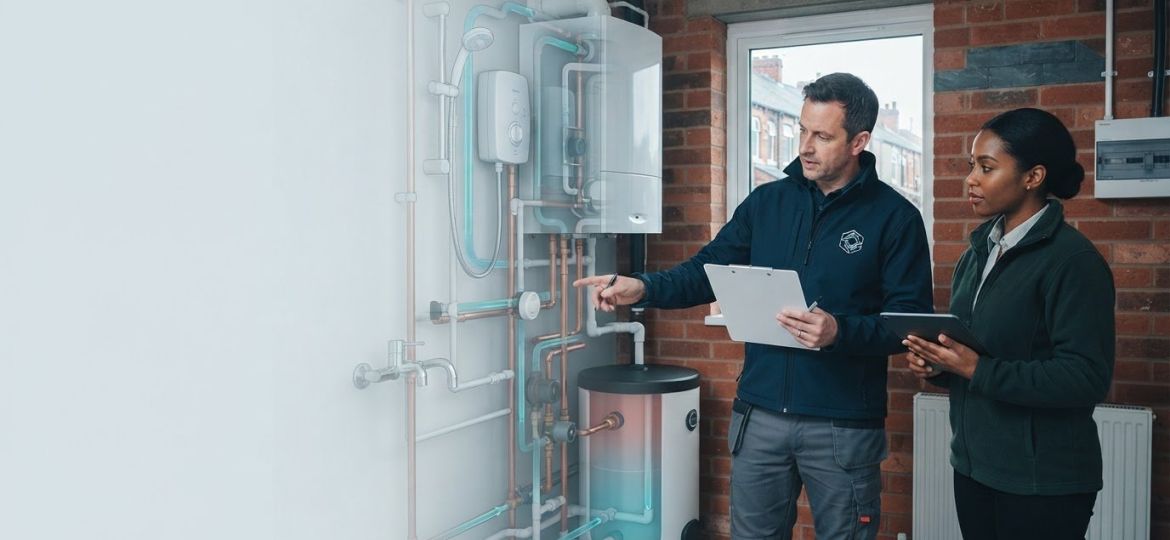
How to Get a Legionella Certificate in the UK: 2026
Get instant Quote. If a letting agent or records request asks for a “Legionella certificate”, it helps to know what evidence is actually useful. UK law does not require a document by that name. The key evidence is a suitable and sufficient risk assessment, supported by records of relevant control measures. Understanding how to get a legionella certificate starts with identifying the water system and arranging an assessment that reflects its specific risks.
Legionella duties are grounded in UK health and safety legislation, including the Health and Safety at Work etc. Act 1974 and the Control of Substances Hazardous to Health Regulations 2002. This guide explains what evidence to request and retain, when sampling may be appropriate, and how to arrange an assessment. The Testing Lab PLC provides LCA-registered Legionella risk assessments as a UK-wide national service provider, with its head office in Doncaster and over 18 years of industry experience. Every water system in England, Scotland and Wales is unique and must be assessed individually.
Key Takeaways
- For how to get a legionella certificate, focus on a property-specific risk assessment and supporting records, rather than a government-issued certificate.
- Identify the water system and responsible person, then arrange an assessment suited to the system’s scope and risks.
- Sampling is not automatically necessary. Use the assessment findings to determine what evidence and control measures are appropriate.
- Keep records accessible and review them when the system or relevant risk information changes. The Testing Lab PLC provides LCA-registered assessments UK-wide, with its head office in Doncaster and over 18 years of industry experience. Every water system in England, Scotland and Wales is unique and must be assessed individually.
Is There an Official Legionella Certificate in the UK?
No. There is no government-issued or legally recognised “Legionella certificate” required across the UK. A letting agent may use that phrase when requesting evidence, but the meaningful records are a suitable and sufficient risk assessment and documentation of relevant control measures. A certificate-style document on its own does not show whether risks were properly assessed or managed.
In England, Scotland and Wales, Legionella control sits within broader health and safety duties, including the Health and Safety at Work etc. Act 1974, the Control of Substances Hazardous to Health Regulations 2002 and the Management of Health and Safety at Work Regulations 1999. The assessment should reflect the water system and risks at the specific premises. The health condition caused by Legionella bacteria, Legionellosis, is one reason risk assessment and appropriate controls matter.
What document should a landlord or duty holder ask for?
Ask for the risk assessment report and associated records, rather than relying on a generic certificate as proof of compliance. The report should identify the system assessed, describe the relevant findings and set out appropriate control measures or actions. Supporting records should help the responsible person understand what needs managing and show how controls are being maintained.
This is the practical answer to how to get a legionella certificate: arrange an assessment that produces useful, system-specific evidence. Sampling may be appropriate in some circumstances, but it is not automatically required for every property. A report is not a guarantee that water will remain safe indefinitely. Risks and controls need to be reviewed if relevant circumstances change. The Testing Lab PLC provides LCA-registered Legionella risk assessment services. Every water system in England, Scotland and Wales is unique and must be assessed individually. The Testing Lab PLC is a UK-wide national service provider, with its head office in Doncaster and over 18 years of industry experience.
How to Get a Legionella Risk Assessment and Useful Records
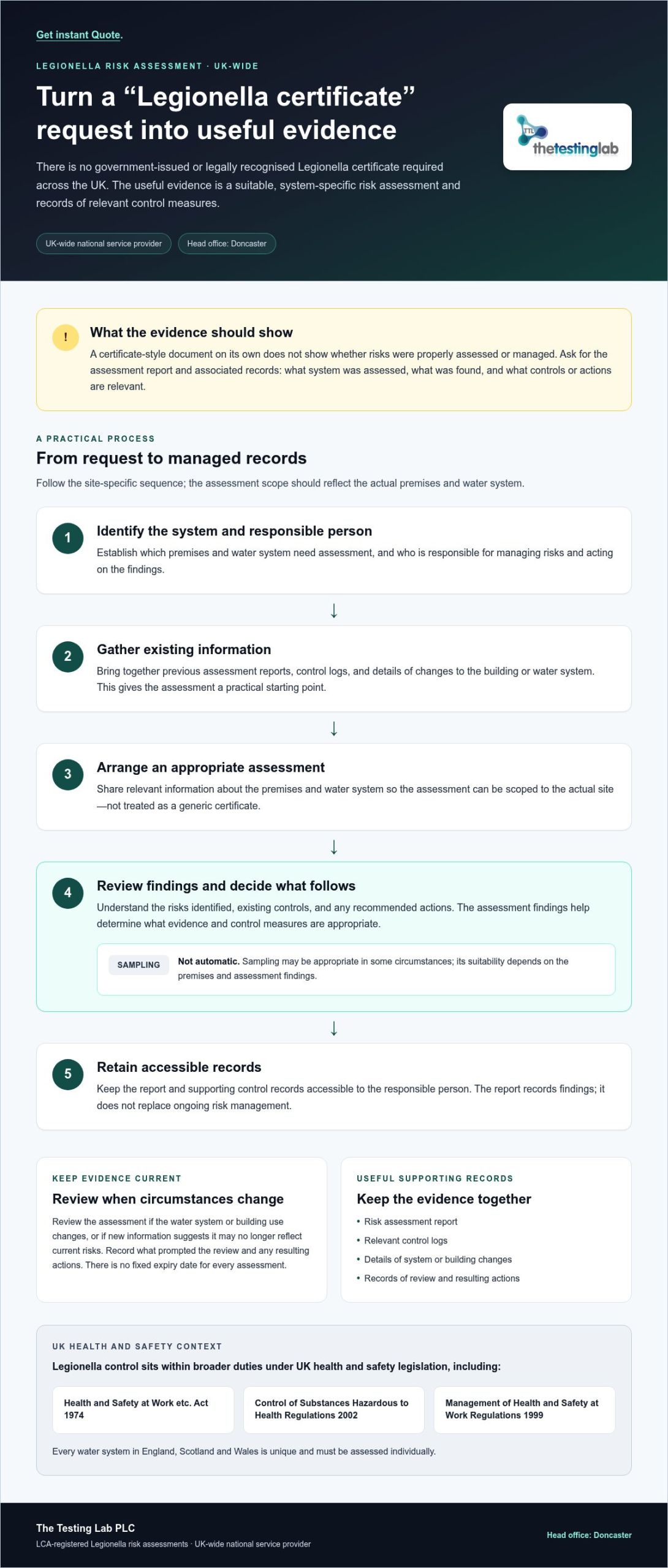
Turn a request for a certificate into useful evidence with a clear process. UK health and safety legislation requires risks to be assessed and managed, while the HSE guidance on Legionella and Legionnaires’ disease explains the risk-based approach. The useful outcome is a report that reflects the premises, supported by records showing how relevant actions are handled.
- Identify the system and responsible person. Establish which premises and water system need assessment, and who is responsible for managing the risks and acting on the findings.
- Gather existing information. Pull together any previous assessment reports, control logs and details of changes to the building or water system. This gives the assessment a practical starting point.
- Arrange an appropriate assessment. Share relevant information about the premises and its water system so the assessment can be scoped to the actual site, rather than treated as a generic certificate.
- Review the findings and follow up. Understand the risks identified, the controls already in place and any recommended actions. Sampling is not automatically needed; its suitability depends on the circumstances and assessment findings.
- Retain records. Keep the report and supporting control records accessible to the responsible person. The assessment records findings, but does not replace ongoing risk management.
What happens during an individual assessment?
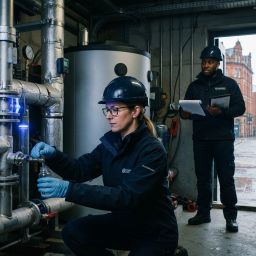
The assessor considers the water system and relevant risks at the premises, then documents the findings and appropriate actions. The Testing Lab PLC provides LCA-registered Legionella Risk Assessments. Every water system in England, Scotland and Wales is unique and must be assessed individually, so the assessment scope should reflect the specific system rather than rely on a standard certificate template.
To arrange a tailored assessment, request an instant quote.
Choose a UK-Wide Assessment Route and Keep Evidence Current
A risk assessment is a working record, not a document to file away indefinitely. Keep the findings and related control records accessible to the person responsible for the premises. Review them if the water system or building use changes, or if new information suggests the assessment may no longer reflect current risks. This supports the ongoing risk-management approach required under UK health and safety legislation. A certificate alone cannot show that controls remain appropriate.
There is no fixed expiry date for every assessment. The need for review depends on the system and relevant circumstances. Record what prompted a review and any resulting actions. For landlords, facilities teams and other duty holders managing properties across the UK, keeping records organised by site makes it easier to track findings and follow up on control measures.
What can a tailored Legionella service support?
The Testing Lab PLC provides LCA-registered Legionella services UK-wide across England, Scotland and Wales. With over 18 years of industry experience and its head office in Doncaster, this national service provider supports Legionella risk assessments, water-hygiene monitoring, sampling and water management. Cleaning and remedial works may also be relevant where findings indicate a need; they are not automatic parts of every assessment.
Sampling is one possible activity, not a default requirement. The appropriate scope depends on the premises and the assessment findings. If you are deciding how to get a legionella certificate, focus on obtaining useful, system-specific evidence and managing any actions identified, rather than seeking a generic document or a guaranteed compliance outcome.
For a tailored next step, Get instant Quote.
Make Your Next Step a Clear One
Before arranging an assessment, gather the details that will help define its scope: information about the property’s water system, existing assessment records, control logs and any known changes or concerns. This gives the assessment a practical starting point and helps keep the work relevant to the premises.
If you are still considering how to get a legionella certificate, focus on closing evidence gaps and keeping risk management aligned with UK health and safety duties, rather than relying on a document title alone. The Testing Lab PLC provides LCA-registered Legionella risk assessments as a UK-wide national service provider, with its head office in Doncaster and over 18 years of industry experience.
Arrange a property-specific assessment: Get instant Quote.
Frequently Asked Questions
Is a Legionella certificate legally required in the UK?
No formal Legionella certificate is legally required UK-wide. The duty is to assess and control risk where applicable. Under the Health and Safety at Work etc. Act 1974, the COSHH Regulations 2002 and the Management of Health and Safety at Work Regulations 1999, responsibilities depend on the circumstances and control of the premises. For how to get a legionella certificate, use current HSE guidance to understand the relevant duties. This overview is not legal advice.
Does a Legionella risk assessment always include water sampling?
No. A risk assessment can evaluate a system’s design, use and existing controls without automatically requiring laboratory samples. Sampling is a separate testing activity that may help investigate a particular concern or support monitoring, depending on the system and risks. The appropriate approach should follow current HSE recommendations. A sample result does not replace assessing and managing risk.
How often should a Legionella risk assessment be reviewed?
There is no universal fixed expiry date for every assessment. Review it if the water system or building use changes, or if new information raises doubt about whether the findings remain valid. For example, refurbishment that changes pipework or evidence that controls are not working may prompt a review. Check current HSE guidance when deciding on a review interval.
Can one Legionella assessment cover several properties?
Keep separate records for each property because layouts, use and controls can differ. For UK-wide portfolios in Carlisle, Chester, Lancaster, Liverpool, Manchester, Preston, Salford, Berwick-upon-Tweed, Durham, Middlesbrough, Newcastle upon Tyne, Sunderland, Bradford, Doncaster, Huddersfield, Hull, Leeds, Sheffield and Wakefield, organise evidence by site.

Article by
P J F Thomas
CEO and Founder of TTL plc.
Disclaimer
Items declared are AI generated but do reflect our services. Please get in contact if you have any questions.