
Legionella testing for Sunderland dental surgeries
A dental surgery’s Legionella duties extend beyond taking a water sample. For private dental surgeries in Sunderland, legionella testing is guided by a risk assessment of the practice’s water systems; routine sampling depends on what that assessment finds. Under the Health and Safety at Work Act 1974, employers have responsibilities for health and safety, according to the UK Parliament.
That can feel like a lot to manage alongside clinical work, but the essentials are clear: assess the risks, put suitable controls in place and keep appropriate records. This guide explains how UK-wide legislation and guidance apply to legionella testing for private dental surgeries in Sunderland, what an assessment should consider, and which compliance records support effective water management.
The Testing Lab PLC is a national service provider with its head office in Doncaster, offering Legionella Risk Assessments and testing to support dental practices with these responsibilities.
Key Takeaways
- UK-wide duties apply: registered dental practice managers have a general duty of care under the Health and Safety at Work Act 1974, according to UK Parliament.
- A Legionella assessment should guide the controls and records your practice needs; a new assessment every year and an annual Legionella certificate are not legal requirements.
- Sampling needs depend on the assessment findings. The systems to consider include domestic hot and cold water, dental unit waterlines and water-containing equipment.
- Review the assessment if changes to plumbing, occupancy or layout, an extended closure, or monitoring results could affect the risk.
Does a dental practice need a Legionella Risk Assessment?
Yes. Dental practices must assess and manage Legionella risks in their water systems, including private surgeries in Sunderland. For legionella testing for private dental surgeries in Sunderland, a risk assessment identifies the relevant risks and helps determine suitable controls and whether sampling is appropriate to protect patients, staff and visitors.
Assessment requirements for dental practices
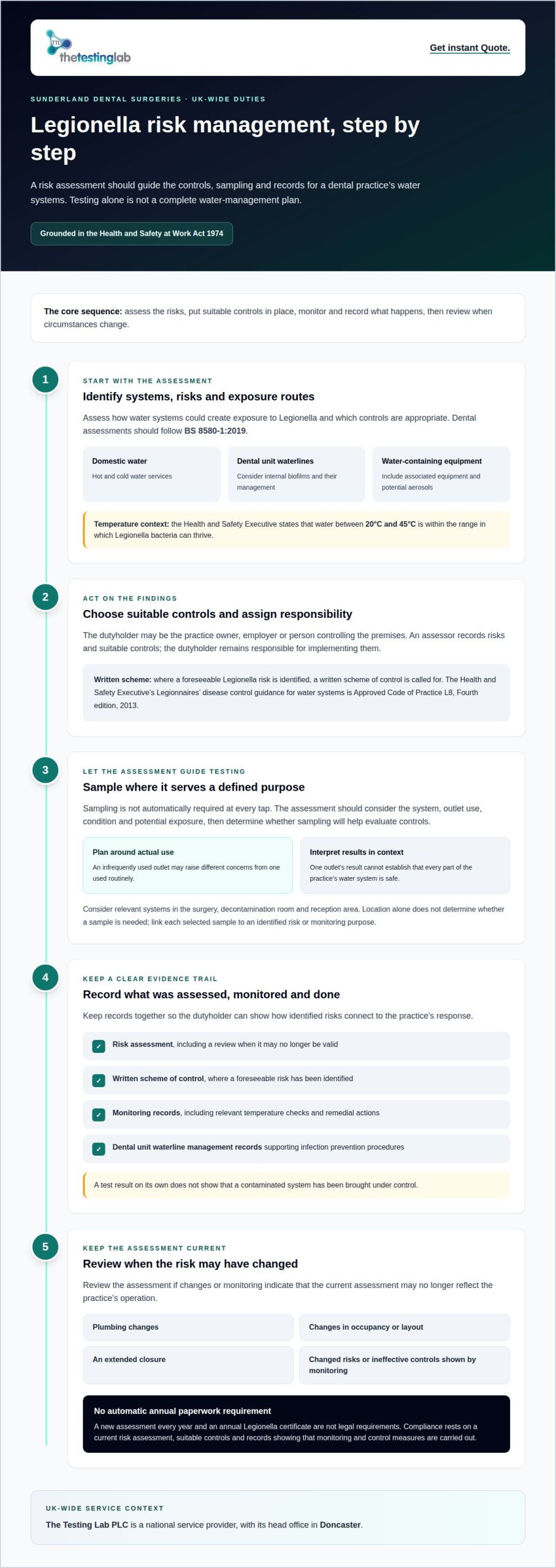
A Legionella risk assessment examines how water systems could create exposure to the bacteria and which controls are appropriate. Dental assessments should follow BS 8580-1:2019 and consider domestic hot and cold water, dental unit waterlines, associated water-containing equipment and contaminated aerosols. The Health and Safety Executive states that water temperatures between 20°C and 45°C are within the range in which Legionella bacteria can thrive. Assessing each system matters because risks and suitable controls can differ between outlets and equipment.
Duties to assess and control risks
UK law places responsibility for managing workplace health and safety on those running the practice. Registered managers of dental practices in the UK have a general duty of care under the Health and Safety at Work Act 1974, according to UK Parliament. The Health and Safety Executive approved its Legionnaires’ disease control guidance for water systems as Approved Code of Practice L8, Fourth edition, 2013. A risk assessment informs the control of legionella, while any identified foreseeable risk calls for a written scheme of control. These duties apply to NHS and private practices, so Sunderland surgeries must manage water-system risks rather than rely on sampling alone.
Dutyholders and competent assessors
The dutyholder may be the practice owner, employer or person controlling the premises, and is responsible for acting on assessment findings. A competent assessor examines water systems and potential exposure routes, then records risks and suitable controls. The dutyholder remains responsible for implementing those controls, even when an assessor is commissioned. Review the assessment if plumbing, occupancy or practice layout changes, after an extended closure, or when monitoring indicates changed risks or ineffective controls. This keeps legionella testing for private dental surgeries in Sunderland aligned with the practice’s current operation.
Legionella certificates and compliance records
A Legionella certificate is not a substitute for managing water systems. UK law does not require dental practices to hold an annual Legionella certificate. Compliance rests on a current risk assessment, suitable controls and records showing that monitoring and control measures are carried out. For a Sunderland practice, these records help demonstrate how health and safety risks are managed across the premises.
Dental waterline management should be considered as part of the practice’s wider premises and equipment arrangements. This applies to dental practice compliance in England, including private and NHS practices. Records should make the link between identified risks and the practice’s response clear. For example, monitoring entries should be considered alongside recorded temperatures and any actions taken when results indicate a problem. A test result on its own does not show that a contaminated system has been brought under control.
Useful records include:
- The Legionella risk assessment, including its review when it may no longer be valid.
- The written scheme of control, where a foreseeable Legionella risk has been identified.
- Ongoing monitoring records, including relevant temperature checks and remedial actions.
- Dental unit waterline management records supporting infection prevention procedures.
Keep the records together so the dutyholder can show what was assessed, monitored and acted upon. A review is needed after changes to the water system or ineffective controls; a new assessment every year is not a legal requirement. To arrange a professional assessment, request a Legionella risk assessment quote.
Which water systems and outlets in a dental surgery need Legionella sampling?
In dental practices, sampling should be guided by the risk assessment, not applied automatically to every tap. The assessment identifies which water systems and outlets present relevant exposure risks and whether sampling will help evaluate control measures. A result from one outlet cannot, by itself, establish that every part of the practice’s water system is safe.
Systems to consider include domestic hot and cold water services, dental unit waterlines and associated equipment that contains water. The assessment should account for how each system is used, its condition and the potential for exposure to contaminated aerosols. An infrequently used outlet, for example, may present different concerns from one used routinely, so the sampling plan should reflect the system’s actual operation.
Dental unit waterlines need specific consideration because biofilms on their internal surfaces can harbour organisms, including Legionella. Sampling these lines may be appropriate when assessment findings indicate a need to investigate or verify controls. They should be considered alongside the practice’s wider water systems, not as a replacement for assessing domestic hot and cold services.
Water systems in the surgery, decontamination room and reception area may all be relevant. Location alone does not determine whether a sample is needed; the water system, outlet use, potential exposure and assessment findings inform that decision. A clear sampling plan links each selected sample to a defined risk or monitoring purpose. Legionella testing for private dental surgeries in Sunderland should follow this assessment-led approach, rather than rely on a routine blanket schedule.
Request a quote for Legionella testing to assess your practice’s sampling needs.
The Testing Lab PLC
The Testing Lab PLC helps UK-wide dental practices assess Legionella risks and understand when testing is appropriate. As a national service provider with its head office in Doncaster, it offers Quick Legionella Risk Assessments and Fast Legionella Testing. These services can support practices reviewing water-system risks, responding to assessment findings or investigating monitoring concerns.
A professional assessment considers the practice’s individual water systems and helps identify suitable control measures. Because every water system is unique, testing should be selected to suit the assessment findings and provide evidence where sampling is appropriate. It does not replace the wider risk-management process. This joined-up approach helps dutyholders focus on relevant risks and maintain clear records.
For support with your practice’s Legionella assessment or testing, contact The Testing Lab PLC.
Set your practice’s next steps in motion
For Sunderland practices, effective legionella testing for private dental surgeries starts with understanding the practice’s current water-management needs. If an assessment identifies unresolved risks or monitoring raises concerns, professional support can help determine an appropriate next step. The response should be based on what the systems and records show.
The Testing Lab PLC offers Quick Water Testing, Quick Legionella Risk Assessments and Fast Legionella Testing. Its LCA-registered Legionella risk assessors can support practices seeking clearer evidence about water quality or risks, and help identify whether further action is appropriate. Choose the service that matches the issue your practice needs to address, rather than treating a single test as a complete management plan.
Take the next step towards a considered approach for your surgery. Request a quote from The Testing Lab PLC, and move forward with confidence.
Frequently Asked Questions
How Often Should the Assessment Be Reviewed?
Review the assessment regularly and whenever there is reason to think it may no longer be valid. A full review every two years is considered good practice, but UK law does not require a new assessment every year. A prolonged closure or ineffective controls, for example, can change how well the existing assessment reflects the practice’s current water-system risks.
Is legionella a particular problem for dentists?
Dental practices need to account for both building water systems and dental unit waterlines. Biofilms can develop inside waterlines and harbour organisms, while dental equipment can generate aerosols. Waterline management is therefore relevant to infection prevention, but every surgery does not have the same level of risk. The practice’s equipment, system condition and controls all matter.
Is legionella testing required by law?
UK-wide health and safety duties require risks to be assessed and controlled, but routine Legionella sampling is not automatically required for every dental practice. The risk assessment determines whether testing is appropriate. HSE guidance (ACOP L8 & HSG274) supports control of Legionella risks in water systems; sampling is one possible monitoring measure, not a replacement for effective controls.
What Do I Need to Demonstrate for Compliance?
Records should show how the practice identifies and manages water-system risks. Keep the assessment, any written control scheme, monitoring records and evidence of actions taken when readings or results raise concerns. For example, a temperature issue record should link the finding to the corrective action and follow-up. These documents help demonstrate how the practice manages risks across its premises and equipment.
What Legionella testing requirements apply to private dental surgeries in England?
Private dental practices in England must manage Legionella risks and meet applicable CQC premises and equipment requirements. The Care Quality Commission considers Legionella and dental waterline management under Regulation 15. Testing should be based on the risk assessment, which may identify a need to sample domestic water, dental unit waterlines or both. There is no requirement to hold an annual Legionella certificate.

Article by
P J F Thomas
CEO and Founder of TTL plc.
Disclaimer
This guide gives general information only and is not legal advice. For advice on your site or samples, contact The Testing Lab PLC.