
Water Dead Leg Legionella Testing for Leeds Office Conversions
Get instant Quote. A conversion can create a Legionella risk even when the water system appears unchanged. Water dead-leg Legionella testing for Leeds office conversions should start with a review of the risk assessment whenever building use or the water system changes; non-domestic premises with systems capable of producing water aerosols require a Legionella risk assessment.
It’s understandable to focus on sampling, but a sample only shows what was found at an outlet on the day it was taken. This guide explains how to spot dead-leg risks after a conversion, when to review the assessment, and how sampling and routine controls fit into a reliable water management approach across the UK. You’ll see why tracing pipework and identifying outlets that are no longer used should come before deciding what testing is appropriate.
Key Takeaways
- Review the Legionella risk assessment when a conversion changes the building’s use or water system.
- Trace redundant pipework and little-used outlets to identify potential dead legs and stagnant sections.
- Use the risk assessment and written scheme to guide routine monitoring and decide when water samples should be sent for laboratory culture.
- Interpret a sample result as a finding from the outlet on the sampling day, not as proof that the whole system is safe.
Risk assessment reviews after system or building-use changes
An office conversion can change water demand, outlet use and pipework configuration. Review the Legionella assessment when these changes affect how water is stored, distributed or used.
Legionella Risk Assessment Reviews
A Legionella risk assessment identifies hazards in a water system and the controls needed to manage them. After conversion, compare the assessment with the completed layout, intended occupancy and actual outlet use. A new kitchenette, relocated washroom or rarely used shower may change the risk profile. Responsibility rests with the dutyholder who controls the premises or water system; landlords, employers and contractors should agree handover duties according to their control and roles.
Dead Leg Definition and Risk
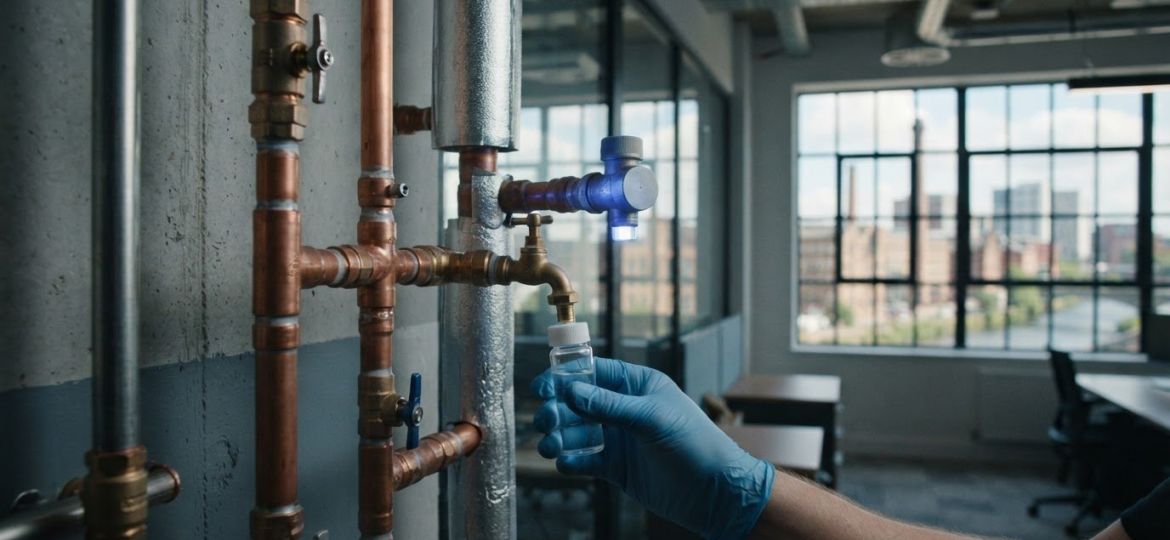
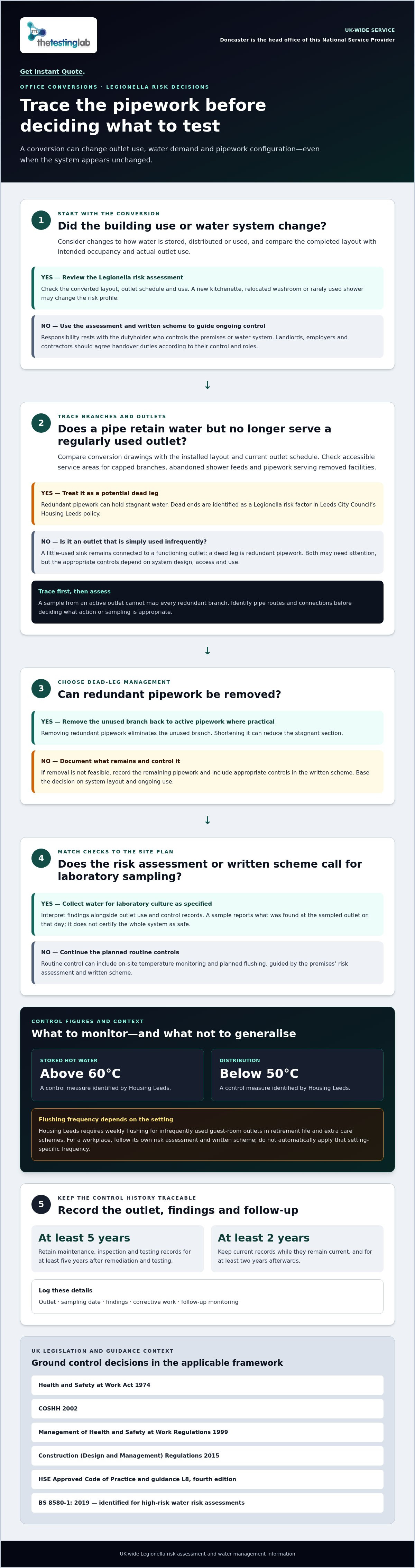
A dead leg is a length of pipework that retains water but no longer serves a regularly used outlet. Water can stagnate in redundant branches, making them a relevant Legionella risk factor. Leeds City Council’s Housing Leeds policy identifies dead ends in a water system as a factor that increases Legionella risk. During a conversion, trace capped branches and outlets removed from the new floor plan.
Dead Leg Management Options
Managing dead legs means removing redundant pipework or controlling sections that remain. Where practical, remove an unused branch back to the active pipework; shortening it can reduce the stagnant section. If removal isn’t feasible, document the remaining pipework and include appropriate controls in the written scheme. Choose whether to remove, shorten or manage a dead leg based on the system layout and ongoing use.
Applicable Regulations and HSE Guidance
Applicable UK controls include legislation and guidance for managing workplace health risks from water systems. Leeds City Council names the Health and Safety at Work Act 1974 as relevant legislation for Legionella management. Relevant frameworks also include COSHH 2002, the Management of Health and Safety at Work Regulations 1999, and the Construction (Design and Management) Regulations 2015. HSE’s fourth edition Approved Code of Practice and guidance L8 informs Legionella control; BS 8580-1: 2019 is also identified for high-risk water risk assessments.
Water sampling and routine control
Routine control combines on-site temperature monitoring, planned flushing and laboratory sampling where required. For water dead-leg Legionella testing in Leeds office conversions, use the premises’ risk assessment and written scheme to decide which checks suit the system.
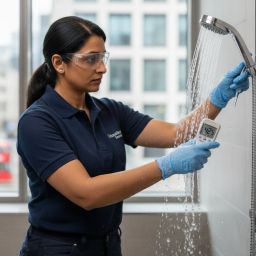
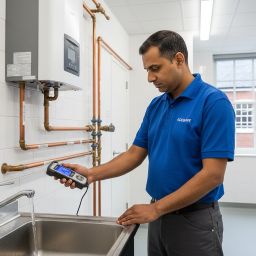
Temperature monitoring means recording water temperatures at selected points to assess control measures. Housing Leeds identifies maintaining stored hot water above 60°C and distribution below 50°C as a Legionella control measure. Record readings consistently and investigate changes, especially at outlets near altered office facilities.
Flushing means running water through an infrequently used outlet to replace stagnant water. Housing Leeds requires weekly flushing for infrequently used guest-room outlets in retirement life and extra care schemes. For a workplace, follow the site’s risk assessment and written scheme rather than applying that setting-specific frequency automatically.
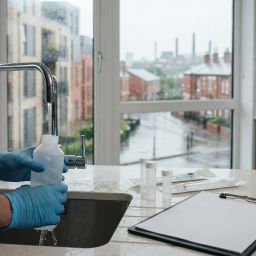
Legionella sampling means collecting water for laboratory culture when the assessment or written scheme calls for it. A result records what was found at the sampled outlet on that day; it doesn’t certify the whole system as safe. For water dead-leg Legionella testing in Leeds office conversions, interpret results alongside outlet use and the system’s control records.
After remediation and testing, retain maintenance, inspection and testing records for at least five years. Keep current records while they remain current and for at least two years afterwards. Log the outlet, sampling date, findings, corrective work and follow-up monitoring to maintain a traceable control history.
Before a converted office resumes normal use, map affected outlets and update monitoring records. A water testing quote request can help organise the sampling step.
What is a water system dead leg and why does it increase Legionella risk?
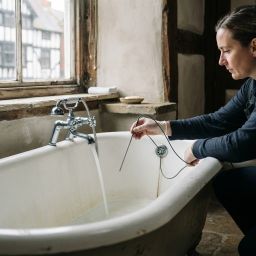
A dead leg is a pipe branch that retains water but no longer supplies a regularly used outlet. During a Leeds office conversion, it might be a capped branch left behind after a kitchenette or washroom is removed. The outlet disappears from the new floor plan, but the connected pipe can remain within the water system.
Water in redundant pipework is not refreshed through normal use. That stagnation can support conditions associated with Legionella growth, making dead ends a recognised risk factor. Leeds City Council’s Housing Leeds policy identifies dead ends in a water system as increasing Legionella risk. Hidden branches therefore matter, even when visible outlets appear functional.
Trace pipework against the conversion drawings and inspect accessible service areas. Compare the installed layout with the current outlet schedule. Look for capped take-offs, abandoned shower feeds and branches serving removed facilities. A mismatch between the drawings and the building can point to pipework that needs closer assessment.
Distinguish a dead leg from an outlet that is simply used infrequently. A little-used sink remains connected to a functioning outlet; a dead leg is redundant pipework that may not receive regular turnover. Both situations can require attention, but controls depend on the actual design, access and use. Record each finding in the water system documentation.
For UK-wide premises, assess dead legs as part of the water system risk review, not as an isolated sampling issue. A water sample from an active outlet cannot map every redundant branch. Identify the pipe route and connection first, then determine whether removal or a documented control is appropriate.
Arrange Legionella testing and risk assessment support to assess identified dead-leg concerns in your converted office.
The Testing Lab PLC: Quick Water Testing
The Testing Lab PLC provides Quick Water Testing when a Leeds office conversion calls for water sampling, alongside Fast Legionella Testing and assessment services. As an LCA-registered provider of Legionella risk assessments, the company offers Quick Legionella Risk Assessments and Fast Legionella Risk Assessment to review changes to the system and its controls. Consider sampling results alongside the water system’s risk assessment and monitoring records, rather than treating them as standalone assurance.
The Testing Lab PLC provides UK-wide services from its head office in Doncaster. Its testing and assessment services can support premises teams as they address identified risks and plan appropriate controls for converted buildings.
For an assessment of your premises’ Legionella risks, visit the Legionella risk assessment service page.
Make the conversion handover part of water control
A conversion is a useful point to connect building handover with ongoing water-system management. For UK-wide office portfolios, make the latest pipework layout, outlet schedule and control responsibilities accessible to the people managing the premises. This gives future teams a practical reference when occupancy or room use changes.
For water dead-leg Legionella testing in Leeds office conversions, treat the next step as a coordinated review, not simply a decision to take samples. Identify system changes, document relevant outlets and determine whether the assessment or monitoring arrangements need updating. The Testing Lab PLC offers Quick Water Testing, Quick Legionella Risk Assessments and Fast Legionella Testing to support these needs. Contact the team to arrange the appropriate testing or assessment.
Arrange the next step around your building’s water-system requirements. Contact The Testing Lab PLC about your Legionella testing or risk assessment needs, and move forward with a clear plan for the converted office.
Frequently Asked Questions
How should dead legs be identified and assessed during an office conversion in Leeds?
Compare the proposed plumbing design with the completed installation and the facilities that remain in use. For example, a former staff kitchen may leave a capped pipe branch behind a newly fitted wall. Add suspected redundant branches to the conversion handover record, then assess their connection and use alongside the full water-system risk assessment. This helps facilities teams track unresolved items after contractors leave.
When is Legionella water testing required for an office building in the UK?
Sampling is guided by the premises’ risk assessment or written scheme, rather than a single routine interval for every UK office. A non-domestic building with a water system capable of producing aerosols requires a Legionella risk assessment. The assessment determines whether sampling is appropriate, which outlets matter and how results should inform control measures. A change in occupancy or facilities can prompt a fresh review.
What water samples and testing methods are used to detect Legionella in office water systems?
When required by the risk assessment or written scheme, water samples are collected from selected outlets and sent to a laboratory for culture. Sampling points should reflect the system’s identified risks, such as outlets serving areas with altered use. A culture result describes what was found at that outlet on the sampling day; it doesn’t establish conditions at every other outlet.
How can a Leeds business find a UKAS-accredited Legionella testing laboratory or water hygiene contractor?
For laboratory testing, confirm that UKAS accreditation applies to the laboratory and relevant testing scope. The Testing Lab PLC is a UKAS-accredited laboratory, number 7758, and is LCA-registered for Legionella risk assessments. It offers Quick Water Testing, Fast Legionella Testing and risk assessments for UK businesses, including Leeds premises. Keep laboratory sampling distinct from assessment work, since each serves a different part of water-system control.

Article by
P J F Thomas
CEO and Founder of TTL plc.
Disclaimer
Items declared are AI generated but do reflect our services. Please get in contact if you have any questions.