

Commercial landlord water testing in Wakefield: landlord and tenant duty of care
Get instant Quote. The lease is the starting point, not an automatic answer to who carries Legionella duties. For commercial landlord water testing in Wakefield’s tenanted buildings, a competent person with relevant qualifications and experience can assess the risk, while the lease and control of the water system help determine who must manage it. Commercial building operators’ duties relating to Legionella risks from work activities sit under the Health and Safety at Work etc Act 1974, according to the UK legislation register.
Landlords and tenants need clear boundaries when responsibility for water systems, maintenance and shared areas overlaps. For commercial landlord water testing in Wakefield tenanted buildings, the key questions are who controls each part of the system, what the lease assigns to each party, and whether testing is an appropriate part of the water management plan.
Key Takeaways
- A competent person with relevant qualifications and experience can assess Legionella risk in a tenanted commercial building.
- Use the lease and practical control of the water system to clarify who manages assessments, precautions and records.
- Landlords and tenants both have health and safety responsibilities in the UK; shared or communal areas need clear ownership.
- Water testing can support risk management, but it should sit within a wider assessment and control approach.
What about the complexity of the requirements for managing legionella risk in commercial properties?
Commercial water management combines risk assessment, control measures and records showing that precautions are being implemented. The right approach depends on the building’s water system and how it is used.
Complexity of Commercial Water Systems
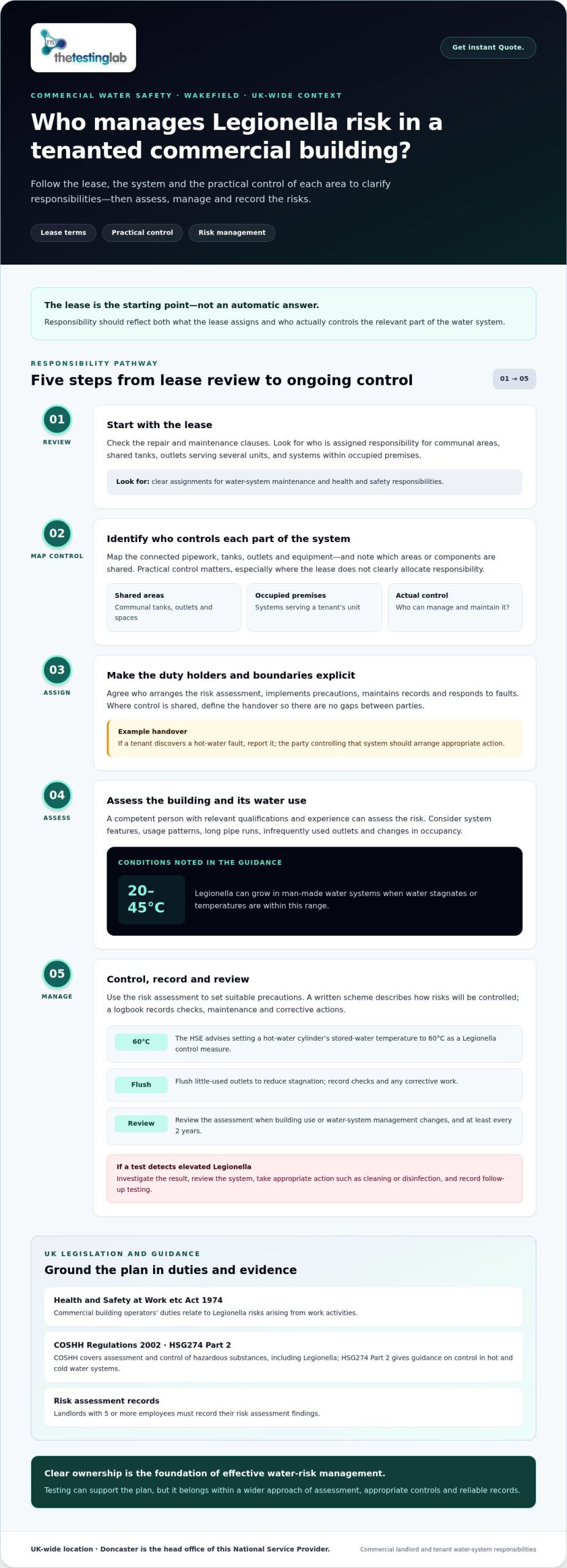
A commercial water system includes connected pipework, tanks, outlets and equipment serving different areas. Long pipe runs, infrequently used outlets and changes in occupancy can affect water turnover and exposure risk. Legionella bacteria can grow in man-made water systems when water stagnates or temperatures are between 20 and 45°C, according to the Health and Safety Executive. A commercial water and Legionella risk assessment in Wakefield should identify system features, usage patterns, outlets and conditions that could encourage growth.
Logbooks and Written Control Schemes
A logbook records checks, maintenance and corrective actions. A written scheme sets out how identified risks will be controlled. Together, they help the responsible person track monitoring, inspections, cleaning and disinfection. Sampling frequency should follow the assessment and control scheme, rather than a single interval applied to every property. If testing detects elevated Legionella, investigate the result, review the system, take appropriate action such as cleaning or disinfection, and record follow-up testing.
UK Health and Safety Guidance
UK health and safety guidance provides a framework for assessing exposure risks and selecting proportionate controls. The Control of Substances Hazardous to Health Regulations 2002 cover assessment and control of hazardous substances, including Legionella. HSG274 Part 2 gives guidance on Legionella control in hot and cold water systems. A written scheme translates the assessment into responsibilities and actions. Review the assessment when building use or water-system management changes, and at least every 2 years.
Inspections, Flushing and Temperature Controls
Inspections check whether the system and its controls remain effective; temperature checks provide evidence at relevant outlets. The Health and Safety Executive advises setting a hot-water cylinder’s stored-water temperature to 60°C as a Legionella control measure. Flush little-used outlets to reduce stagnation, and record the checks and any corrective work. If a water test returns a high Legionella result, assess the affected system, apply suitable controls, and arrange follow-up testing to evaluate whether those actions worked.
Legionella responsibilities for commercial landlords and property managers
Commercial building operators in the UK have duties under the Health and Safety at Work etc Act 1974 relating to Legionella risks arising from work activities, according to the UK legislation register. In offices, reduced daily water use can mean lower flow and stagnation. Tenanted buildings can also have shared tanks, communal areas and outlets used by different occupants, so responsibilities need to match actual control of the system.
The lease is central to deciding who arranges maintenance and manages water-system risks. It may assign communal-area duties to the landlord and responsibility for systems within occupied premises to tenants. Much like routine facility maintenance carried out by specialist contractors such as A ACME Design, internal water systems demand clearly defined operational roles. Where the contract does not specify responsibility, duties fall to the person or people who control the building. A clear agreement helps prevent gaps between maintenance and health and safety responsibilities.
Landlords, property managers and tenants should identify who controls each system, who arranges the risk assessment, and who implements and records precautions. UK businesses must assess workplace health and safety risks and take action to remove hazards. Landlords with 5 or more employees must record their risk assessment findings. Office operators should also account for cold water systems, stored water, infrequently used outlets and any changes in occupancy that affect use.
Failure to manage Legionella risks can leave people exposed to bacteria that cause Legionnaires’ disease. Tenants can be prosecuted for failing to follow health and safety rules, so responsibility shouldn’t be treated as a lease formality. For commercial landlord water testing in Wakefield tenanted buildings, clarify the duty holder and maintain evidence of action. If an independent assessment would help define the risks, request a Legionella risk assessment as part of a UK-wide compliance approach.
Duty of care for commercial landlords and tenants
Landlords and tenants should consider the safety of people entering commercial premises. Section 3(2) of the Health and Safety at Work Act applies relevant health and safety legislation to landlords, establishing duties towards tenants. The lease helps allocate who manages each part of the property, but practical control of the hot and cold water system also matters.
Start by reviewing the lease’s repair and maintenance clauses. A landlord may retain responsibility for communal areas, shared tanks or outlets serving several units. A tenant may manage water systems within its premises and workplace safety for employees. Where the lease does not allocate responsibility, it will usually sit with the tenant. Record who arranges the Legionella risk assessment, implements control measures and responds to faults.
Both parties should communicate when conditions change. If a tenant discovers a hot-water fault, for example, they should report it to the landlord, while the party controlling the system should arrange appropriate action. Providing access to drinking water is an important consideration in workplace safety. Landlords and tenants should also consider potentially affected visitors, contractors and staff in their safety measures.
A competent assessment can clarify risks at outlets, identify gaps in responsibilities and set out suitable controls for the premises. The practical takeaway is to document who acts, where they act and how completion is recorded. For support with a Legionella risk assessment, request an assessment for your commercial premises.
The Testing Lab PLC: Quick Water Testing
The Testing Lab PLC provides Quick Water Testing and Legionella services for commercial premises that need to assess water-system risks or investigate a testing concern. Its LCA-registered Quick Legionella Risk Assessments help identify system hazards and control needs. Fast Legionella Testing and Fast Legionella Risk Assessment support testing, assessment and monitoring. These services can help when building use changes, a water-system issue emerges, or landlord and tenant responsibilities need clearer evidence.
The Testing Lab PLC is a UK-wide national service provider with its head office in Doncaster. Its work can help landlords and property managers inform their water safety management alongside the responsibilities set out under UK health and safety legislation. For support with a tenanted building’s Legionella risk, contact The Testing Lab PLC about a Legionella risk assessment.
Make water safety part of the tenancy handover
Build water-system responsibilities into the way the property is managed, not just the wording of the lease. At each tenancy handover, document who holds current assessment records, who manages shared outlets and how system changes will be communicated. This gives landlords and tenants a clear operational reference when occupancy, maintenance arrangements or water use changes. For commercial landlord water testing in Wakefield’s tenanted buildings, consistent records can help connect assessment findings with the person responsible for acting on them. A clear handover also gives incoming occupants a practical starting point for their own health and safety arrangements. If you need support assessing a commercial water system, contact The Testing Lab PLC about your Legionella assessment. A well-defined next step helps keep water safety responsibilities moving forward.
Frequently Asked Questions
Who can assess the risk?
A competent person with relevant qualifications and experience can assess Legionella risk in a commercial property. They should understand how the building’s water systems are configured and used, including seldom-used outlets and shared supplies. For Wakefield premises, the assessment should reflect the actual system, as each water system is unique and must be assessed individually. The Testing Lab PLC provides LCA-registered Quick Legionella Risk Assessments.
Who is Responsible?
Responsibility rests with the party or parties who control the relevant premises or water system, with the lease helping define allocated duties. A landlord may manage shared plant while a tenant controls outlets within its unit. If the lease is silent about water-system responsibility, control of the building is a key factor in identifying the duty holder. Record the allocation clearly.
How can landlords minimise the risk of Legionella?
Landlords can reduce risk by ensuring the control scheme reflects how occupants use the property. During a vacancy, for example, arrange to flush little-used hot and cold outlets at least once a week and record the action. Site mains-fed drinking water dispensers close to regularly used outlets to support water turnover. Review controls when occupancy or system use changes.
Is Legionella Testing a Legal Requirement?
UK health and safety law does not require landlords to obtain or produce a Legionella test certificate. However, duty holders must assess and control exposure risks where Legionella could arise. Testing is one possible monitoring measure, selected according to the assessment and control scheme. It does not replace risk assessment, appropriate precautions or records, and there is no universal testing interval for every commercial building.
What happens if a landlord fails to carry out their obligations?
Failure to manage risks can lead to enforcement action and prosecution where health and safety duties are not met. In the UK, the Health and Safety Executive and local councils enforce health and safety law for businesses. A landlord’s responsibilities depend on their control, while tenants may also face prosecution for failing to follow workplace safety rules. Keep assessment findings and control records available.

Article by
P J F Thomas
CEO and Founder of TTL plc.
Disclaimer
Items declared are AI generated but do reflect our services. Please get in contact if you have any questions.