
Urgent Asbestos Bulk Analysis for Wakefield Distribution Hubs
Get instant Quote. A delivery deadline doesn’t make an unknown material safe to disturb. Urgent asbestos bulk analysis at Wakefield distribution centres is needed when suspected material must be identified before refurbishment, repairs or groundworks, or after damage exposes it. Under the Control of Asbestos Regulations 2012, paragraph (3) requires the dutyholder to ensure a suitable and sufficient assessment of whether asbestos is or is liable to be present in non-domestic premises, according to the UK Government.
That distinction matters in a busy logistics building, where work may involve roof sheets, insulation, floor finishes, service components or soil, and delays can affect planned operations. Asbestos use is banned in the UK, yet buildings constructed before 2000 may still contain it.
This guide explains when urgent asbestos bulk analysis is justified at Wakefield distribution centres, which building materials and soils may need testing, and how sampling, packaging and transport fit into a controlled process. It also explains the UK rules that shape survey decisions, helping facilities teams act on evidence rather than appearance alone.
Key Takeaways
- Learn when suspected asbestos should be analysed before planned work or after material is disturbed.
- See which building materials and soil at distribution centres may need bulk testing.
- Understand how samples should be double-bagged, with site paperwork kept separate.
- Find out how UK-wide asbestos rules shape dutyholders’ assessment and survey decisions.
How should asbestos bulk samples from a distribution centre be collected, packaged and transported?
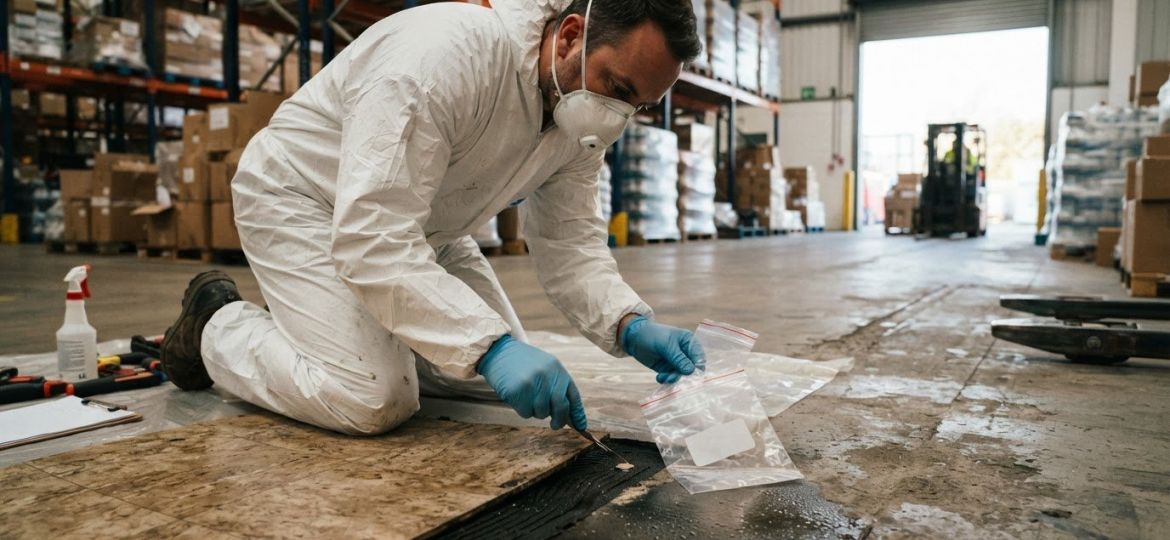
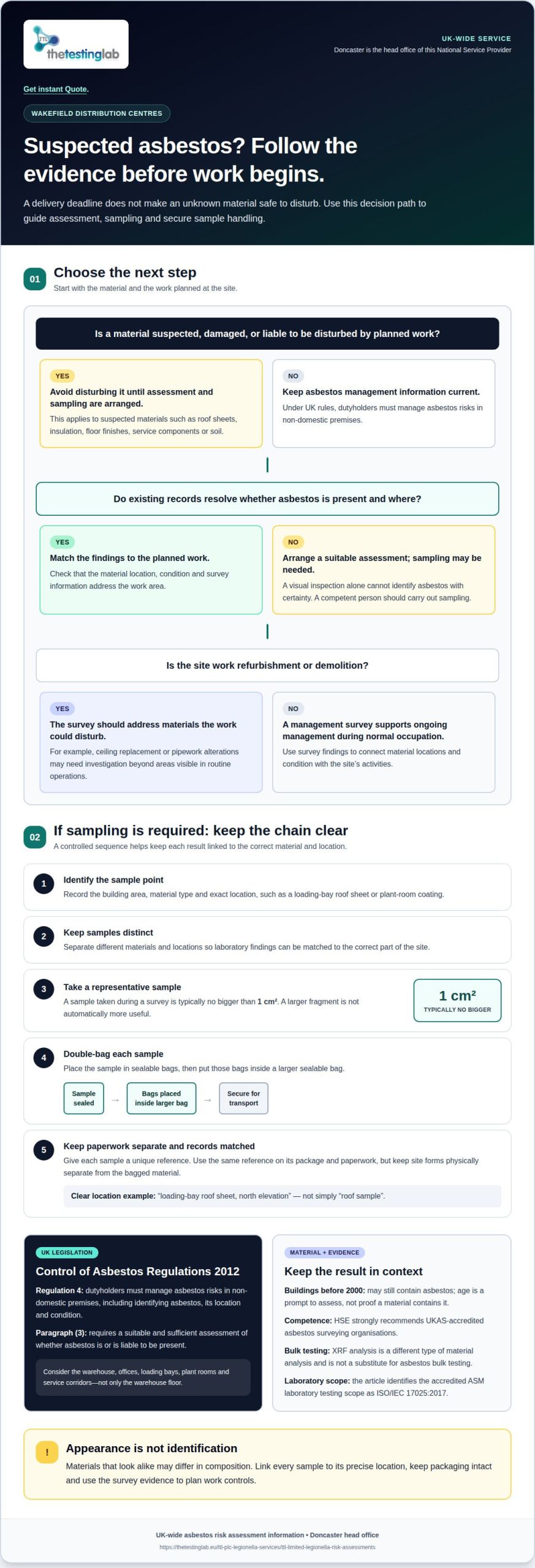
At a Wakefield distribution centre, sampling should follow a controlled sequence: identify the material, record its location, take a representative sample, then package it securely. A competent person should carry out sampling using appropriate procedures, not warehouse staff during routine maintenance. If a ceiling panel, floor finish or pipe insulation is suspected, avoid disturbing it until sampling is arranged. This helps prevent an urgent investigation from creating additional exposure or disrupting other work.
Representative sampling matters because materials that look alike may differ in composition. The sample should relate to a clearly identified material and location, such as a particular floor tile or insulation layer. A representative sample taken during a survey is typically no bigger than 1 cm². A larger fragment is not automatically more useful: the laboratory needs material that accurately represents the item under investigation.
- Identify the sample point. Record the building area, material type and exact location, such as a loading-bay roof sheet or plant-room coating.
- Keep samples distinct. Separate samples from different materials or locations so laboratory findings can be matched to the correct part of the site.
- Double-bag each sample. Place it in sealable bags, then put those bags inside a larger sealable bag.
- Keep paperwork separate. Site forms and sample records should travel separately from the bagged materials, not inside the sample packaging.
- Arrange secure transport. Keep packages intact and clearly associated with their sample records until they reach the laboratory.
Accurate records support traceability. Give each sample a unique reference and a clear description of the material and its location. For example, “loading-bay roof sheet, north elevation” is more useful than “roof sample”. Use the same reference on the paperwork and package, keeping documents physically separate. This reduces the risk of confusing samples from different work zones or buildings.
Bulk asbestos identification is distinct from other material investigations. XRF analysis provides a different type of material analysis and should not be treated as a substitute for asbestos bulk testing. According to United Kingdom Accreditation Service (UKAS), the accredited ASM laboratory’s testing scope is to ISO/IEC 17025:2017. For UK-wide distribution operations, the laboratory’s scope and clear sample traceability help frame a dependable result for the specific material submitted.
For each sample, use sealable bags for the double-bagging stage, then place them in a larger sealable bag before transport. Keep this sequence intact as the package is prepared for travel, with the sample enclosed in the required bag layers on its way to the laboratory.
What UK rules apply to asbestos surveys and sampling at commercial distribution centres?
Across the UK, the Control of Asbestos Regulations 2012 (CAR 2012) provides the framework for managing asbestos risks in non-domestic premises. Regulation 4 requires dutyholders to manage asbestos risks by identifying asbestos on their premises, including its location and condition. At a distribution centre, that means considering areas such as offices, loading bays, plant rooms and service corridors, not just the warehouse floor.
Paragraph (3) requires the dutyholder to ensure a suitable and sufficient assessment of whether asbestos is or is liable to be present in non-domestic premises, according to UK Government, legislation.gov.uk. The findings help determine what materials may contain asbestos and whether their condition could create a risk. Where records do not resolve uncertainty, a survey may include sampling and laboratory analysis. A visual inspection alone cannot identify asbestos with certainty.
Asbestos use is banned in the UK, but buildings constructed before 2000 may still contain it. A distribution hub built or refurbished before that date may have asbestos-containing materials in roof components, insulation, textured coatings or floor finishes. The building’s age is a prompt to assess potential risk, not proof that a particular material contains asbestos.
Choose the survey type to match the planned work. A management survey supports ongoing asbestos management during normal occupation. Before refurbishment or demolition, the survey needs to address materials that the planned work could disturb. For example, replacing a ceiling or altering pipework may require investigation beyond areas visible during routine operations. Survey findings should link material locations and condition to the scope of work.
- Define the work area: identify the warehouse zone, offices or plant areas affected by maintenance or construction.
- Use competent surveyors: the Health and Safety Executive strongly recommends UKAS-accredited asbestos surveying organisations.
- Record findings clearly: link each suspected material to its location, condition and relevant survey information.
- Plan before disturbance: use survey findings to inform work controls and prevent unassessed materials being disturbed.
For urgent asbestos bulk analysis at Wakefield distribution centres, the practical next step is to establish which materials relate to the work and what evidence the survey requires. A focused asbestos assessment quote request can help organise that next step around the site and its planned activity.
Armco says that a person responsible for maintaining non-domestic premises who needs details of the location, amount, type and condition of asbestos-containing materials needs an asbestos survey. These details help make survey findings useful for maintenance planning and decisions about materials that work may affect.
AEC describes a representative asbestos sample taken during a survey as typically no bigger than 1cm2. AEC also identifies Regulation 4, CAR 2012 as requiring duty holders to manage asbestos risks by identifying asbestos on their premises, including its location and condition. Survey records and samples can help establish which materials need ongoing attention.
The Testing Lab PLC
The Testing Lab PLC provides comprehensive asbestos analysis across Yorkshire and the surrounding region, including testing of building materials and soil. For Wakefield distribution teams, this offers a practical next step when survey findings identify suspected materials that need laboratory analysis before planned work proceeds. Clear sample references and site information help connect results to the relevant location and project decisions.
Headquartered in Doncaster, The Testing Lab PLC supports teams with urgent asbestos bulk analysis Wakefield distribution centres so they can move from uncertainty towards evidence-led planning. The appropriate next step depends on the material, its location and the work planned at the site.
Contact The Testing Lab PLC to discuss your distribution centre’s asbestos analysis requirements.
Turn the findings into a clear next step
Once analysis is available, connect each result to the specific work area and the decisions that follow. For urgent asbestos bulk analysis at Wakefield distribution centres, keep material identification aligned with site plans, contractor information and the scope of planned work. Clear records give facilities teams a stronger basis for coordinating the next stage, while a laboratory result does not replace project-specific controls.
If suspected material is holding up a maintenance or refurbishment decision, set out the site location, material and planned activity when you get in touch. Discuss your asbestos analysis requirements with The Testing Lab PLC and take the next step with a well-defined brief. A structured start helps keep decisions focused and supports confident planning.
Frequently Asked Questions
How much does urgent asbestos bulk analysis cost per sample near Wakefield?
Which UKAS-accredited laboratories test asbestos bulk samples for Wakefield sites?
The Testing Lab PLC provides UK-wide asbestos analysis, and the article refers to an accredited ASM laboratory with testing scope to ISO/IEC 17025:2017.

Article by
P J F Thomas
CEO and Founder of TTL plc.
Disclaimer
This guide gives general information only and is not legal advice. For advice on your site or samples, contact The Testing Lab PLC.