
Soil contamination verification for Newcastle brownfield sites
A brownfield site’s history alone does not establish that its land is legally contaminated. For soil contamination verification on brownfield sites in Newcastle upon Tyne, the assessment considers whether a contaminant source, a pathway to a receptor and the receptor itself are present.
That distinction matters when redevelopment plans involve sensitive uses such as housing or when a site has an industrial past. This guide explains how land, soil and water risks are assessed, how planning conditions can require remediation evidence, and what investigations may be needed before redevelopment proceeds.
The Testing Lab PLC is a UK-wide National Service Provider, with its head office in Doncaster.
Key Takeaways
- See how a desk study and targeted sampling can build a clearer picture of a brownfield site’s contamination risks.
- Understand how planning conditions can require contamination information before approval and evidence before remediation is signed off.
- For a brownfield land register, a site may qualify for housing if it covers more than 0.25 hectares, according to the Ministry of Housing, Communities and Local Government.
- Learn which site history and proposed land use can shape the investigations needed for safe redevelopment.
How do professionals test land for contaminants?
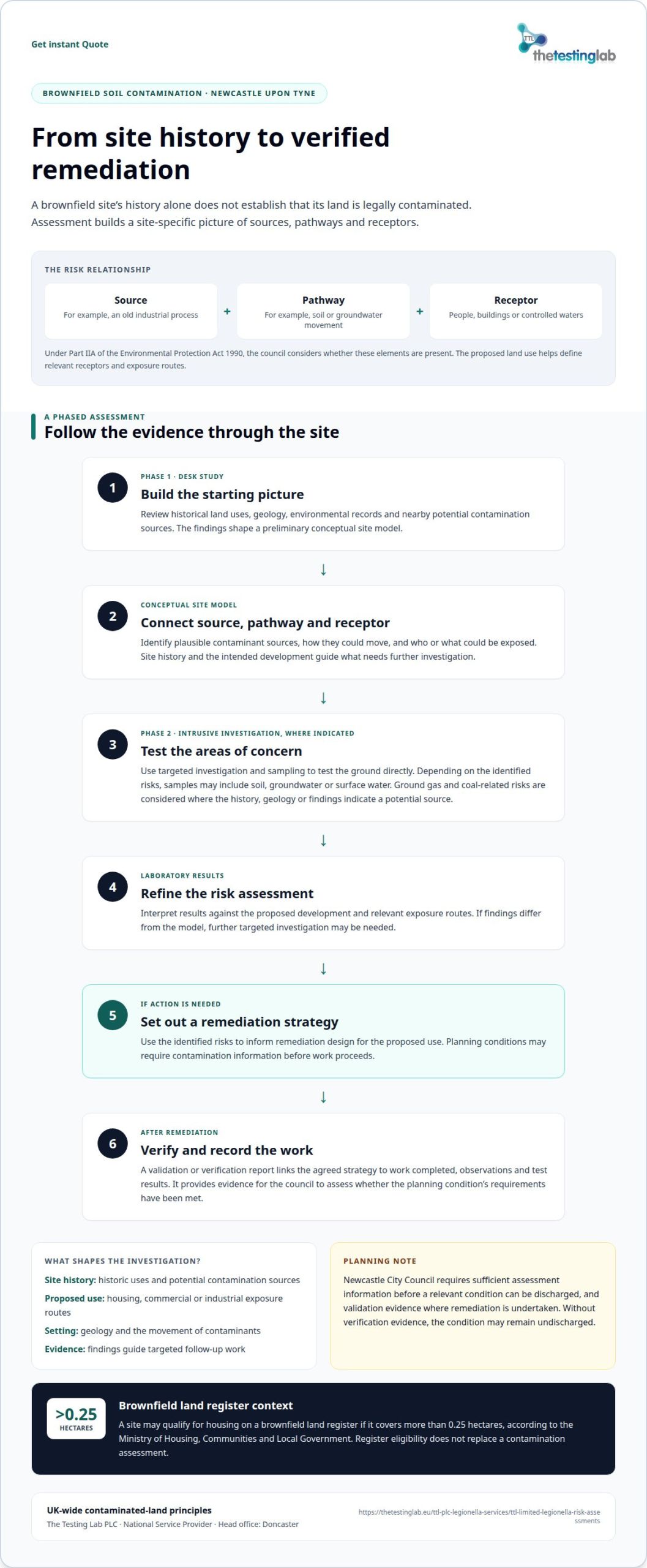
For soil contamination verification on brownfield sites in Newcastle upon Tyne, professionals build a site-specific risk assessment. Under Part IIA of the Environmental Protection Act 1990, the council’s approach considers whether a contaminant source, a pathway and a receptor are present. A source might be an old industrial process; a pathway could be soil or groundwater movement; receptors include people, buildings and controlled waters. The assessment follows UK-wide contaminated land principles while accounting for the site’s local history.
Housing, commercial and industrial redevelopment can involve different receptors and exposure routes, so the proposed land use shapes the investigation. Housing may require close attention to direct contact with soil and vapours; commercial or industrial proposals are assessed against their intended use and the people or environments potentially exposed. A site may qualify for housing on a brownfield land register if it covers more than 0.25 hectares, according to the Ministry of Housing, Communities and Local Government. Register eligibility does not replace a contamination assessment.
Assessment proceeds in stages. A desk study reviews historical uses, geology and environmental records to form a preliminary conceptual site model. If evidence points to potential risks, an intrusive investigation collects targeted soil, groundwater or surface-water samples. Laboratory results refine the risk assessment and inform a remediation strategy where action is needed. Verification then evaluates whether completed remediation meets its specified objectives.
Ground gas and coal-related risks are considered where site history, geology or investigation findings indicate a potential source. Monitoring locations and sampling methods are selected to test relevant pathways, such as gas migration into a proposed building. This phased approach focuses work on identified risks and gives the development team evidence to inform design and planning decisions.
Planning conditions and remediation validation
For brownfield development in Newcastle, planning conditions can require contamination evidence before work proceeds. Remediation design and verification should address the risks identified for the proposed use.
Verification Reports After Remediation
A validation or verification report records the remediation completed and the evidence showing whether it met its objectives. It should link the agreed remediation strategy to the work undertaken, relevant observations and test results. This enables Newcastle City Council to assess whether the planning condition’s requirements have been met. Clear records matter on industrial sites, where remediation may involve several areas or stages.
Newcastle City Council requires sufficient information to assess contamination risks before discharging a planning condition, as well as validation of remediation. Without verification evidence, the council cannot assess whether the required work has been completed effectively. The condition may therefore remain undischarged, affecting the development’s progress.
Planning and Legal Requirements
In England, the Environmental Protection Act 1990 establishes the contaminated land regime under Part IIA, according to UK Parliament. DEFRA provides statutory guidance for local authorities implementing that regime. These UK-wide provisions inform contaminated-land assessment; planning conditions also set site-specific requirements for development and remediation evidence.
For Newcastle, the council’s contaminated land inspection strategy covers 2025 to 2030. The council requires assessment information before a relevant condition can be discharged, followed by validation evidence where remediation is undertaken. The required documents should therefore match the condition’s wording and the site-specific remediation strategy.
Where redevelopment also involves building water systems, a quote for a Quick Legionella Risk Assessment can address that separate risk.
Contamination investigations for redevelopment
For redevelopment in Newcastle, the investigation scope should reflect the site’s history, proposed use and environmental setting. Site owners and developers are responsible for investigating contamination and ensuring the planned development is safe and suitable. A phased approach focuses intrusive work on plausible risks rather than treating every part of a brownfield site alike.
A Phase 1 desk study reviews historic land uses, geology, environmental records and nearby potential contamination sources. For example, former industrial activity may indicate possible soil or groundwater impacts, while the site’s geology can influence how contaminants move. The findings inform a conceptual site model, identifying possible sources, pathways and receptors, and help define the next investigation.
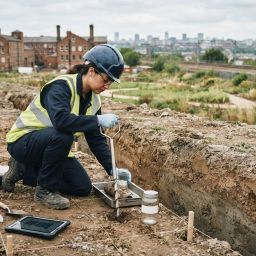
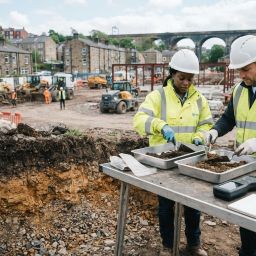
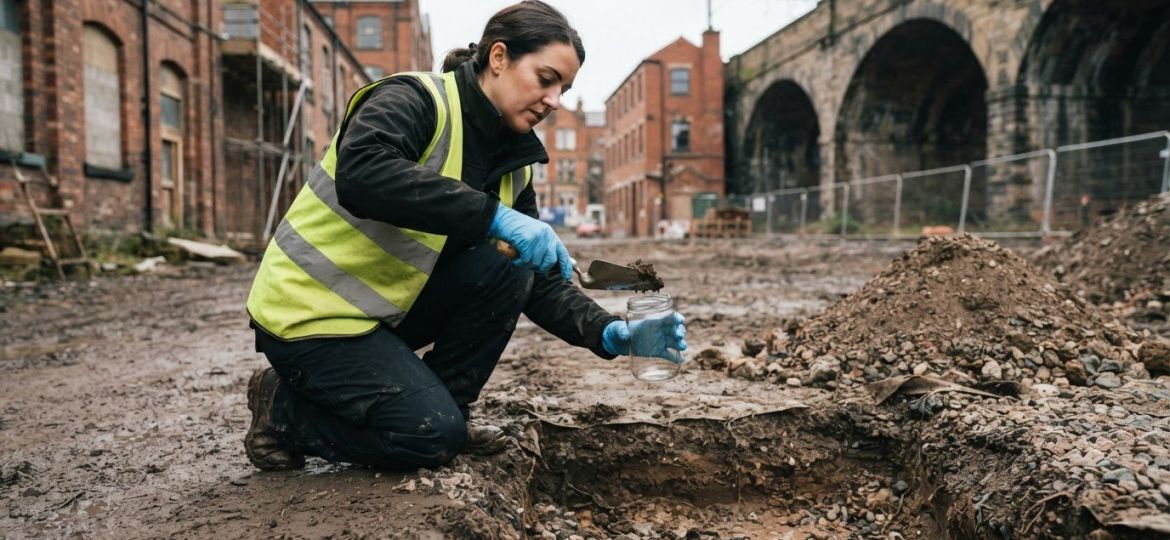
Where desk-study evidence identifies potential risks, a Phase 2 intrusive investigation tests the ground directly. The investigation plan can target areas of concern and include soil, groundwater or surface-water sampling. Results are interpreted against the proposed development and the identified exposure routes. If findings differ from the model, further targeted investigation may refine the risk assessment.
Geotechnical investigation answers related but distinct design questions. Ground conditions affect foundations and earthworks, as well as whether soils can support proposed structures. Coordinating geotechnical and contamination work can relate ground conditions to the site layout while keeping engineering and environmental findings distinct. On a proposed housing site, for example, contamination results and ground-strength data inform different design decisions.
Across UK-wide redevelopment projects, a clear investigation scope links desk-study evidence, sampling locations, laboratory results and development plans. This gives the project team a traceable basis for deciding whether remediation or further assessment is needed. Submit a quote request for your project to outline its investigation requirements.
The Testing Lab PLC
The Testing Lab PLC provides UK-wide services from its head office in Doncaster, supporting projects in Newcastle upon Tyne and across the North East & North West. For redevelopment projects, its related services include Quick Water Testing, Quick Legionella Risk Assessments, Fast Legionella Testing and Fast Legionella Risk Assessment.
These services address water testing and Legionella risks, which are distinct from contaminated-land investigation and remediation verification. Keeping the workstreams separate helps project teams match evidence to the relevant site and planning requirements.
If your project also needs water or Legionella support, contact The Testing Lab PLC.
Set your redevelopment project up for its next step
For soil contamination verification on Newcastle upon Tyne brownfield sites, align the investigation scope with the proposed development and the evidence required by its planning conditions. A clear brief helps the project team define which risks need addressing, how findings will inform remediation and what records must support validation. This keeps environmental decisions connected to design and planning milestones.
Where redevelopment also involves water quality or Legionella risks, The Testing Lab PLC offers Quick Water Testing, Quick Legionella Risk Assessments and Fast Legionella Testing. The Testing Lab PLC is LCA-registered for Legionella risk assessments. These services address separate project needs and do not replace contaminated-land assessment or remediation verification.
To discuss relevant testing support for your project, send a quote request to The Testing Lab PLC. A well-defined scope is a practical starting point for confident redevelopment planning.
Frequently Asked Questions
How are the sites assessed?
Professionals assess whether the site’s condition is compatible with its intended redevelopment, using evidence relevant to potential exposure and environmental effects. Proposed gardens, for example, may involve different soil-contact considerations from a warehouse with limited ground access. Findings help determine whether the design can proceed as planned, needs risk controls or requires further investigation before decisions are made.
What must a contaminated land verification report include for a brownfield site?
A useful report lets the planning authority trace the remediation work back to its objectives. It typically records the areas treated, methods used, materials brought onto or removed from the site, and supporting inspection or test results. If clean cover soil was installed, for example, the report should document where it was placed and show that the specified work was completed.
Which local environmental records and datasets identify potentially contaminated sites in Newcastle upon Tyne?
Newcastle City Council’s public contaminated land register is one relevant record, maintained under section 78R of the Environmental Protection Act 1990. It includes land designated as a Special Site, but does not contain historic land-use details or all records used in investigations. A fuller desk study therefore considers historic maps, planning information, geology and other relevant environmental records.
How do professionals specify soil sampling and laboratory testing for contaminated brownfield sites in England?
Professionals design sampling around suspected contaminants, site layout and intended use. A former industrial area might need samples from identified process areas, with groundwater considered where the site model indicates a potential pathway. The analytical schedule is selected to test compounds suggested by site history and observations, so results address defined risks rather than an arbitrary list.
Who can prepare and certify remediation and verification reports for Newcastle brownfield sites?
A suitably qualified contaminated-land professional can prepare reports using investigation findings and remediation records. The author should explain the assessment approach, evidence and conclusions clearly, so Newcastle City Council can evaluate the submission against the relevant planning condition. Laboratory results support the report, but do not alone establish that remediation objectives have been achieved across the site.

Article by
P J F Thomas
CEO and Founder of TTL plc.
Disclaimer
This guide gives general information only and is not legal advice. For advice on your site or samples, contact The Testing Lab PLC.