
Post-Mitigation Soil Sampling After Brownfield Remediation: UK Guide 2026
Could a remediated site meet its objectives even if a sample reveals residual contamination? Post mitigation soil sampling after brownfield site remediation should be designed around the agreed objectives, not treated as a final tick-box exercise. Clear evidence matters, but sampling can miss a hotspot if locations are poorly selected, and results can be difficult to interpret without the right context.
This guide explains how to plan representative verification sampling, compare laboratory results with site-specific criteria and decide what evidence is needed next. It covers UK contamination management, including the Environment Agency’s Land Contamination Risk Management guidance and relevant legal requirements. The Testing Lab PLC is a UK-wide national service provider, with its head office in Doncaster and services across England, Scotland and Wales. The company has over 18 years of industry experience. You’ll learn what test results can demonstrate and when further assessment or project decisions may still be needed.
Key Takeaways
- Use post mitigation soil sampling after brownfield site remediation to test agreed, site-specific objectives, not an assumed universal threshold.
- Shape sampling locations and analyses around site history, remediation records, ground conditions and intended land use.
- Compare results with the project’s agreed criteria, then document whether objectives are met or uncertainty remains.
- Use the findings to support the next decision, which may include further investigation or targeted remediation under the relevant UK framework.
Why post-mitigation soil sampling matters after brownfield remediation
Remediation changes or removes contamination; mitigation reduces exposure or risk, sometimes by managing how land is used. Post-mitigation sampling is soil testing that checks evidence against the project’s agreed objectives. The terms “verification” and “validation” may describe this stage. Check the project documents, planning conditions and relevant regulatory framework for the specific sampling requirements and acceptance criteria.
Requirements depend on the site and the UK nation where it is located. In England, the Environment Agency’s Land Contamination Risk Management guidance informs risk management, while Part 2A of the Environmental Protection Act 1990 provides a statutory framework for contaminated land. Planning conditions may set additional project-specific requirements. Brownfield sites can have varied histories and contaminants, as outlined in this overview of brownfield land. Verification should address the actual risks and proposed use rather than assume every site has the same criteria.
What can post-remediation soil samples demonstrate?
Representative results help assess whether contamination in the sampled areas is consistent with the agreed objectives and intended use, such as housing or commercial development. The value of post mitigation soil sampling after brownfield site remediation depends on the design: each result relates to a particular location, depth and set of analytes. It cannot establish conditions in unsampled areas or address contaminants that were not analysed.
Sampling evidence supports decisions, but does not by itself guarantee planning discharge or regulatory sign-off. Interpret results alongside remediation records, site conditions and project criteria. If a result is unexpected, the project team can assess whether further investigation or action is needed before concluding that the objectives have been met.
How to plan representative soil sampling after brownfield remediation
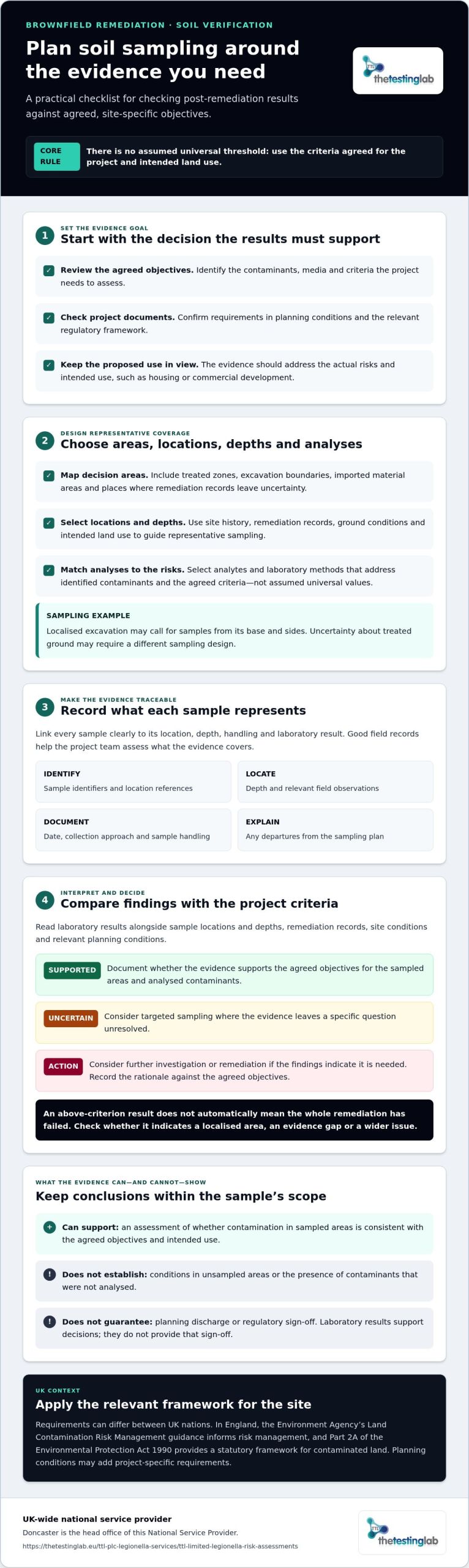
Start with the agreed objectives and project documents. A practical post mitigation soil sampling after brownfield site remediation plan should state what decision the results need to support, which areas need evidence and how findings will be assessed. For UK-wide projects, requirements can differ between nations. In England, the Environment Agency’s Land contamination: risk management (GOV.UK) sets out a risk-based framework that includes remediation and verification.
- Review the objectives: identify the contaminants, media and criteria the project needs to assess.
- Define decision areas: map treated zones, excavation boundaries, imported material areas and locations where remediation records leave uncertainty.
- Plan locations and depths: use site history, remediation records, ground conditions and intended land use to select representative sample locations.
- Select analyses: choose analytes and laboratory methods that address identified contaminants and agreed criteria, rather than applying universal values.
- Record fieldwork: link every sample clearly to its location, depth, handling and laboratory result.
What should a post-remediation sampling plan specify?
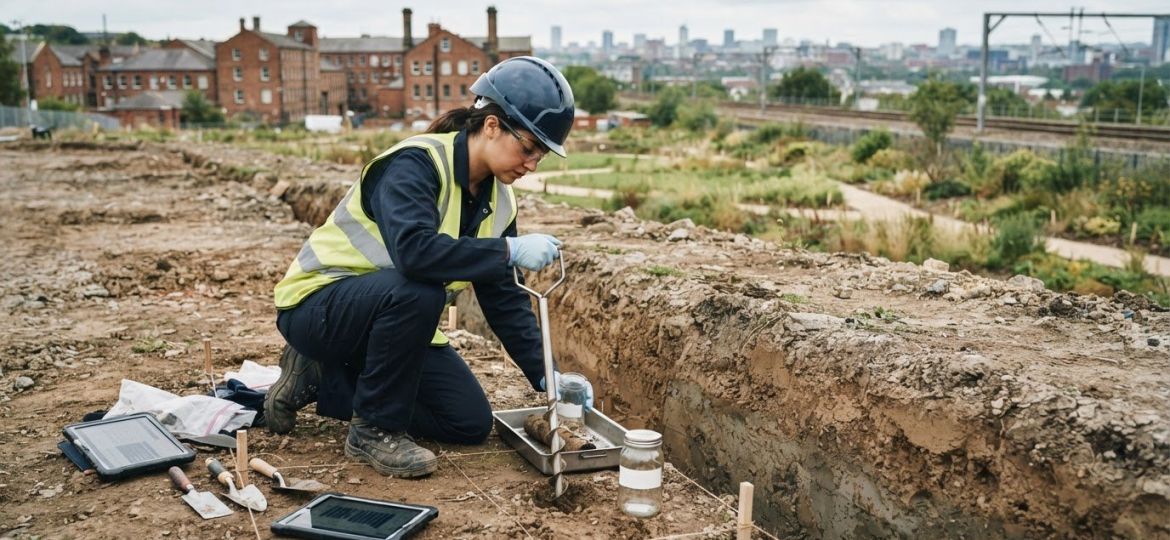
Set out the sampling rationale, decision areas, locations, depths, collection approach, sample handling and analytical requirements, as dictated by the project conditions. For example, localised excavation may call for samples from its base and sides, while uncertainty about treated ground may need a different sampling design. Explain how each sample contributes evidence toward the stated objective. This is central to post mitigation soil sampling after brownfield site remediation: the design should reflect site-specific conditions, not rely on a standard template.
Good field records make the evidence traceable. Record sample identifiers, location references, depth, date, observations and any departures from the plan. The Testing Lab PLC provides soil testing and sample collection, backed by over 18 years of industry experience. Doncaster is the head office of this national service provider, which serves projects across the UK. Where asbestos in soil is a concern, asbestos-in-soil testing can address that specific hazard. For coordinated project sampling and testing, request a project quote.
How to interpret post-remediation soil results and decide what happens next
Interpret results against the remediation criteria agreed for the project and proposed land use, not a universal pass-or-fail threshold. Read the laboratory findings alongside sample locations, depths, remediation records and relevant planning conditions. In the UK, this evidence contributes to the wider risk-management process, but the project team and relevant authority determine whether it meets the site’s requirements.
A result above a criterion does not automatically mean the whole remediation has failed. First check whether it indicates a localised area, a gap in the evidence or a wider issue. The project team may document that objectives are met, investigate uncertainty with targeted sampling, or consider further remediation. Record the rationale for any next step against the agreed objectives.
What should a clear soil-testing report help the project team decide?
A useful report identifies each sample and location, presents the analytical findings, explains relevant limitations and compares results with the criteria supplied for interpretation. It should make clear which areas and analytes the evidence covers, helping the team distinguish a supported conclusion from an unresolved question. Laboratory results support decisions; they do not provide regulatory or planning sign-off.
The Testing Lab PLC provides UK-wide services as a national provider, with its head office and single testing facility in Doncaster. The company has over 18 years of industry experience. Its laboratory holds UKAS accreditation No. 7758; any test described as accredited must fall within the applicable accredited scope. For asbestos-related concerns, asbestos in-soil investigation can inform project understanding. Separate topsoil testing may also help assess material against a relevant specification.
Make the next project decision with confidence
Use verification findings as a practical handover point: connect the evidence to the remediation objectives and planning requirements, then record any assumptions or unanswered questions for the project team. This creates a clearer basis for decisions about site use, further investigation or future work, and makes the reasoning easier to review later.
Across UK-wide brownfield projects, the next step is not always more remediation. It may be documenting that available evidence supports the agreed objectives, or defining focused follow-up where uncertainty remains. The decision should be proportionate, traceable and consistent with the project’s requirements.
For soil testing and laboratory analysis to support your project, Get instant Quote. Request a quote to discuss your project’s sampling and testing requirements.
Frequently Asked Questions
How soon after brownfield remediation should soil samples be taken?
There is no fixed waiting period. For post mitigation soil sampling after brownfield site remediation, take samples once the remedial work is complete and the area is accessible, before later construction could cover or disturb it. Timing depends on the treatment method, ground conditions and project requirements. Coordinate the sampling window with the site team and any agreed verification plan.
How many soil samples are needed to verify brownfield remediation?
There is no universal sample count. The number depends on the size and variability of the area, remediation layout, contaminants of concern and the decision the sampling must support. A localised excavation and a broad area of variable made ground, for example, need different sampling designs. This project-specific approach applies in Carlisle, Chester, Lancaster, Liverpool, Manchester, Preston, Salford, Berwick-upon-Tweed, Durham, Middlesbrough, Newcastle upon Tyne, Sunderland, Bradford, Doncaster, Huddersfield, Hull, Leeds, Sheffield and Wakefield.
What happens if post-remediation soil results do not meet the agreed criteria?
If results from post mitigation soil sampling after brownfield site remediation do not meet the agreed criteria, review the affected sample and area before deciding what to do. Check the location, depth and analytical scope against the records. The project team can then investigate the extent of the finding, reassess its relevance to the proposed use or consider targeted remediation and follow-up testing.
Can one soil sample prove that a brownfield site is safe for development?
No. A single sample represents only the material collected at its particular location and depth, for the substances analysed. It cannot establish conditions elsewhere or show that the whole site is suitable for every type of development. Decisions need evidence appropriate to the relevant areas and proposed use, with any gaps or uncertainty considered alongside planning requirements and site records.

Article by
P J F Thomas
CEO and Founder of TTL plc.
Disclaimer
Items declared are AI generated but do reflect our services. Please get in contact if you have any questions.