

Legionella assessment in Huddersfield: what testing involves
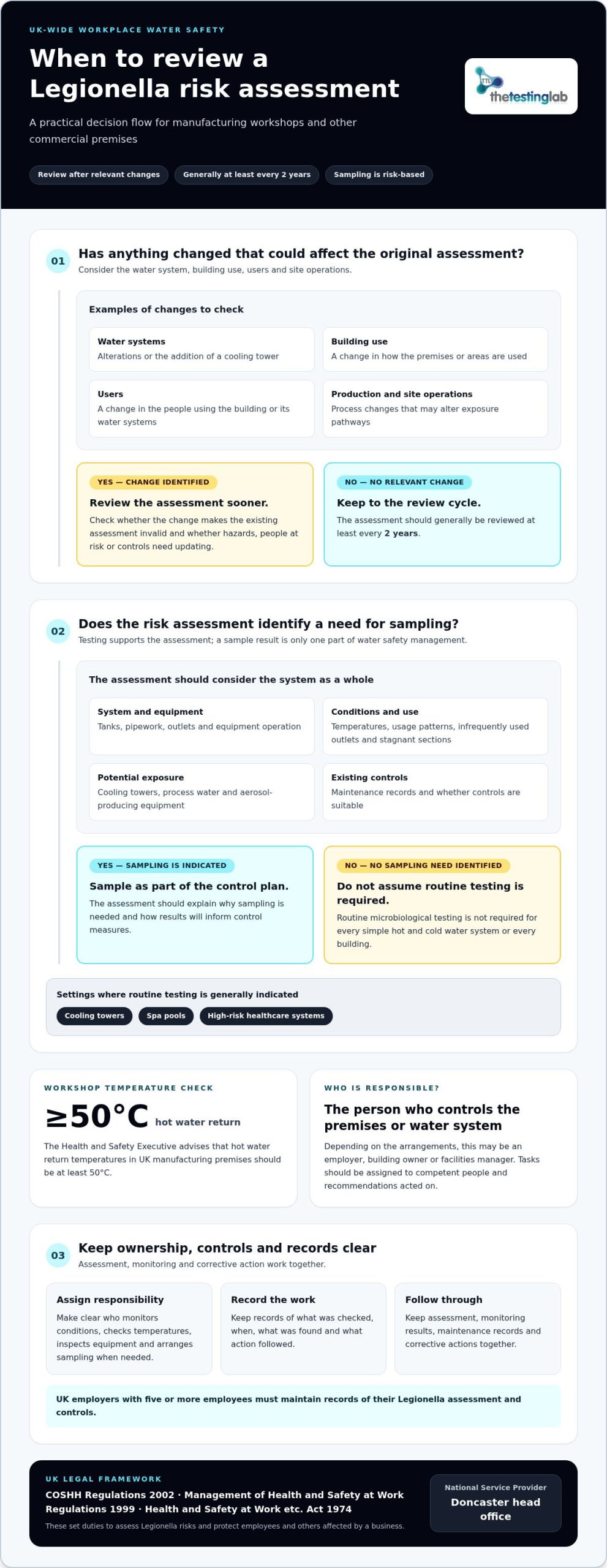
Get instant Quote. A legionella assessment for Huddersfield manufacturing workshops is more than taking a water sample. It reviews the water system, how it’s used and where conditions could allow Legionella to grow; sampling is recommended when the risk assessment identifies a need. The assessment should generally be reviewed at least every two years, or sooner if the water system, building use or users change.
It’s understandable to want a clear picture of what a legionella assessment involves and who is responsible, especially when a workshop’s water systems serve different processes and areas. This article explains how assessment and sampling fit together, who holds responsibility at commercial premises, and which changes should prompt a review. It also explains why a sample result is only one part of effective water safety.
Key Takeaways
- Review the risk assessment when water systems, building use or users change, and generally at least every two years.
- In UK manufacturing premises, hot water return temperatures should be at least 50°C, according to the Health and Safety Executive.
- The Control of Substances Hazardous to Health Regulations 2002 require duty holders to assess Legionella risks, according to legislation.gov.uk.
- The Health and Safety at Work etc. Act 1974 sets a general duty to protect employees and others affected by a business, according to legislation.gov.uk.
Risk-assessment review after changes to systems or building use
A legionella assessment for Huddersfield manufacturing workshops reviews water systems, their use and controls that limit exposure to bacteria. HSG274 Parts 1-3 address cooling towers, hot and cold water systems, and other risk systems. For process water, the assessment considers the equipment, how it operates and whether it could create exposure.
Assessing Industrial and Manufacturing Water Systems
Cooling towers can disperse contaminated droplets, while hot and cold water systems may present risks in storage, distribution and at outlets. Process water also needs consideration where conditions or aerosol-producing equipment could create exposure, such as effluent treatment plants, spray paint systems, and fire or dust suppression systems. A legionella assessment for Huddersfield manufacturing workshops identifies the hazards and controls relevant to each site rather than assuming every system presents the same risk.
Surveying and Assessing Workshop Water Systems
A survey maps the system and examines how equipment is used, giving the risk assessment a practical basis. An inspection can cover tanks, pipework, outlets, temperatures, usage patterns and maintenance records. It should identify infrequently used outlets, stagnant sections and aerosol-producing equipment. These findings help determine whether controls are suitable and sampling is needed. Routine testing is not required for every building.
Review the assessment when changes may make it invalid, including alterations to water systems, building use or users. It should generally be reviewed at least every two years, or sooner after relevant changes. Adding a cooling tower or changing production processes may alter exposure pathways. The Health and Safety Executive advises that hot water return temperatures in UK manufacturing premises should be at least 50 °C.
A legionella assessment for Huddersfield manufacturing workshops should also be reviewed when changes to site operations could affect its original conclusions. A landlord of a domestic rental property may complete the assessment if competent to do so. Manufacturing workshops can involve multiple systems and processes that need to be assessed together.
Legionella risk assessments for Huddersfield workplaces and property managers
Across UK workplaces, duty holders must assess legionella risk where water systems could expose people to bacteria. The Control of Substances Hazardous to Health Regulations 2002 treat legionella bacteria as a hazardous substance and require duty holders to assess risks, according to legislation.gov.uk. The Management of Health and Safety at Work Regulations 1999 also set general risk-assessment duties. A written document should identify hazards, people at risk, controls and any action required.
Responsibility rests with the person who controls the premises or water system, such as an employer, building owner or facilities manager. A competent person should assess and inspect the system, then recommend practical controls. At a site with cooling towers, the assessment needs to account for their distinct risks, not just sinks and showers. Low-use outlets also matter because infrequent use can increase risk.
Testing frequency is risk-based across the UK, not set by one universal schedule for every workplace. Routine microbiological testing is not required for every simple hot and cold water system; sampling is appropriate when the assessment indicates a need. Cooling towers, spa pools and high-risk healthcare systems are among the settings where routine testing is generally indicated. The assessment should explain why sampling is needed and how results will inform control measures.
Landlords renting properties in Huddersfield must assess and control Legionella risks in domestic water systems, including holiday lets and short-term accommodation. A landlord can complete the assessment personally if competent to do so. For complex premises or uncertain controls, a Legionella risk assessment quote can help scope the work around the system and its use.
Duty holders at manufacturing and other commercial premises
Across the UK, responsibility follows control: employers and others managing premises must organise Legionella controls for the water systems they oversee. Clear ownership matters when maintenance, monitoring and corrective action involve different teams.
Legislation and Duty-Holder Responsibilities
The Health and Safety at Work etc. Act 1974 sets a general duty to protect employees and others affected by a business, according to legislation.gov.uk. At a workshop, this means considering staff, contractors and visitors who could be exposed through water systems. A duty holder should assign tasks to competent people, make sure monitoring is completed, and act on recommendations rather than leaving them unowned. Responsibilities can sit with an employer, building owner or facilities manager, depending on who controls the premises and system.
Workshop Control Measures and Written Records
Control measures are the practical checks and maintenance activities used to limit exposure to Legionella bacteria. A workshop’s written plan should set out who monitors system conditions, checks temperatures, inspects equipment and arranges sampling when the assessment calls for it. Records should show what was checked, when, what was found and what action followed. UK employers with five or more employees must maintain records of their Legionella assessment and controls.
Legionella testing does not replace effective management. The duty holder should keep the assessment, monitoring results, maintenance records and corrective actions together so staff can track whether recommendations have been completed. If a landlord and tenant share responsibilities, document who manages each system and control.
To organise an assessment or testing for a commercial water system, request a Legionella assessment quote.
The Testing Lab PLC: Quick Water Testing
The Testing Lab PLC offers Quick Water Testing, Quick Legionella Risk Assessments, Fast Legionella Testing and Fast Legionella Risk Assessment across the UK. Turn to these services when a workshop needs an assessment, when an existing assessment needs review, or when sampling is identified as necessary. Testing supports wider water management; it doesn’t replace assessment of the system, its use and controls.
For Huddersfield manufacturing premises, the appropriate next step depends on the water systems involved and the questions the assessment needs to resolve. The Testing Lab PLC is a UK-wide national service provider with its head office in Doncaster.
Contact The Testing Lab PLC to discuss a suitable next step, or explore its Legionella risk-assessment service.
Turn assessment findings into a clear next step
For a Huddersfield workshop, an assessment is valuable when its findings guide practical decisions. Turn recommendations into assigned responsibilities, maintenance plans and a review process that reflects site changes. This helps managers keep water-safety controls connected to production activity rather than treating the assessment as a standalone document.
A legionella assessment for Huddersfield manufacturing workshops can also help clarify which questions need specialist attention, from system risks to whether sampling is appropriate. Keep the next step proportionate to the premises and its water systems, with actions that staff can understand and maintain across the UK.
If you’re ready to discuss assessment or testing needs for your premises, contact The Testing Lab PLC. A considered plan can help your team move forward with confidence.
Frequently Asked Questions
What does legionella testing in Huddersfield involve?
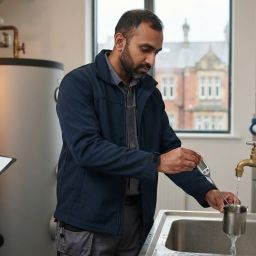
It involves collecting water samples from locations selected to investigate a specific Legionella risk. Trained personnel should collect microbiological samples following BS 7592 protocols, and laboratories should analyse them to ISO 11731 standards. For a workshop, sampling points could relate to a particular cooling or process-water system. The results help interpret conditions at those points, not automatically describe every part of the site.
Do different buildings need different testing?
Yes. Testing depends on the building’s water systems and risk profile, not simply its property type. A workshop with a cooling tower, for example, differs from an office with a simple hot and cold water system. Routine microbiological testing is generally indicated for cooling towers, spa pools and high-risk healthcare systems; the assessment determines whether sampling is needed elsewhere.
What happens after the testing?
Interpret results alongside the risk assessment and the system’s operating conditions. If findings point to a control issue, the responsible team can identify the affected system, assign corrective work and record the action taken. Follow-up sampling may be appropriate when the assessment indicates it. Consider each sample result in context, rather than treating it as a complete picture of the premises.
Who Can Carry Out Legionella Testing and How Should It Be Done?
A competent person should assess the risks and decide whether sampling is appropriate. Where samples are required, trained personnel should collect them using BS 7592 protocols, with analysis to ISO 11731 standards. The sampling plan should suit the system and the question being investigated, such as checking a particular outlet or process-water circuit, rather than relying on an arbitrary selection of taps.
Why is it Important?
Legionella infection can occur when someone inhales water droplets containing the bacteria after they become aerosolised. Systems that produce mist or spray therefore need consideration, including equipment used in some industrial processes. A suitable assessment helps the responsible team understand where exposure could occur and which controls matter. It also supports a reasoned decision about monitoring and sampling, rather than testing without a clear purpose.

Article by
P J F Thomas
CEO and Founder of TTL plc.
Disclaimer
Items declared are AI generated but do reflect our services. Please get in contact if you have any questions.