
Legionella compliance: when to review your risk assessment
An incident-free record does not prove that a water system is safe. In Great Britain, there is no universal legal requirement to review every Legionella risk assessment annually. Review it when there is reason to believe it may no longer be valid. Many duty holders review assessments every two years, or sooner when risks are higher. To prove Legionella compliance, you need to show that the assessment and controls still reflect the building and its water system.
It is understandable to take comfort from having no reported cases, but that alone does not show that risks are properly controlled. This article explains when a review is needed, why an incident-free history is not enough, and which gaps in assessment, monitoring or record-keeping can weaken compliance.
You’ll also learn how a risk assessment and ongoing evidence work together to demonstrate a considered approach to Legionella control across the UK.
Key Takeaways
- Review the risk assessment when changes to a building or its water system could make the existing findings outdated.
- An absence of reported Legionella cases does not, by itself, demonstrate that risks are controlled.
- Clear monitoring records help show what controls were completed, when they were done and what action followed any problems.
- Use a risk assessment or water testing to address gaps in your Legionella control arrangements.
How often should a Legionella risk assessment be reviewed?
There is no universal UK legal requirement to repeat every Legionella risk assessment annually. Many duty holders review assessments every two years, or sooner when risks are higher. Review yours sooner if building use, layout, occupancy or water outlets change, or if an incident suggests the existing assessment may no longer be valid.
In Great Britain, the Health and Safety at Work etc. Act 1974 underpins Legionella control duties, according to UK Government. The COSHH Regulations 2002 also underpin duties to assess and manage risks from hazardous substances, including Legionella. Employers and premises controllers must assess risks and implement suitable precautions for the water systems they control.
A responsible person coordinates Legionella compliance on behalf of the duty holder. They need suitable training, time and authority to manage the risk and oversee control arrangements. The assessment should describe the water system, identify hazards and people at risk, and set out control measures and a review frequency.
An assessment should examine the system’s design and use, including stored water, outlets, temperatures, monitoring, cleaning and maintenance. For example, a little-used outlet or altered pipework may change the risk profile. A clear Legionella risk assessment records the system’s risks and the measures needed to control them.
Landlords must manage risks associated with water systems under their control; employers must assess workplace risks. In England, care providers also consider HTM 04-01 alongside established Legionella control guidance. A formal certificate isn’t the same as evidence of effective assessment and management.
The cost of assessment and ongoing compliance depends on system complexity, site access and the monitoring or remedial work required. Request an instant quote for your specific site.
Does a lack of Legionella cases mean a water system is safe?
No. Water-system risks depend on the system’s design, conditions and controls, not simply on whether illness has been reported. Hot and cold water systems, cooling systems and spa pools need controls suited to their individual risks.
Why no reported illness does not prove safety
An absence of reported disease cannot establish that legionella bacteria are absent or controlled. The Health and Safety Executive states that Legionella can multiply in stagnant water where temperatures remain between 20°C and 45°C. A system may therefore present a risk without any known illness. Employers and the responsible person need evidence from inspection and monitoring, rather than relying on an incident-free record.
Risk varies by system: infrequently used outlets can allow water to stagnate, while cooling towers and spa pools have distinct control needs. HSG274 Part 1, covering evaporative cooling systems, was updated in 2024. Its separate focus reflects why one code of practice cannot be applied identically to every system.
Water testing and monitoring
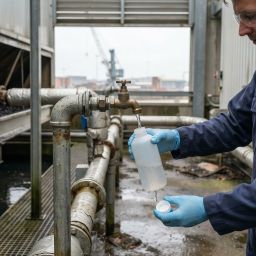
Legionella testing checks water samples for bacteria. It supports, but does not replace, risk assessment and routine controls. Testing is not automatically a legal requirement in the UK. It may be appropriate when an assessment identifies a sampling need, such as investigating a control failure or assessing a higher-risk system.
Sampling should follow a consistent protocol, with laboratory analysis and results interpreted alongside system conditions. BS 7592:2022 provides guidance for Legionella water sampling. The responsible person should record results and actions taken, including corrective measures after a positive result. A Legionella water testing quote can help plan sampling where the assessment indicates it’s needed.
Checks and compliance records
Check sentinel outlets, tanks and calorifiers according to the site’s risk-based monitoring scheme. The assessment should set appropriate checks for the system. Little-used outlets are typically flushed weekly. Record monitoring, inspections, findings, dates, responsible staff and corrective actions so the log shows what happened and when.
Keep Legionella control records for at least five years across the UK. Clear records help the employer and responsible person trace missed checks, temperature concerns or remedial work, then assess whether further action is needed.
Common compliance failures
Compliance can fail through small operational gaps, even where a Legionella risk assessment exists. Across the UK, the key test is whether the documented control measures match the system and are carried out consistently.
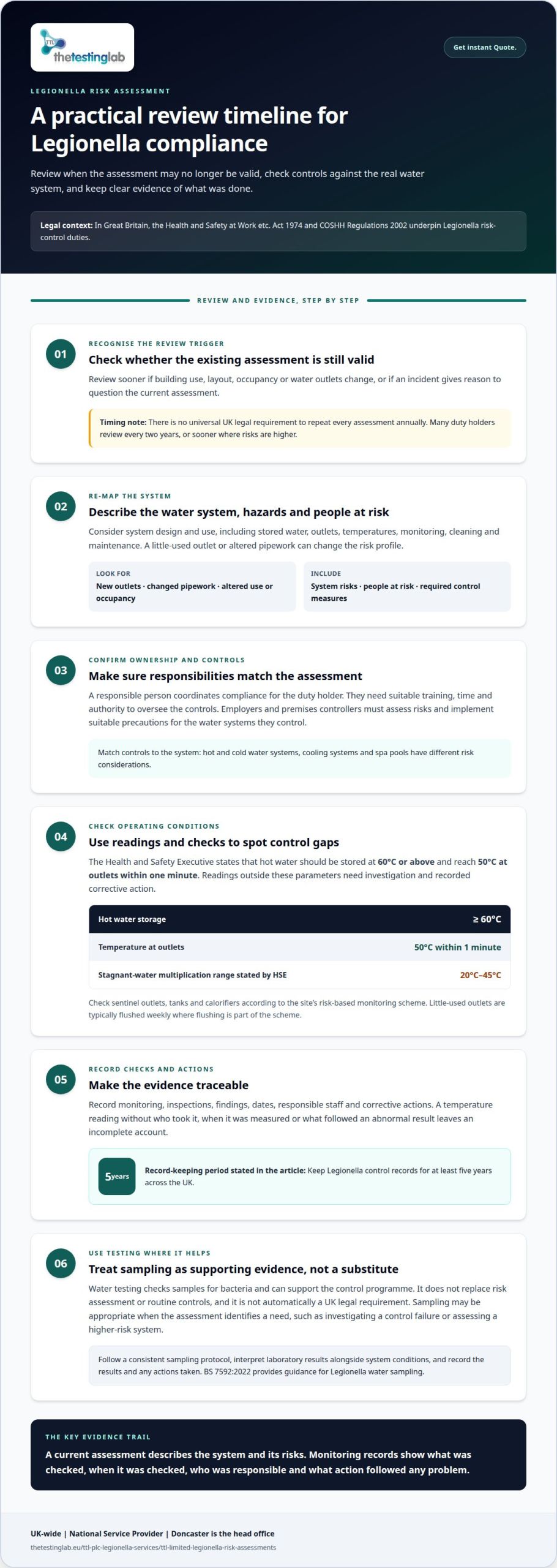
Temperature control is a common point of failure. The Health and Safety Executive states that under HSG274, hot water in Legionella control should be stored at 60°C or above. The Health and Safety Executive also states that hot water should reach 50°C at outlets within one minute. Readings outside these parameters need investigation and recorded corrective action, not just a note in a log.
Records can reveal another gap. A monitoring sheet that shows a temperature but omits who took it, when it was measured or what happened after an abnormal result gives an incomplete account. Record completed checks, findings, remedial actions and the person responsible. If flushing is part of the scheme, note whether it was completed and any issue found at the outlet.
Premises can also drift from the original assessment. New outlets, altered pipework, changed occupancy or a system left unused can affect the technical risk picture. Review the assessment after such changes, then update control measures and responsibilities. ACOP L8 is an approved code of practice, not law itself; however, a duty holder prosecuted for a health and safety breach who hasn’t followed it must prove compliance by an equally effective means.
For a practical way to address gaps, arrange a Legionella compliance assessment focused on your premises, system and control records.
The Testing Lab PLC
The Testing Lab PLC helps UK duty holders strengthen Legionella control with Quick Legionella Risk Assessments, Fast Legionella Risk Assessments and water testing. A new assessment can help when a premises changes, existing records reveal gaps or the current control measures need review. Testing can support an assessment where sampling is appropriate, while assessment findings help inform the wider control approach.
As a national service provider with its head office in Doncaster, The Testing Lab PLC works with organisations across the UK. The appropriate support depends on the water system, its risks and the evidence needed to assess or monitor it.
For support with your premises, contact The Testing Lab PLC.
Make your next compliance decision with confidence
Turn your review into a clear plan: identify the evidence your premises need, assign responsibility for outstanding actions and decide whether specialist assessment or sampling is appropriate. That practical approach is central to how to prove Legionella compliance, because records are most useful when they support consistent control decisions.
The Testing Lab PLC offers Quick Water Testing, Quick Legionella Risk Assessments and Fast Legionella Testing to support duty holders with relevant testing and assessment needs. The right next step depends on the water system and the questions your records raise.
Discuss your Legionella requirements with The Testing Lab PLC, and move forward with a clearer plan for your premises.
Frequently Asked Questions
How long do Legionella records need to be kept?
Keep Legionella control records for at least five years in Great Britain and Northern Ireland. Organise the archive by premises and date so the duty holder can retrieve evidence for a particular site visit or period. A clear record set links scheduled tasks to completion, identifies who carried them out and makes follow-up actions traceable.
Legionella Compliance: Can You Prove the Work Was Done?
Yes. A coherent evidence trail can show that planned controls were carried out and that issues led to action. For example, align the written monitoring scheme with dated records, inspection findings, maintenance entries and follow-up reports. If a task was missed or a result was outside the expected range, retain the record of the response as well as the original finding.
What is ACOP L8 and is it a legal requirement?
ACOP L8 is an approved code of practice for Legionella control in Great Britain, but it isn’t law itself. It sets out an established approach to managing risks alongside HSG274. If prosecuted for a health and safety breach after not following ACOP L8, a duty holder must prove they achieved compliance by an equally effective means.
Does a water hygiene contractor hold the Legionella legal duty?
No. Using a contractor to carry out monitoring or other assigned tasks does not, by itself, transfer the duty holder’s responsibility for managing Legionella risk. The employer or person controlling the premises still needs suitable arrangements, including clear responsibilities and oversight. For example, agree who receives results and who ensures recommended corrective actions are completed.
Is testing mandatory?
No. Legionella testing is not automatically a legal requirement across the UK. Sampling may be needed when the risk assessment identifies a reason, such as investigating a concern or evaluating a control measure. Testing provides information about a sample at a particular time; consider it alongside system conditions and wider risk-control arrangements, not as a substitute for them.

Article by
P J F Thomas
CEO and Founder of TTL plc.
Disclaimer
This guide gives general information only and is not legal advice. For advice on your site or samples, contact The Testing Lab PLC.