
Private borehole water testing for rural homes near Berwick-upon-Tweed
What if borehole water looks clear but may still be contaminated? For rural estates near Berwick-upon-Tweed, private borehole water testing can identify concerns that appearance, smell and taste cannot reveal. If you’re buying a property with a private supply, testing provides useful evidence about water quality before you decide.
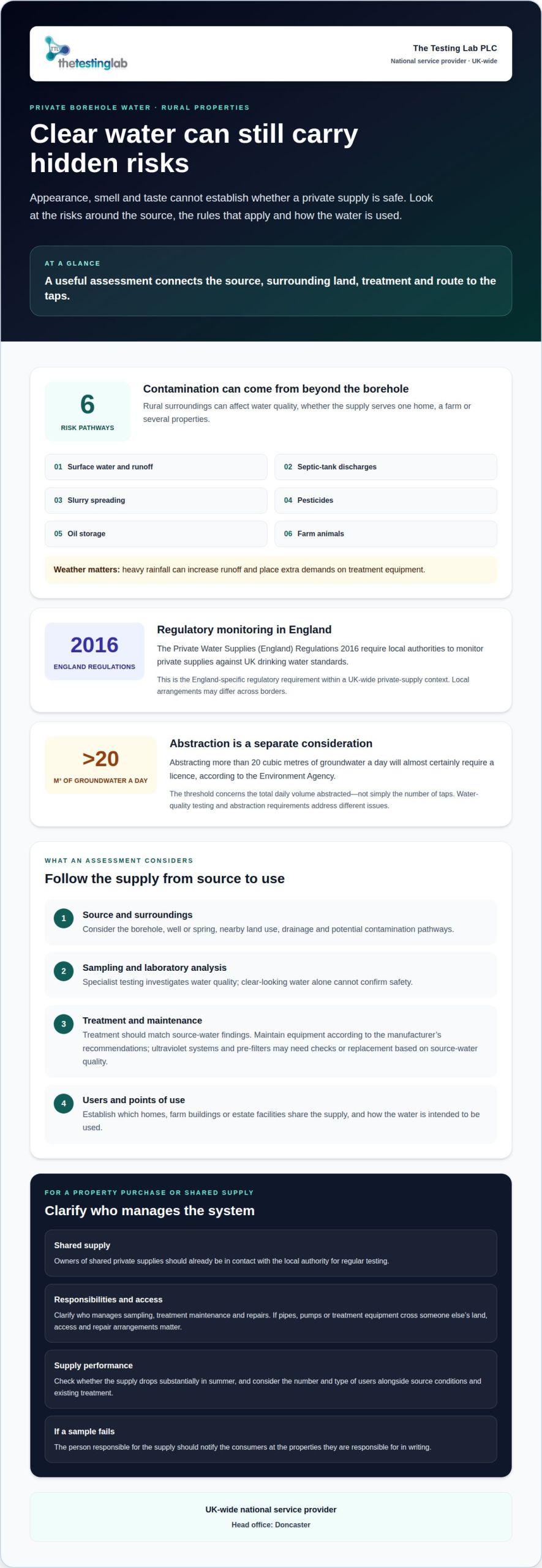
It’s sensible to look beyond the water source itself. Contamination risks can come from surface water, septic-tank discharges, slurry spreading, pesticides, oil storage and farm animals. The supply may serve one home or several properties, so it’s important to understand how it is used.
This article explains when testing matters, which risks to consider for homes, farms and estates, and how a water-quality assessment can inform your next steps. The Testing Lab PLC is a National Service Provider offering Quick Water Testing UK-wide, with Doncaster as its head office.
Key Takeaways
- Clear, normal-tasting water can still carry contamination risks from farm activity, drainage or nearby storage.
- In England, the Private Water Supplies (England) Regulations 2016 require local authorities to monitor private supplies against UK drinking water standards, according to UK legislation.
- When buying a rural property, understand who shares the supply and how its source, equipment and maintenance responsibilities are managed.
- Shared private supplies should already be in contact with the local authority for regular testing; expert water testing can help assess water quality for homes, farms and estates.
Contamination risks on rural properties
On a rural property near Berwick-upon-Tweed, a borehole, well or spring can face risks beyond its immediate surroundings. Surface water may carry contaminants from septic-tank discharges, slurry spreading, pesticides, oil storage or farm animals. Heavy rainfall can increase runoff and place extra demands on treatment equipment. These pathways matter whether the source serves one house, a farm or several homes.
Water intended for drinking can look, smell and taste normal despite contamination. A clear tap-water sample therefore cannot establish that a private supply is safe. A specialist assessment considers the source, surrounding land and route to the taps, then uses sampling and laboratory analysis to investigate water quality. This offers a sounder basis for decisions than appearance alone.
For properties in England, the Private Water Supplies (England) Regulations 2016 require local authorities to monitor private water supplies for compliance with UK drinking water standards, according to UK legislation. That monitoring sits within the UK-wide context of private supplies, but property owners still need to understand local risks. For example, a Scottish Borders estate near Berwick may have different local arrangements from a supply in England.
Water quality is not the only consideration for a rural estate. Abstracting more than 20 cubic metres of groundwater a day will almost certainly require a licence, according to the Environment Agency. The threshold concerns the total daily volume abstracted, not simply the number of taps installed. Where a farm or estate has several users, assess its water demand alongside contamination pathways. Testing can help identify quality concerns; abstraction requirements depend on the volume taken.
Services for rural homes, farms and country estates
A private supply may serve one home or several properties, so the assessment should reflect how the water is used. Private borehole water testing for rural estates near Berwick-upon-Tweed should take account of the source and the people relying on it.
Water testing for rural homes and farms
For a farmhouse, home or livestock operation, an assessment should consider the supply from its source to the taps. Sampling and laboratory analysis help establish whether the water is suitable for its intended use. The appropriate testing depends on the source and supply arrangement, including whether groundwater comes from a borehole or spring.
Water treatment is separate from testing. Treatment should match the source-water findings, and equipment should be maintained according to the manufacturer’s recommendations. For example, a property using ultraviolet treatment needs the system checked and its pre-filters replaced as required by source-water quality. This connects analysis with practical monitoring, rather than relying on treatment equipment alone.
Borehole testing across nearby rural areas
Across Berwick-upon-Tweed and nearby rural areas, private supplies may serve one home or several properties. Owners of shared supplies should already be in contact with the local authority for regular testing. If you’re buying a property, establish which homes, farm buildings or estate facilities use the borehole, and whether the supply drops substantially in summer.
A supply review also considers the route from the protected source to each point of use. A nearby stream or surface-water drainage can inform the assessment of the surrounding environment. If pipes, pumps or treatment equipment cross someone else’s land, access arrangements and responsibility for repairs, renewals and electricity affect ongoing management. Private borehole water testing for rural estates near Berwick-upon-Tweed can inform decisions about the supply.
For an estate, connect test findings with the number and type of users, source conditions and existing treatment. Request a quote for water-testing requirements when you need a structured assessment for a rural supply.
Who tests private borehole water in Berwick-upon-Tweed and nearby rural areas?
For a shared private supply near Berwick-upon-Tweed, the local authority has a central role in routine oversight. Owners of shared supplies should already be in contact with their local authority for regular testing. For a single-property supply, specialist water testing can include sampling and laboratory analysis to assess water quality.
These roles serve different purposes. Local-authority monitoring relates to regulatory oversight, while specialist testing can provide property-specific results, including during a purchase. Buyers can use those findings to understand the supply before deciding how to proceed. Testing should reflect the source and how people use the water, rather than relying on a visual inspection of the borehole head.
For a rural estate, the assessment should also reflect how the supply is arranged. Identify which homes or farm buildings receive water and whether they share the borehole, pipes or treatment equipment. If a sample fails, the person responsible for the supply should notify consumers at the properties they’re responsible for in writing. Establishing responsibility in advance can help avoid confusion if a problem arises.
During a property purchase, clarify who manages sampling, treatment maintenance and repairs. If the source or equipment is on someone else’s land, access rights also affect how the supply can be maintained. These details help distinguish a result for one tap from a useful picture of the wider estate supply.
For a clear next step, request a quote for private water testing tailored to the property’s supply and intended use.
Contact Northumberland County Council as the local authority and explain whether the supply is shared, which homes or buildings it serves, and who manages it. Owners of shared supplies should be in contact with their local authority for regular testing.
The Testing Lab PLC
The Testing Lab PLC helps rural property owners investigate water-quality concerns through Quick Water Testing. For a home purchase, farm supply or estate system, testing can provide information to support decisions about the water and its management. It’s useful when you need to investigate a private supply or understand a result in the context of the property’s water arrangements.
The Testing Lab PLC provides Quick Water Testing nationwide from its Doncaster head office. Its testing and water-management expertise can help clarify next steps for a private supply, while local-authority responsibilities for regulatory monitoring remain separate.
If you’d like to discuss your property’s water-testing needs, contact The Testing Lab PLC.
Make your next water decision with confidence
For private borehole water testing at rural estates near Berwick-upon-Tweed, a clear brief can help turn results into practical decisions. Bring together the source location, the properties and activities it serves, and any concerns identified during a purchase. This context helps focus the assessment on the questions that matter to your household, farm or estate.
The Testing Lab PLC offers Quick Water Testing, Quick Legionella Risk Assessments and Fast Legionella Testing. Legionella services are LCA-registered. These services address different water-quality and risk-assessment needs, depending on the issue you’re investigating. Match the work to the specific supply and the decision you need to make, rather than treating every concern as the same problem.
Ready to discuss the right approach for your property? Contact The Testing Lab PLC to take the next step towards a clearer understanding of your water supply.
Frequently Asked Questions
What is the law relating to private water supplies?
In England, the Private Water Supplies (England) Regulations 2016 require local authorities to monitor private supplies against UK drinking water standards, according to UK legislation. The Private Water Supplies Regulations 2009 apply to supplies from wells, boreholes or springs provided by someone other than a local water utility. For a property purchase, establish whether its supply is private and whether it serves other premises.
What do I need to know about my supply?
Find out where the source, pipes and treatment equipment are, who uses the supply, and who is responsible for maintenance and repairs. For example, an estate borehole might serve a farmhouse and cottages through shared pipework. Establish whether equipment is on someone else’s land and whether access arrangements are in place. These details clarify how the supply is managed day to day.
Which UK laboratory tests are required for private borehole drinking water?
There isn’t one fixed laboratory test panel for every private borehole. The type and frequency of sampling and analysis depend on the supply’s risk assessment. A domestic borehole and an estate supply serving several premises may therefore need different assessment scopes. Choose testing to investigate the specific source and supply conditions, rather than assuming one sample answers every water-quality question.
How often must private water supplies be tested in England?
There isn’t a single testing interval for every private supply in England. Sampling frequency and analysis depend on the risk assessment outcome. Local authorities carry out risk assessments of certain categories of private supplies at least once every five years. That assessment helps determine the appropriate monitoring approach; it doesn’t mean every supply follows the same sampling schedule.
What are the legal requirements for private water supplies in Northumberland?
Northumberland is in England, so the Private Water Supplies (England) Regulations 2016 apply: local authorities must monitor private supplies for compliance with UK drinking water standards, according to UK legislation. The monitoring and sampling approach depends on the supply’s risk assessment. For a shared borehole, establish who is responsible for the supply and its consumers, as well as how monitoring is arranged.

Article by
P J F Thomas
CEO and Founder of TTL plc.
Disclaimer
This guide gives general information only and is not legal advice. For advice on your site or samples, contact The Testing Lab PLC.