
TMV Legionella Monitoring: Service Frequency and Compliance
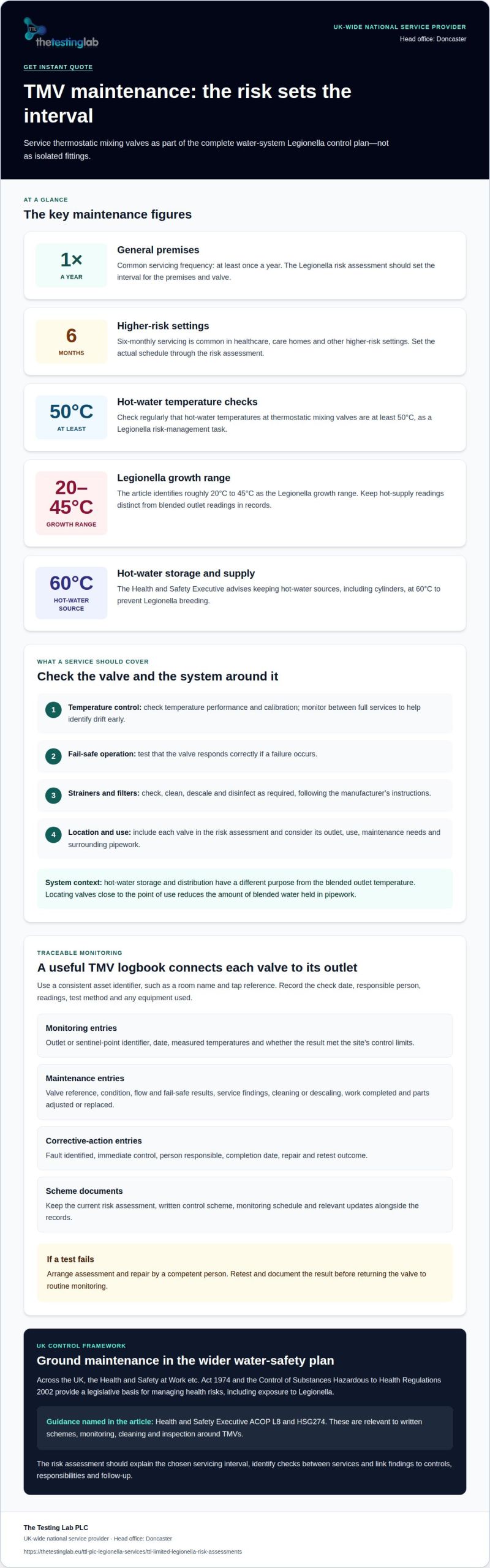
A TMV can help prevent scalding, but it also needs to be maintained as part of a considered Legionella control plan. In general UK premises, valves should be serviced at least once a year, with the Legionella risk assessment setting the interval. Six-monthly servicing is common in healthcare, care homes and other higher-risk settings. Effective TMV Legionella monitoring compliance considers both the valve and the water system it serves.
Between full services, temperature checks can help identify drift early. A service should also assess temperature control, fail-safe operation, and strainers or filters. Include TMVs in the Legionella risk assessment and ongoing water safety plan rather than treating them as isolated plumbing components.
This guide explains servicing frequency, how monitoring varies by setting and what a proportionate maintenance programme involves. The Testing Lab PLC is a UK-wide national service provider, with its head office in Doncaster, supporting water safety decisions through Legionella risk assessments and testing.
Key Takeaways
- Set TMV servicing intervals according to the Legionella risk assessment, taking the setting and level of risk into account.
- Include TMVs in the risk assessment and water safety plan, and consider how their position and use affect monitoring.
- Keep clear records of temperature checks, servicing findings and corrective actions to make follow-up and trends easier to track.
- Use Legionella risk assessments or water testing to support a more structured approach when a system’s risks or monitoring needs need attention.
Should TMVs Be Included in a Legionella Risk Assessment?
Yes. Across the UK, assess TMVs as part of the water system, including their location, use and maintenance needs.
Including TMVs in risk assessments
A Legionella risk assessment should identify each thermostatic mixing valve and consider how it affects water temperature and use. This matters because the valve mixes hot and cold water close to an outlet, so its condition and performance form part of the wider legionella risk. In the UK, hot-water temperatures at thermostatic mixing valves should be checked regularly to ensure the water is at least 50°C, as a Legionella risk management task set out in the Health & Safety Executive’s ACOP L8 and HSG274 guidance.
Risk-based servicing and monitoring frequency
The Legionella risk assessment should set TMV servicing and monitoring frequency according to the premises, valve use and identified risks. General premises commonly schedule servicing at least once a year; six-monthly servicing is common in healthcare, care homes and other higher-risk settings. The assessment should explain the chosen interval and identify any additional checks between services. This gives facilities teams a clear basis for consistent monitoring without treating every setting alike.
Legionella risk management actions
Risk management actions turn assessment findings into controls, responsibilities and follow-up. A failed temperature, flow or fail-safe test can indicate that the valve is not controlling water safely, while poor monitoring can leave deterioration unnoticed and weaken evidence of effective management. What are the risks and compliance consequences? Unresolved faults may increase scalding or Legionella risk and leave gaps in monitoring records. After a failed test, arrange assessment and repair by a competent person, then retest and document the result before returning the valve to routine monitoring.
TMV and monitoring records
Records should connect each valve’s condition and test results to the relevant outlet and maintenance history. Log the outlet or valve identifier, check date, measured temperatures, flow and fail-safe results, servicing performed, faults found, corrective actions, and retest outcome. Keep the risk assessment and monitoring schedule alongside these entries so changes in use or condition can inform future assessments. Where premises also manage effluent discharge, keep that separate monitoring activity distinct from TMV records, including effluent discharge permit monitoring.
Legionella control and TMV maintenance
Across the UK, Legionella control depends on managing the complete water system, not treating thermostatic mixing valves as isolated fittings. Hot-water storage and distribution serve a different purpose from the blended outlet temperature. The Health and Safety Executive advises keeping hot-water sources, including cylinders, at 60°C to prevent Legionella breeding.
According to UK legislation, the Health and Safety at Work etc. Act 1974 provides a legislative basis for managing health risks, including exposure to Legionella. The Control of Substances Hazardous to Health Regulations 2002 also provide a legislative basis for managing those risks, according to UK legislation. A written scheme can translate this framework into defined controls, monitoring and corrective actions.
The Health and Safety Executive identifies ACOP L8 and HSG274 Part 2 as relevant to written schemes, monitoring, cleaning and inspection around TMVs. A competent person should follow the manufacturer’s instructions during routine servicing. Checks should cover temperature control and calibration, fail-safe operation, and cleaning, descaling and disinfection of strainers or filters. Together, these checks assess whether valves deliver stable mixed water and respond correctly to a failure.
Keep the hot supply and mixed outlet readings distinct in maintenance records. The Legionella growth range is roughly 20°C to 45°C, while TMVs deliver blended water to reduce scalding risk. Locating valves close to the point of use reduces the amount of blended water held in pipework. These system details help explain why servicing must consider both valve function and surrounding pipework.
For a structured review of water-system controls, request a Quick Legionella Risk Assessment quote.
What records and logbook entries should be kept for TMV and Legionella monitoring?
A clear logbook links each thermostatic mixing valve to its outlet, checks and maintenance history. In premises across the UK, use a consistent asset identifier, such as a room name and tap reference, so staff can locate the correct valve. Record the check date, responsible person, readings, test method and any equipment used. This makes comparisons between visits practical and traceable.
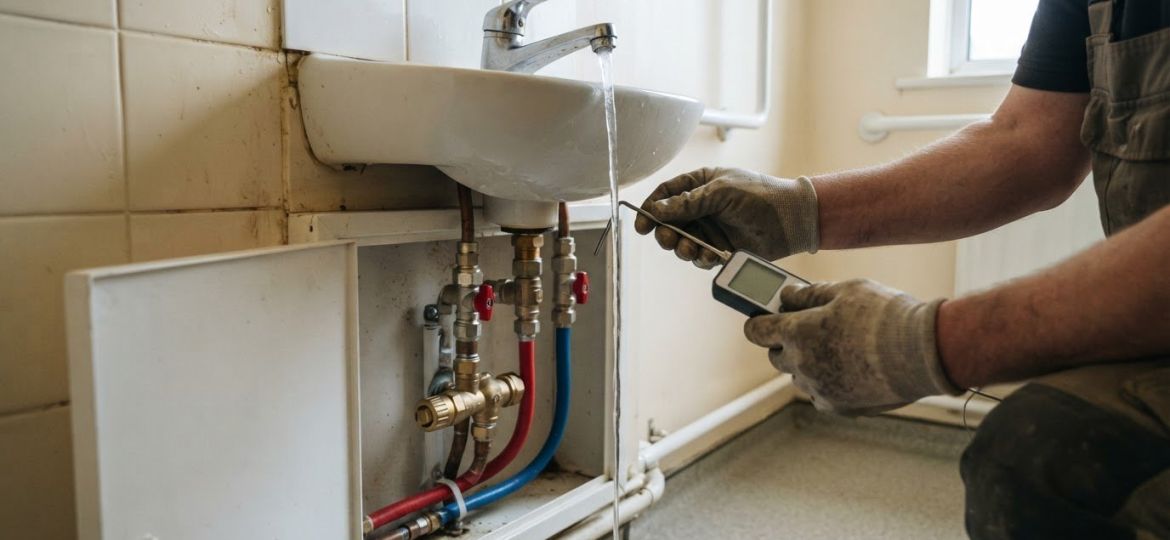
For each TMV inspection or service, record the measured hot-water inlet and mixed outlet temperatures, alongside flow and fail-safe test results. Include the valve’s condition, any cleaning or descaling, and parts adjusted or replaced. If a result falls outside the commissioned settings, note the fault, immediate control, person assigned to resolve it and follow-up test outcome.
- Monitoring entries: outlet or sentinel-point identifier, date, temperature, and whether the result met the site’s control limits.
- Maintenance entries: valve reference, service findings, work completed, and the next scheduled action.
- Corrective-action entries: issue identified, response, responsible person, completion date, and retest result.
- Scheme documents: current risk assessment, written control scheme, monitoring schedule and relevant updates.
Keep records together in a controlled logbook or organised digital system. Make amendments traceable, preserve earlier entries, and ensure staff can retrieve the current assessment and service history. Reviewing trends can reveal repeated temperature drift, recurring valve faults or monitoring gaps that need assessment. These records support consistent TMV Legionella monitoring compliance and show how findings led to action.
For help establishing a documented monitoring basis, request a Fast Legionella Risk Assessment quote.
The Testing Lab PLC
The Testing Lab PLC helps UK-wide facilities make informed Legionella control decisions through risk assessments and water testing. Its head office is in Doncaster, and its national service supports premises reviewing monitoring arrangements, responding to concerns or needing clearer evidence about water-system risks.
A Quick Legionella Risk Assessment or Fast Legionella Risk Assessment can help identify relevant hazards and shape proportionate control measures. Where testing is needed to investigate water quality, Fast Legionella Testing can provide evidence to inform the next steps. These services support sound decision-making alongside your site’s TMV servicing and maintenance arrangements.
For a practical discussion about your facility’s Legionella assessment or testing needs, contact The Testing Lab PLC.
Turn monitoring findings into a stronger routine
Effective TMV Legionella monitoring compliance is built into everyday facilities management, rather than treated as a separate paperwork exercise. Connect monitoring findings with maintenance planning and the people responsible for acting on them. This helps teams keep water safety controls practical as building use and operational priorities change.
Where further assessment or testing would support decisions, The Testing Lab PLC offers Quick Water Testing, Quick Legionella Risk Assessments and Fast Legionella Testing. These services can help facilities teams investigate water concerns and strengthen their understanding of system risks.
To discuss a suitable next step for your premises, start a conversation with The Testing Lab PLC. A considered plan can help your team move forward with clarity.
Frequently Asked Questions
How often should a thermostatic mixing valve be serviced?
In general UK premises, plan full TMV servicing at least once a year; six-monthly servicing is common in healthcare, care homes and other higher-risk settings. The Legionella risk assessment determines the appropriate interval for each site. For example, a care setting may need a closer maintenance schedule than lower-risk premises, with interim outlet checks helping identify temperature drift.
Do TMVs Need to Be Tested?
Yes. Testing helps show whether a valve controls temperature and flow correctly and whether its fail-safe mechanism operates. A competent person can record the results, including any calibration or cleaning required, and arrange follow-up if a check fails. Testing is useful after installation, servicing or a change in outlet use, since each can affect how the valve performs.
What temperature should TMVs be set at to avoid legionella?
No TMV outlet setting alone prevents Legionella. The valve blends hot and cold water for use, so the setpoint must also address scald risk and the outlet’s purpose. According to the Health and Safety Executive, hot-water sources such as cylinders should be kept at 60°C to prevent Legionella breeding. A competent assessment should consider the hot supply and mixed outlet separately.
Why Are TMVs Important?
TMVs reduce the risk of scalding by blending hot and cold water before it reaches an outlet. This is particularly relevant where users may be more vulnerable to burns, such as in care settings. Their role is distinct from controlling Legionella in the wider system: safe operation depends on managing the valve and hot-water supply as connected parts of the premises’ water controls.
What is a thermostatic mixing valve (TMV) and how does it relate to Legionella control?
A thermostatic mixing valve combines hot and cold water to deliver a controlled mixed temperature at an outlet. Because it changes water temperature, it needs to be considered within the wider Legionella control arrangements, not treated as a standalone safeguard. In the UK, the Health and Safety Executive’s ACOP L8 and HSG274 guidance are relevant to written schemes and monitoring around TMVs.

Article by
P J F Thomas
CEO and Founder of TTL plc.
Disclaimer
This guide gives general information only and is not legal advice. For advice on your site or samples, contact The Testing Lab PLC.