
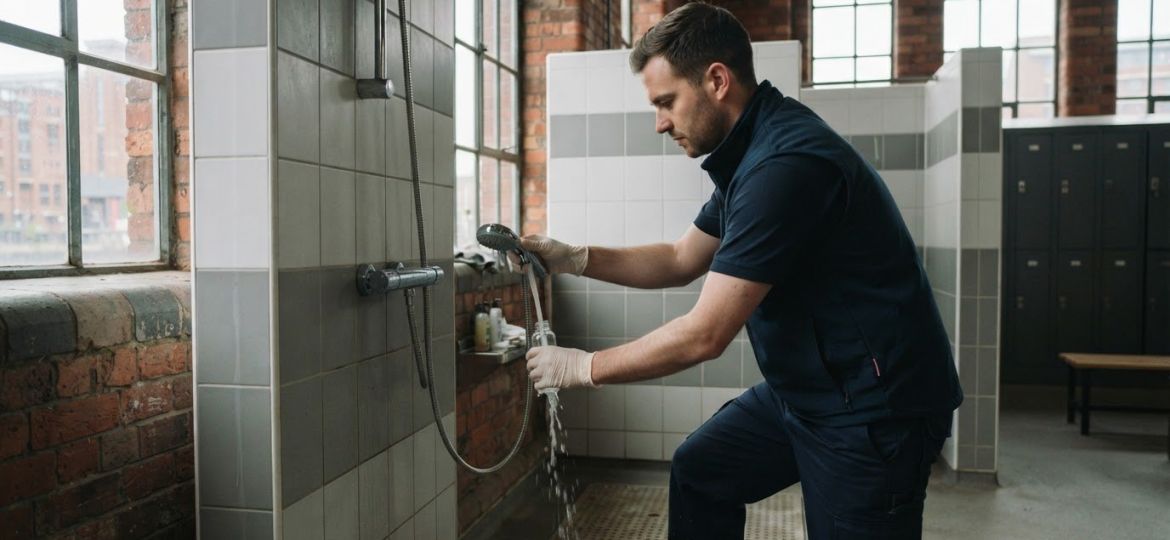
Legionella monitoring services for commercial gyms in Liverpool
A Legionella risk assessment is the starting point, not the whole control plan. For a commercial gym, a Legionella monitoring service in Liverpool should account for the building’s water systems, how they’re used and the people who may be exposed. According to the Health and Safety Executive, UK duty holders are subject to the Health and Safety at Work Act 1974 and need a competent Legionella risk assessment.
Showers, hot tubs and other water systems can create conditions in which Legionella bacteria proliferate. A risk assessment examines the system and helps determine whether sampling or remedial action is needed. Ongoing monitoring checks that control measures remain effective.
This guide explains what an assessment includes, how remedial work and monitoring fit into the process, and what commercial gyms in Liverpool should consider. The Testing Lab PLC provides UK-wide services from its head office in Doncaster.
Key Takeaways
- UK duty holders are subject to the Health and Safety at Work Act 1974 and need a competent Legionella risk assessment, according to the Health and Safety Executive.
- An assessment examines the gym’s water systems, how they are managed and who could be exposed, helping identify where controls or further action may be needed.
- Remedial works address identified control issues, while ongoing monitoring helps keep water-management measures under review as systems or building use change.
- UK-wide water management services are available from The Testing Lab PLC, whose head office is in Doncaster.
What is a Legionella Risk Assessment and What is Included?
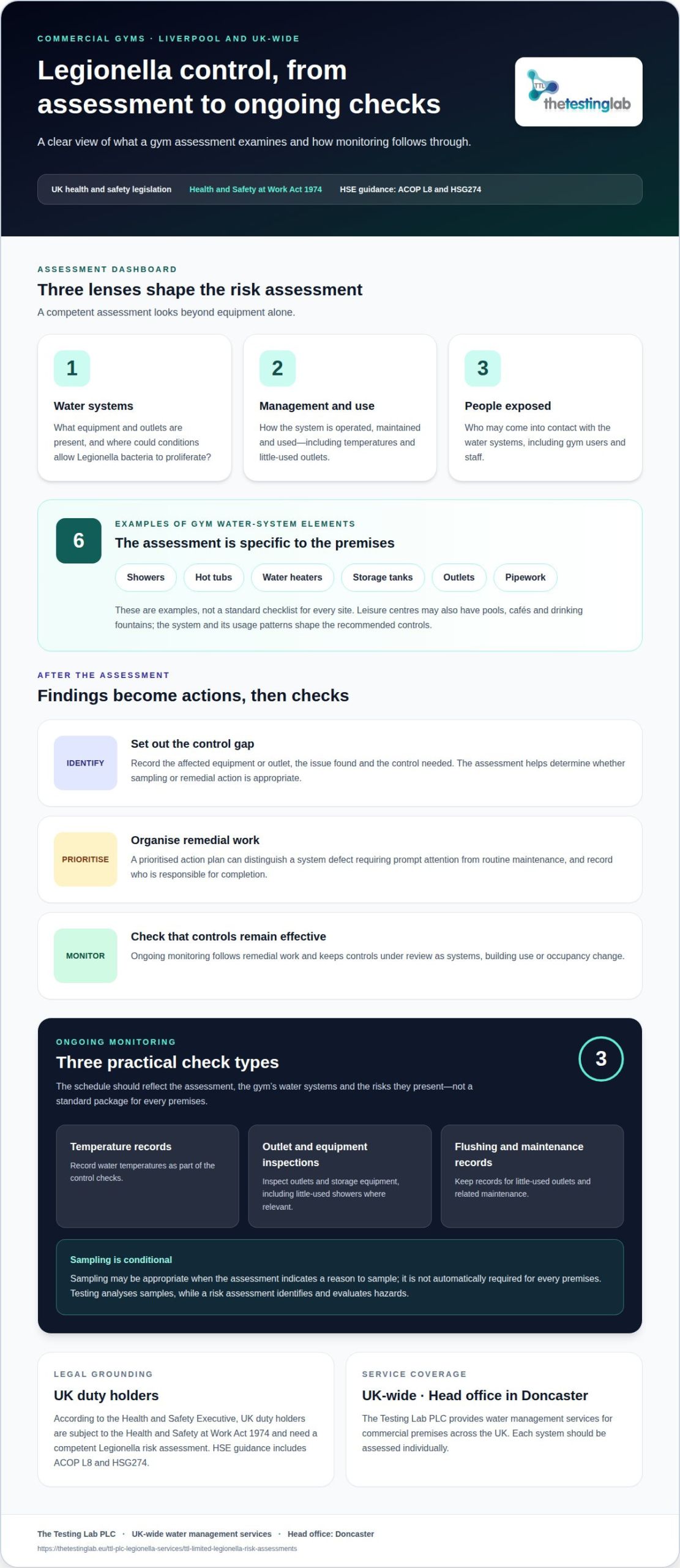
A Legionella risk assessment surveys water systems, their management and the people who may be exposed. In Liverpool and across the UK, it helps gyms identify control measures and whether sampling is appropriate.
Gym and Leisure Centre Assessments
A gym assessment may cover showers, hot tubs, water heaters, storage tanks, outlets and pipework. The assessor considers water temperatures, little-used outlets and how the system is operated. Leisure centres may also have pools, cafés and drinking fountains; residential premises can have different usage patterns and water-system arrangements. These site-specific details shape the Legionella risk and the recommended controls.
Applicable UK Regulations and HSE Guidance
According to the Health and Safety Executive, UK duty holders are subject to the Health and Safety at Work Act 1974 and need a competent Legionella risk assessment. HSE guidance includes ACOP L8 and HSG274. The assessment should cover system management as well as equipment, so businesses can identify and maintain appropriate controls.
Failure to control Legionella can expose gym users and staff to bacteria that cause Legionnaires’ disease, a severe form of pneumonia. Poor control can also lead to enforcement or prosecution under UK health and safety law; specific penalties depend on the circumstances. For Liverpool and Merseyside businesses, a competent contractor should understand the premises and document its findings. Ask how sampling is handled: requested samples are sent to a UKAS-certified laboratory for analysis. A risk assessment identifies and evaluates hazards; testing analyses samples. Effluent discharge permit monitoring is a separate environmental process, not a substitute for a water hygiene survey.
Remedial works and ongoing monitoring services
Assessment recommendations should lead to clear remedial actions, not remain as findings in a report. In a Liverpool gym, this could mean addressing a temperature-control issue, improving maintenance around a water heater or managing a little-used shower outlet. The appropriate work depends on the system, the identified Legionella control gap and how the facility operates.
A prioritised action plan helps the duty holder organise remedial works by the level of risk and the control needed. It should identify the affected equipment or outlets, describe the corrective action and record who is responsible for completion. For example, a system defect requiring prompt attention should be distinguished from routine maintenance. This makes recommendations easier to track across gym areas, changing rooms and leisure facilities, while supporting consistent compliance records.
Ongoing monitoring checks whether control measures remain effective after remedial work. Depending on the assessment, checks can include recording water temperatures, inspecting outlets and storage equipment, and keeping flushing or maintenance records for little-used outlets. Sampling may be appropriate where the assessment indicates it, but it is not automatically required for every premises. Changes to water systems, building use, occupancy or control measures can also prompt a review of Legionella controls. These principles apply to gyms in Liverpool and across Merseyside.
For a professional review of identified risks and next steps, request a Legionella risk assessment for your premises.
Legionella monitoring services
A Legionella monitoring service for commercial gyms in Liverpool turns assessment findings into a practical programme of checks. Its scope should reflect each gym’s water systems, operating patterns and existing control measures.
Monitoring for Commercial Gyms
Monitoring can include scheduled temperature checks, outlet inspections and records for little-used showers. Legionella testing may also be appropriate when the assessment identifies a reason to sample. The right schedule depends on the system and the risks it presents, not a standard package for every premises. For example, a shower block with infrequently used outlets may need different controls from regularly used facilities. Changes in occupancy or system use should inform reviews of the monitoring plan.
Water Hygiene Services for Gyms
Water hygiene support can coordinate monitoring records, system checks, sampling and follow-up recommendations. Relevant guidance can help inform how Legionella risks are managed. Accurate records show which measures were completed and when. Disinfection may be considered where assessment findings indicate it, but it does not replace ongoing controls or appropriate testing. In Liverpool leisure centres, this approach helps keep showers and other relevant water systems under review.
For commercial gyms in Liverpool, a Legionella monitoring service should connect each check to a control measure and recorded outcome. A risk assessment helps determine which activities and samples suit the premises. To arrange a professional assessment and discuss the next steps, request a Legionella assessment.
The Testing Lab PLC: Water Management Services
The Testing Lab PLC provides Water Management Services for commercial premises across the UK, with its head office in Doncaster. For a Liverpool gym, this can be a practical next step when an assessment identifies water-system risks or testing is needed to inform control decisions.
Quick Legionella Risk Assessments help establish risks within a water system, while Fast Legionella Testing and Quick Water Testing provide testing options when sampling is required. The appropriate service depends on the gym’s water systems and the question to resolve: assess the risk or analyse water samples. Each system is unique and should be assessed individually.
To discuss water management support for your gym, contact The Testing Lab PLC.
Put your gym’s monitoring plan into action
Start by defining what your premises needs: a risk assessment, water analysis or laboratory testing. This helps a Liverpool gym focus its enquiry on the relevant systems and decisions, rather than treating every outlet as if it presented the same issue. The Testing Lab PLC’s LCA-registered Legionella risk assessments and water management services support a site-specific approach.
The Testing Lab PLC offers Quick Legionella Risk Assessments, Quick Water Testing and Fast Legionella Testing. These options address different needs: assessing system risks, testing water, or analysing samples. The right starting point depends on whether you need a clearer view of the system or evidence from water samples. That distinction can help you plan the next stage of water management with greater purpose.
Take the next step at a pace that suits your facility. Contact The Testing Lab PLC to discuss your gym’s requirements and move towards a clear, informed plan.
Frequently Asked Questions
How often do I need an assessment in Liverpool?
Arrange an assessment when your gym’s water-system risks need evaluating, including before relying on an existing control plan after a change to the setup. For routine planning, assessments are commonly reviewed approximately every two years. The interval should also reflect the premises, system use and whether previous findings remain relevant.
How often should the assessment be reviewed?
Review the assessment promptly after a material change, such as altered pipework, a change in how the building is used, or a change in the person responsible for water safety. A positive sample result is another reason to review the arrangements. Without such changes, an approximately two-year review is a useful routine interval for Liverpool premises.
What should I have ready before the assessment?
Have any previous risk assessment, water-system schematic, asset list and monitoring records ready. Include temperature checks, maintenance, flushing records for little-used outlets and any Legionella sampling. Identify the person responsible for water safety and arrange access to relevant plant rooms, tanks, heaters and gym areas. This information helps the assessor understand the system’s operation and history.
Will I receive a report after the assessment?
Yes. The written report should record the systems assessed, the findings and the recommended control measures or actions. Assign responsibility for each action and track completion alongside relevant maintenance records. For gyms with separate shower areas or plant rooms, clearly identifying the affected location helps facilities staff follow recommendations accurately.
How often should commercial gym water systems be monitored and sampled for Legionella?
Monitoring frequency depends on the risks and controls identified for each water system; there is no single sampling interval suitable for every gym. The assessment should inform a schedule for checks such as temperature monitoring and outlet maintenance. Legionella sampling is appropriate when the risk assessment indicates testing is needed, or when a result or system change prompts further investigation.

Article by
P J F Thomas
CEO and Founder of TTL plc.
Disclaimer
This guide gives general information only and is not legal advice. For advice on your site or samples, contact The Testing Lab PLC.