

What’s a Better Alternative to ALS Global for Geotechnical Surveys?
Last Updated: 25 October 2026
Quick Summary
A geotechnical surveys alternative should prioritise UKAS accreditation, local operatives for faster response, and digital reporting systems that deliver results without delays. Look for providers with genuine sector experience, transparent pricing, and a track record of working with organisations like yours, whether that’s social housing, construction, or property development.
- UKAS accreditation guarantees compliance with UK testing standards and independent verification of quality.
- Providers with national coverage and local operatives respond faster and understand regional geology and building regulations.
- Digital reporting systems reduce errors and turnaround times compared to paper-based workflows.
- Sector-specific experience matters: providers familiar with social housing, construction, or property development understand your compliance needs.
- A quality geotechnical report includes borehole logs, laboratory test results, interpretation, and specific geotechnical parameters for design use.
Table of Contents
- Why You Might Be Looking for an Alternative to Your Current Geotechnical Survey Provider
- What Makes a Reliable Geotechnical Survey Provider Worth Switching To
- Comparing Geotechnical Survey Companies: Key Differences Beyond Brand Name
- Geophysical Survey vs Geotechnical Survey: Understanding Which One You Actually Need
- Using a Geotechnical Site Investigation Checklist to Evaluate Providers
- What to Expect in a Geotechnical Survey Report and How to Spot Quality
- Getting Started with a Geotechnical Survey Provider You Can Trust
- Frequently Asked Questions
Why You Might Be Looking for an Alternative to Your Current Geotechnical Survey Provider
When a geotechnical survey takes longer than expected or doesn’t give you the clarity you need, it can hold up your entire project. You’ve probably experienced this: waiting for results when timelines are tight, or receiving a report that raises more questions than it answers. Finding a geotechnical surveys alternative that works better for your specific situation isn’t about switching for the sake of it, it’s about getting what you actually need: speed, accuracy, and a provider who understands your project’s constraints.
The reality is that not every geotechnical survey provider operates the same way. Some are set up for massive infrastructure contracts and treat smaller projects as afterthoughts. Others have outdated processes that slow everything down. If you’re managing multiple sites across the country, juggling compliance requirements, or working with tight budgets, the fit matters enormously. A provider that works brilliantly for one type of project might be entirely wrong for yours.
This guide walks you through what makes a reliable geotechnical survey provider worth switching to, how to compare providers beyond brand recognition, and what to look for in a geotechnical survey report that actually tells you something useful.
What Makes a Reliable Geotechnical Survey Provider Worth Switching To
The difference between a provider you can trust and one that creates headaches comes down to a few core things. First is accreditation, specifically UKAS accreditation, which means independent verification that the provider meets rigorous UK standards. UKAS-accredited providers like The Testing Lab have been assessed against ISO/IEC 17020 and ISO/IEC 17025 standards, which govern how testing and inspection services are conducted.
Second is turnaround time without compromising accuracy. A provider that rushes work might miss critical findings that affect your foundation design or ground stability assessment. Conversely, a provider that takes weeks when days would suffice is costing you money. The sweet spot is a provider with efficient processes, often supported by digital reporting systems, that deliver results quickly without cutting corners.
Third is whether they actually understand your sector. Social housing providers need different support than construction firms. Property developers face different compliance timelines than facilities managers. A provider that’s worked across multiple sectors and understands the regulatory landscape in your area is worth more than a generic service.
Experience matters too. Providers with genuine track record, over 18 years in the industry, for example, have seen the problems that come up and know how to handle them. They’ve worked with critical infrastructure organisations and social housing providers, which means they understand the full range of project scales and complexity.
Comparing Geotechnical Survey Companies: Key Differences Beyond Brand Name
When you’re evaluating geotechnical survey companies, it’s easy to get caught up in brand recognition. But the real differences lie in specific capabilities and how they operate. Here’s what actually separates one provider from another.
Accreditation and compliance standards. Not all providers carry the same credentials. UKAS accreditation is the baseline for credible work in the UK, but some providers hold additional registrations.
National coverage with local response. A provider with operatives across England, Scotland, and Wales can respond locally without the delays of coordinating from a central office. This matters if you’re managing multiple sites or need quick site visits.
Digital reporting and accuracy systems. Some providers still rely on paper-based or basic digital workflows. Others have built bespoke reporting software that reduces human error, speeds up turnaround, and gives you clearer data.
Sector experience. Providers who’ve worked extensively with social housing providers understand compliance requirements and budget constraints in that sector. Those with construction firm clients know how to support tight project timelines. Providers serving property developers understand pre-renovation assessment needs.
Transparency on what’s included. A reliable provider is clear about what a quote covers and what costs extra. Hidden costs appearing mid-project damage trust and budgets. The Testing Lab’s approach is built on cost-effective solutions for risk management, meaning what you’re quoted is what you pay.
| Provider Characteristic | Why It Matters | What to Verify |
|---|---|---|
| UKAS accreditation | Guarantees compliance with UK testing standards | Check the accreditation number and scope on the UKAS register |
| Local operatives | Faster response, regional expertise | Ask for typical response times in your area |
| Digital reporting | Faster turnaround, fewer errors | Request a sample report to see the format |
| Sector experience | Understanding of your specific compliance needs | Ask for references in your sector |
| Transparent pricing | Avoids budget surprises mid-project | Request a detailed quote breakdown |
Geophysical Survey vs Geotechnical Survey: Understanding Which One You Actually Need
This is where many organisations get confused. A geophysical survey and a geotechnical survey sound similar, but they’re fundamentally different, and choosing the wrong one wastes time and money.
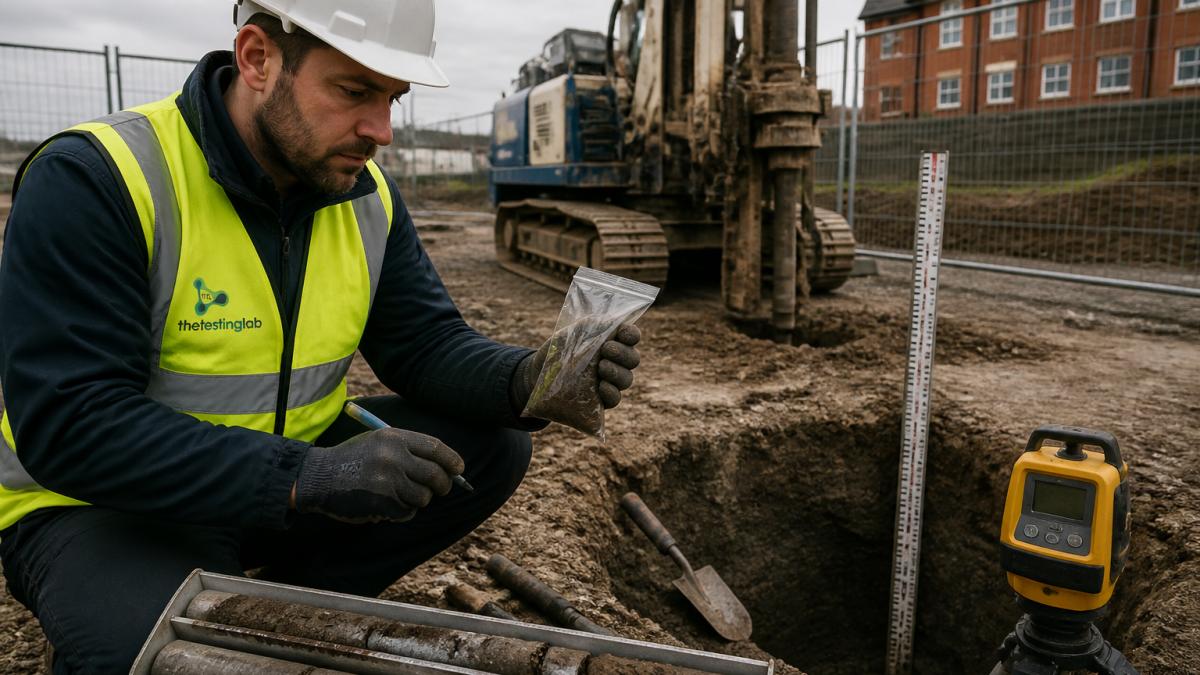
A geotechnical survey involves physical testing of soil and rock samples. Boreholes are drilled, samples are extracted, and they’re tested in a laboratory for properties like bearing capacity, permeability, and compressibility.
A geophysical survey uses non-invasive techniques, electrical resistivity, ground-penetrating radar, seismic methods, to image what’s underground without drilling. It’s useful for mapping subsurface features, identifying voids or contamination, or surveying large areas quickly.
The confusion arises because geophysical surveys sound less invasive and therefore cheaper. In some cases, they are. But if you need actual soil property data for foundation design or ground stability assessment, a geophysical survey alone won’t give it to you.
A common mistake is ordering a geophysical survey when you actually need geotechnical surveys. You get back maps of subsurface features, but no laboratory test results. Then you have to go back and do the geotechnical work anyway, and you’ve lost time and money.
The right approach: ask what decisions your survey results need to support. If it’s foundation design or structural assessment, you need geotechnical surveys. If it’s initial site characterisation or contamination mapping, geophysical might be the starting point.
Using a Geotechnical Site Investigation Checklist to Evaluate Providers
Before you commit to a provider, you need to know what a proper geotechnical site investigation looks like.
Scope and objectives. Does the provider clearly state what the survey will investigate?
Borehole locations and depth. Are the proposed borehole locations justified by the site layout and project requirements? Is the depth sufficient to reach stable bearing strata?
Sampling and testing programme. What samples will be taken? What laboratory tests will be performed? Standard tests include particle size analysis, Atterberg limits, and shear strength testing. Specialist projects might need additional tests.
Reporting timeline. How long will results take? A provider with efficient processes typically delivers reports within 5-10 working days of fieldwork completion. If they’re quoting weeks, ask why.
Reporting format and detail. Will you get a written report with recommendations, or just raw data? A proper geotechnical survey report includes interpretation and recommendations for foundation design or ground improvement.
Quality assurance. How do they verify accuracy? UKAS-accredited providers follow documented quality procedures. Ask what these are. A provider that can’t explain their QA process is a red flag.
Cost breakdown. Is the quote itemised? Fieldwork, laboratory testing, and reporting should be separate line items so you understand what you’re paying for. Bundled quotes hide where costs come from.
What to Expect in a Geotechnical Survey Report and How to Spot Quality
A geotechnical survey report is your project’s foundation document, literally. It informs design decisions and risk management. Knowing what to look for helps you spot a quality report from a rushed one.
Executive summary. A good report opens with a clear summary: site location, project context, investigation scope, and key findings. You should be able to understand the main conclusions without reading 50 pages.
Site description and geology. The report should describe what was found: soil types, depths, groundwater conditions. This section should reference the borehole logs, detailed records of what was encountered at each depth.
Laboratory test results. Test results should be presented clearly, often in tables and graphs. Each test should be explained: what it measures, what the results mean for your project.
Interpretation and recommendations. This is where quality providers add value. They interpret the data in the context of your project. For a foundation design, they’ll recommend foundation type and depth.
Geotechnical parameters. The report should provide specific values: soil unit weight, angle of friction, cohesion, permeability. These are what your structural engineer needs for design calculations.
Limitations and caveats. A credible report acknowledges what it doesn’t cover.
Professional certification. The report should be signed by a qualified professional, typically a Chartered Geotechnical Engineer. This confirms accountability and professional responsibility.
A quality geotechnical survey report gives you confidence in your project’s ground conditions. When you’re reviewing reports, understanding what UKAS accreditation means for laboratory testing standards helps you assess the credibility of the underlying data.
Getting Started with a Geotechnical Survey Provider You Can Trust
Switching to a new provider is a practical decision, not a dramatic one. Start by clarifying what you need: project scope, timeline, budget, and any sector-specific compliance requirements.
Contact providers who tick your boxes and ask for a proposal. A good proposal includes site visit, scope of work, timeline, and cost breakdown. It should answer the questions you have, not leave you guessing.
Before you commit, verify accreditation. Check the UKAS register to confirm the provider’s credentials (Search UKAS accredited organisations). Ask for references, ideally from organisations in your sector. A provider with genuine experience in social housing, construction, or property development can speak specifically to your needs.
Review a sample report. Ask to see an anonymised example of their work. This shows you the quality of reporting you’ll receive and whether it matches your expectations.
Discuss timelines honestly. A provider that promises unrealistically fast turnaround is cutting corners. One that’s realistic about fieldwork, laboratory testing, and reporting builds confidence.
Getting the right geotechnical surveys alternative means finding a provider who combines UKAS-accredited expertise with genuine understanding of your project type and timeline constraints. The Testing Lab brings 18 years of experience, national coverage with local operatives, and bespoke digital reporting that reduces delays.
Frequently Asked Questions
What does a geotechnical survey include?
A geotechnical survey includes soil testing, groundwater assessment, and structural stability evaluation. The surveyor examines soil composition, bearing capacity, and subsurface conditions through boreholes, laboratory testing, and site observations. A comprehensive geotechnical survey report documents findings, risks, and recommendations for foundation design and ground stability. UKAS-accredited providers ensure all testing meets recognised standards and quality benchmarks.
How do I choose a geotechnical survey provider?
Verify UKAS accreditation (ISO/IEC 17020 or ISO/IEC 17025), check turnaround times against your project schedule, and confirm experience with your building type or soil conditions. Ask about their digital reporting capabilities and local response times. Request references from similar projects and clarify what’s included in their quote to avoid hidden costs later. Experience matters, providers with 15+ years in the sector typically deliver more reliable assessments.
What is the difference between a geotechnical and a geophysical survey?
Geotechnical surveys involve physical sampling and testing of soil and rock to measure properties like strength and permeability. Geophysical surveys use non-invasive techniques (seismic waves, electrical resistivity) to map subsurface layers without drilling. Geotechnical surveys provide direct laboratory data; geophysical surveys are faster and cheaper but less precise. Many projects use both: geophysical to identify promising borehole locations, then geotechnical to confirm findings.
Why is UKAS accreditation important for geotechnical testing?
UKAS accreditation (United Kingdom Accreditation Service) confirms the provider meets ISO/IEC 17020 or 17025 standards for testing and inspection. It guarantees equipment calibration, staff competence, and quality control procedures. Regulators, insurers, and lenders recognise UKAS credentials. Without accreditation, your survey may not satisfy planning authorities or building control, risking project delays and compliance failures.

