


Choosing Legionella Control Measures: An Office Water System Guide
Last Updated: 17 November 2026
Quick Summary
Choosing legionella control measures for an office water system starts with a written risk assessment that maps every outlet, tank and pipe run. Match controls to the risks found, usually combining temperature control with flushing, cleaning or chemical dosing where temperature alone cannot reach.
- Draw a system schematic and label each outlet high, medium or low risk before selecting any control.
- Temperature control is usually the backbone, with hot water stored at 60°C or above and cold below 20°C.
- Flush outlets used less than weekly, running both hot and cold and recording who did it.
- Set clear escalation thresholds so failed readings are rechecked, investigated, actioned and recorded.
- Review your control scheme whenever occupancy, system design or building use changes.
Table of Contents
- Start With a Legionella Risk Assessment for Offices
- Matching Legionella Control Measures to System Type and Risk
- Building Your Legionella Temperature Monitoring Routine
- Setting a Legionella Flushing Regime for Low-Use Outlets
- Writing Your Legionella Control Scheme
- Adapting Controls for Hybrid Working and Changing Occupancy
- Booking a Legionella Risk Assessment for Your Office
- Frequently Asked Questions
Start With a Legionella Risk Assessment for Offices
Choosing legionella control measures for an office water system starts with a written risk assessment. Without it, you are guessing which outlets, tanks and pipe runs need attention.
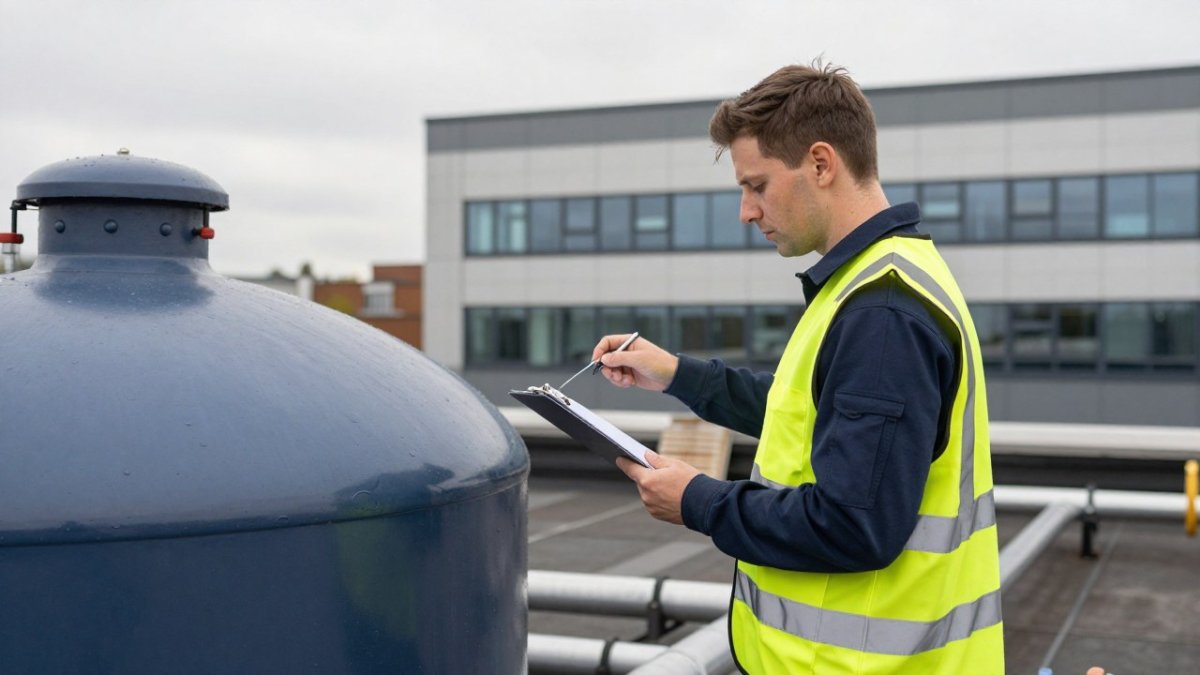
A legionella risk assessment for offices is a structured review of your water system.
The assessment covers five things:
- Every water source, from incoming mains to rooftop tanks
- Hot and cold distribution routes, including little-used branches
- Outlets that produce aerosols, such as showers and spray taps
The Health and Safety Executive’s Approved Code of Practice L8 sets out the legal framework. Dutyholders must assess the risk and manage it.
Mapping Your Office Water System and Outlets
Draw the system before you choose any control. A simple schematic beats a thick report you never open.
Walk the building and mark on a floor plan:
- Cold water tanks and their condition
- Hot water cylinders or calorifiers
- Every tap, shower, spray tap and washing station
This map becomes your outlet risk register. Label each point as high, medium or low risk based on use and aerosol production.
The map also exposes dead legs: pipework that ends in a cap and holds stagnant water. These are among the most common problems we find.
Matching Legionella Control Measures to System Type and Risk
No single control fits every office. The right mix depends on your system design, your occupancy and the risks your assessment found. Legionella control measures fall into a few broad groups, and most offices need more than one.
Temperature control keeps hot water hot and cold water cold, so bacteria cannot multiply. Chemical dosing adds a biocide or pH adjuster to the water. Physical controls cover things like outlet removal, point-of-use filters and redesign to cut dead legs. Flushing keeps water moving through low-use branches. Cleaning and disinfection removes biofilm and sediment when other controls are not enough.
Match the measure to the problem:
| System issue | Suitable control | Why it fits |
|---|---|---|
| Water sitting in a rarely used branch | Flushing or outlet removal | Clears stagnation without new equipment |
| Large tank with slow turnover | Tank cleaning and insulation | Removes sediment and keeps water cooler |
| Complex pipework with many dead legs | Redesign plus chemical dosing | Reaches areas flushing cannot |
| Showers used by staff | Temperature control and regular cleaning | Cuts aerosol risk at the source |
| Older system with scale build-up | Water treatment and descaling | Removes the biofilm bacteria hide in |
A Selection Framework for Office Systems
Use a short decision sequence rather than picking controls from a list. It keeps the choice proportionate and defensible.
- Start with the risk assessment findings. Note every outlet and pipe run rated high or medium risk. These drive the first controls.
- Check whether temperature control alone can reach every part of the system. If sentinel outlets on each loop can be kept within target, temperature control is usually the backbone.
- Identify where temperature control cannot reach. Long branches, dead legs, little-used tanks and complex pipework need flushing, redesign or chemical dosing.
- Match the control to the cause, not the symptom. Stagnation needs flow or removal. Biofilm and scale need cleaning or treatment. Aerosol risk at showers needs cleaning and temperature control together.
- Confirm the control is practical for the building. A control nobody can carry out consistently is not a control. Consider access, staffing and disruption.
- Record the choice and the reason. Your control scheme should show why each measure was selected, so a future reviewer can follow the logic.
This sequence works for a single-floor office and for a multi-building estate. The difference is scale, not principle.
Choosing by Office Size, Occupancy and System Design
Office size and use change which controls are proportionate. A small office with a combi boiler and few outlets may rely mainly on temperature control and weekly flushing. A larger building with tanks, calorifiers and long distribution runs usually needs a fuller scheme.
Consider these patterns:
- Small office, low occupancy, simple system. Temperature control, weekly flushing of low-use outlets and monthly sentinel checks are often enough. Keep the outlet list current.
- Medium office with tanks and a calorifier. Add tank inspection and cleaning, calorifier checks and a clear monitoring schedule. Watch for slow turnover in tanks during quiet periods.
- Large or multi-floor office with complex pipework. Expect to combine temperature control, flushing, cleaning and possibly chemical dosing. Dead legs and redundant branches should be redesigned out where practical.
A common pattern is to over-rely on one control because it is familiar. Most offices need a combination, and the combination should follow the assessment rather than habit.
Temperature Control Compared With Chemical Dosing
Temperature control is usually the first line of defence in an office.
The practical targets, drawn from HSE guidance HSG274, are:
- Hot water stored at 60°C or above (Managing legionella in hot and cold water systems)
- Hot water reaching outlets at 50°C or above within one minute
- Cold water below 20°C
Chemical dosing suits systems where temperature alone cannot reach every part. It needs careful handling and ongoing management.
A common mistake is choosing chemical dosing to avoid fixing a design problem. If dead legs are the cause, dosing treats the symptom, not the source. Fix the pipework first.
Building Your Legionella Temperature Monitoring Routine
Temperature monitoring is how you prove your controls work. It turns a plan into a record.
Set a routine you can actually keep:
- Check sentinel outlets, the nearest and furthest points on each loop
- Record hot and cold readings at the same outlets each time
- Note the time taken for hot water to reach temperature
Monthly checks suit most offices. Busy sites with complex systems may need more. The key is consistency, not frequency alone.
Watch out: taking a reading from a tap that has just run for several minutes gives a false result. Run the outlet briefly first, then measure.
Setting a Proportionate Monitoring Frequency
Frequency should follow risk, not habit. Use these questions to set a schedule you can defend:
- How complex is the system? More tanks, calorifiers and long branches mean more check points and possibly more frequent checks.
- How is the building used? Full occupancy with steady use is easier to manage than hybrid working with quiet floors and intermittent use.
- What did previous readings show? A system with stable readings can stay on a routine schedule. One with repeated borderline results needs closer attention.
A practical pattern for many offices is monthly sentinel checks, with additional checks after any period of low use, refurbishment or change in occupancy. Record the reason for the frequency in your control scheme so it is clear the schedule was chosen deliberately.
Assigning Responsibility and Keeping Records
A monitoring routine fails when nobody owns it. Name the dutyholder and the competent person responsible for carrying out checks, and make sure cover is arranged for leave and sickness.
Records should show:
- The outlet checked and its location
- The reading and the time taken to reach temperature
- The date and the name of the person checking
Keep records for as long as your control scheme requires, and make them easy to review. A clear record is also the best evidence that your controls are working.
Escalation Thresholds and What to Do When a Reading Fails
Set clear thresholds before you need them. A simple escalation path helps everyone respond consistently:
- Recheck the reading. Confirm the result with a second measurement at the same outlet.
- Investigate the cause. Check for recent low use, a closed valve, a faulty blending valve or a problem with the heat source.
- Take immediate action. Flush the outlet, adjust the temperature or isolate the outlet if needed, following your control scheme.
- Record what happened. Note the reading, the cause found and the action taken.
- Review the control. If the same outlet fails repeatedly, the control measure may need changing, not just repeating.
Our monthly water management and monitoring service shows how this works as an ongoing routine, with checks, records and escalation built into one schedule.
Setting a Legionella Flushing Regime for Low-Use Outlets
Flushing is the simplest control for outlets that sit idle. Running water through them stops stagnation and shifts any biofilm.
A workable flushing regime looks like this:
- List every outlet used less than weekly
- Flush each one weekly, running both hot and cold
- Run long enough to replace the standing water in the branch
Hybrid working has made this harder. Desks empty on some days, whole floors go quiet, and a tap nobody uses becomes a risk.
Watch out: flushing a dead leg does not remove it. If a branch has no outlet at the end, the stagnation stays.
Writing Your Legionella Control Scheme
Your control scheme is the written plan that ties everything together. It states what you will do, how often, and who is responsible.
It should include:
- The named dutyholder and any competent person
- Your system map and outlet risk register
- The control measures chosen and why
Keep it practical. For a deeper look at building a full plan, see our guide to comprehensive legionella water management plans, and for the paperwork side, read how to keep the right documents after a legionella assessment.
Adapting Controls for Hybrid Working and Changing Occupancy
Controls built for a full office often fail when occupancy shifts. Fewer people means less water use, more stagnation and colder hot water sitting in the pipes.
Adjust by:
- Reviewing your outlet list each time a floor or team moves
- Adding flushing for areas that empty out
- Rechecking temperatures after any period of low use
Any significant change to occupancy or system design should trigger a review of your risk assessment. Our guidance on when to review your legionella risk assessment explains the triggers in more detail.
The principle is simple: your controls must match how the building is used now, not how it was used two years ago.
Booking a Legionella Risk Assessment for Your Office
A risk assessment is the starting point for every control decision. Get it right and the rest follows.
The Testing Lab provides UKAS-accredited legionella risk assessments with national coverage across England, Scotland and Wales, with local operatives.
For a professional assessment to anchor your controls, request an Instant Quote from The Testing Lab.
Choosing the right controls comes down to one question: does your plan match your building and how people use it?
Frequently Asked Questions
Does every office need a legionella risk assessment?
Every employer with responsibility for premises must assess the risk of exposure to legionella bacteria, and that includes offices. A small office with a simple mains-fed system may need only a straightforward assessment, while larger buildings with tanks, calorifiers or rarely used outlets need a fuller review. The assessment identifies whether your system could allow bacterial growth and spread through aerosols from showers, taps or cooling equipment. It also sets out the controls you need and how often they should be reviewed. Keep the written record and update it whenever the system or occupancy changes.
What temperature should office hot and cold water be maintained at to control legionella?
The standard guidance is to store hot water at 60°C or above and distribute it so it reaches outlets at 50°C or higher within a minute. Cold water should be kept below 20°C throughout, including in tanks and pipework. Where thermostatic mixing valves are fitted to reduce scald risk at basins, check that they are working correctly and that the hot water arriving at the valve is still hot enough. Record the readings you take, note any outlet that falls outside these ranges, and arrange remedial action promptly rather than waiting for the next scheduled visit.
How often should an office water system be checked for legionella risks?
There is no single fixed interval for every building. The frequency comes from your risk assessment and depends on system complexity, occupancy patterns and how well the controls are working. Temperature monitoring is often monthly at sentinel outlets, while a full review of the assessment may be annual or sooner if something changes. Buildings with long shutdowns, seasonal use or frequent layout changes need more frequent checks. Your legionella control scheme should state the intervals clearly and name who carries out each task, so nothing depends on memory.
When should an office water system be cleaned and disinfected?
Cleaning and disinfection is usually triggered by a specific event rather than a calendar date. Common triggers include a positive water sampling result, visible contamination or sediment in a tank, major works on the system, a prolonged shutdown, or a risk assessment finding that cannot be controlled another way. The work should follow a documented procedure, and you should take samples afterwards to confirm it has worked. Record what was done, by whom and when. If you are unsure whether an event warrants disinfection, ask a competent person before the system goes back into normal use.

