

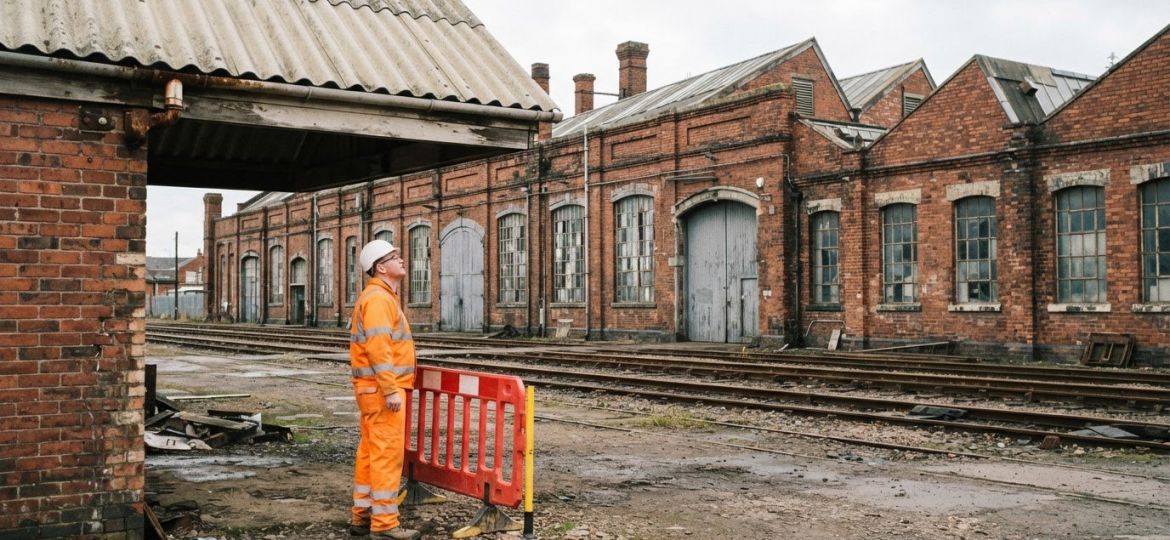
Asbestos Management for Doncaster Rail Engineering Works
The survey is the starting point, not the end of asbestos management compliance at Doncaster rail engineering works. Across the UK, the Control of Asbestos Regulations 2012 require dutyholders responsible for most non-domestic premises to manage asbestos, including through a written register and management plan, according to the UK legislation register. After the survey, record the materials’ locations and condition, set out how risks will be controlled, and keep the information current. Doncaster is the head office of this national service provider.
A survey protects workers only when its findings reach the people planning and carrying out the work. This guide explains how to turn survey results into practical records, brief contractors before work starts, and keep the asbestos register and management plan current as conditions or tasks change. It also shows how accurate survey information supports safer decisions in rail buildings and engineering environments.
Key Takeaways
- Turn survey findings into usable records by capturing material locations, condition and the controls needed to manage risks.
- Keep the asbestos register and management plan current so workers and contractors can access relevant information before work starts.
- Match the survey to the task: routine occupation, intrusive refurbishment and demolition each call for a different level of investigation.
- See how UK-wide water management support can help address separate water-safety needs alongside asbestos planning.
Identifying and recording asbestos-containing materials
Across the UK, buildings built or refurbished before 2000 may contain asbestos. On the railway, treat any suspected material or component as asbestos-containing until proven otherwise. A management survey identifies materials in occupied buildings so they can be monitored without disturbance. Use an accredited surveyor and ensure the survey covers relevant structures, engineering spaces and access routes.
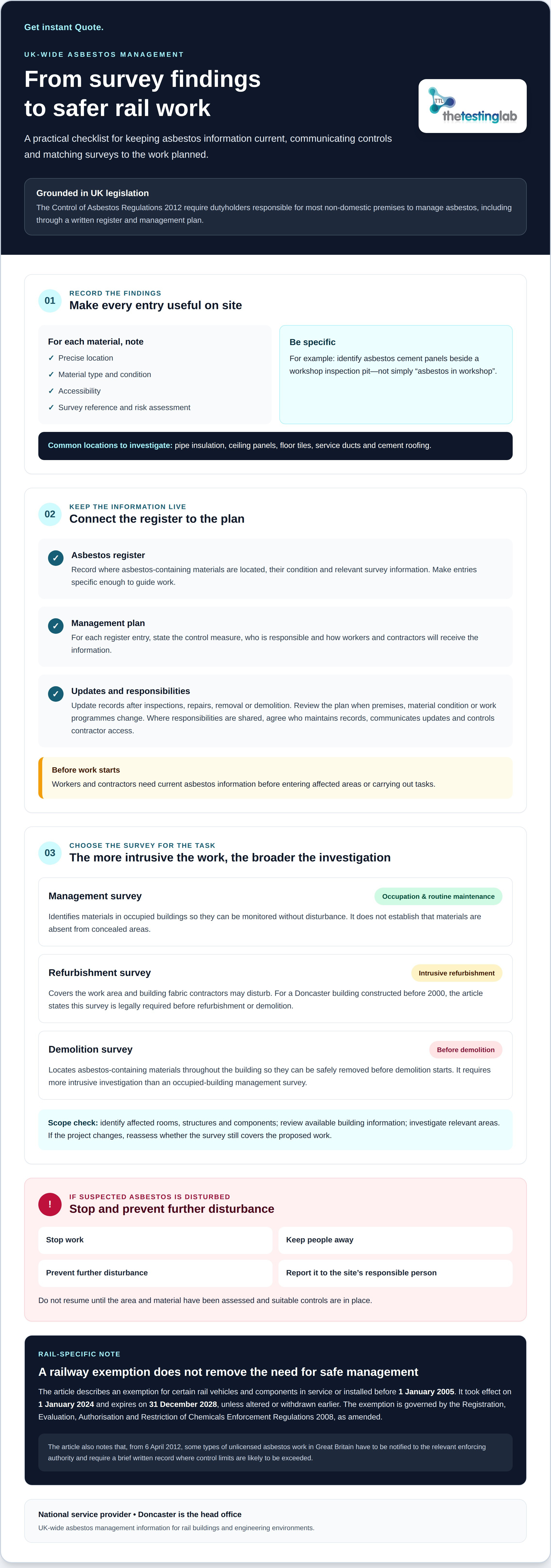
Record each material’s precise location, type, condition and accessibility. For example, identify asbestos cement panels beside a workshop inspection pit rather than simply recording “asbestos in workshop”. Include the survey reference and risk assessment, then use the findings to set controls for maintenance and contractor access. Common locations to investigate include pipe insulation, ceiling panels, floor tiles, service ducts and cement roofing.
Railway vehicles and components containing asbestos are subject to a specific exemption. The railway asbestos exemption is governed by the Registration, Evaluation, Authorisation and restriction of Chemicals Enforcement Regulations 2008, as amended, according to the UK legislation register (legislation.gov.uk). The third exemption certificate covers certain rail vehicles and components in service or installed before 1 January 2005. It took effect on 1 January 2024 and expires on 31 December 2028, unless altered or withdrawn earlier. This exemption does not remove the need to identify and manage materials safely.
From 6 April 2012, some types of unlicensed asbestos work in Great Britain have to be notified to the relevant enforcing authority and require a brief written record where control limits are likely to be exceeded, according to the UK legislation register (legislation.gov.uk). If asbestos is disturbed at a Doncaster rail worksite, fibres may be released and exposure can cause serious disease. Stop work, keep people away, prevent further disturbance and report the incident to the site’s responsible person. Do not resume until the area and material have been assessed and suitable controls are in place.
Asbestos registers, management plans and dutyholder responsibilities
Across the UK, clear records connect survey findings to maintenance decisions and contractor controls. The Control of Asbestos Regulations 2012 require those responsible for most non-domestic premises in Doncaster to manage asbestos, including maintaining a written asbestos register and management plan, according to the UK legislation register (legislation.gov.uk).
Maintaining asbestos registers
The asbestos register records where asbestos-containing materials are located, their condition and relevant survey information. Make each entry specific enough to guide work, such as identifying a material in a station plant room or along a lineside structure. Update the record when inspections, repairs, removal or demolition change a material’s status. Workers planning tasks need current information before entering affected areas.
Preparing management plans
An asbestos management plan explains how identified materials will be controlled, monitored and communicated. For each register entry, state the control measure, who is responsible for applying it, and how workers and contractors will receive the information. Link planned maintenance to the register so work does not proceed on outdated assumptions. Review the plan when the premises, material condition or work programme changes.
Clarifying dutyholder responsibilities
Dutyholders are responsible for maintaining or repairing non-domestic premises, including relevant railway buildings and rolling stock. They must locate asbestos, keep records current, assess risks, choose controls and inform workers where asbestos is present. Where responsibilities are shared, agree who maintains the register and plan, communicates updates and controls contractor access. Clear responsibilities help prevent gaps between site ownership and operational control.
For project-specific coordination, submit a project enquiry.
What asbestos surveys are required before maintenance, refurbishment or demolition of rail buildings?
Choose a survey that matches the planned work and the parts of the structure it may affect. A management survey supports occupation and routine maintenance, but does not establish that materials are absent from concealed areas. For asbestos management compliance at Doncaster rail engineering works, match the survey scope to each task.
Before intrusive refurbishment, arrange a refurbishment survey covering the work area and building fabric contractors may disturb. This applies to renovation or repair likely to affect asbestos-containing materials. For a Doncaster building constructed before 2000, a refurbishment and demolition survey is legally required before refurbishment or demolition. Planned rail projects need a survey scope aligned with drawings, work specifications and access requirements.
Before demolition, a demolition survey must locate asbestos-containing materials throughout the building so they can be safely removed before demolition starts. Railway buildings may contain materials in concealed or inaccessible parts of the structure. Planned refurbishment or demolition therefore requires more intrusive investigation than an occupied-building management survey. Use the findings to plan work sequencing, access controls and removal arrangements before site activity begins.
Define the survey scope for the task: identify affected rooms, structures and components, review available building information, then investigate relevant areas. If the project changes, reassess whether the survey still covers the proposed work. A survey for routine maintenance cannot automatically support intrusive alterations or demolition. Matching each survey to the work helps maintain asbestos management compliance at Doncaster rail engineering works.
Align survey requirements with your rail project’s scope and work programme. Request a project quote to discuss the required asbestos survey support.
The Testing Lab PLC: Water Management Services
The Testing Lab PLC provides Water Management Services for a separate but important part of rail-site risk control: water safety. Doncaster is the head office of this national service provider, supporting work across the UK. Where a station, workshop or engineering site needs water-system risk support, Quick Legionella Risk Assessments can help assess the relevant risks. Fast Legionella Testing and Quick Water Testing support testing needs. Legionella control in the UK must comply with the Control of Substances Hazardous to Health Regulations 2002. These services address water management, not asbestos surveying or asbestos removal, so keep the responsibilities and records distinct within site procedures.
For water-management support at your rail premises, contact The Testing Lab PLC.
Build asbestos controls into your next rail project
Make asbestos management compliance for Doncaster rail engineering works part of project mobilisation, not a document review left until work is about to start. Assign responsibility for keeping project information aligned with the current register, and make changes to the work scope trigger a review of relevant controls. This carries survey findings through planning, contractor briefings and worksite decisions.
Keep water-system requirements separate from asbestos controls. The Testing Lab PLC offers Quick Water Testing, Quick Legionella Risk Assessments and Fast Legionella Testing for distinct water-management needs.
If you’re planning water testing or legionella assessment, contact The Testing Lab PLC to discuss the next step. A clear project process supports informed decisions and steadier delivery.
Frequently Asked Questions
What happens after the survey?
Use the findings to decide whether planned work can proceed, needs additional controls or must wait for further investigation. Match each work package to the survey scope, then brief the people responsible for delivery. If a contractor’s task extends into an uninspected area, for example, pause that part of the work and resolve the information gap before disturbing the structure.
What UK asbestos laws and regulations apply to rail engineering works in Doncaster?
Across the UK, the Control of Asbestos Regulations 2012 provide the main framework for managing asbestos risks. The Health and Safety at Work Act 1974 also applies to workplace safety, while the Construction (Design and Management) Regulations 2015 address sharing information before construction work. Rail enforcement responsibilities are set under the Health and Safety (Enforcing Authority for Railways and Other Guided Transport Systems) Regulations 2006. HSE guidance includes HSG247, HSG248 and HSG210.
Who is responsible for asbestos management in Doncaster rail engineering premises and projects?
Responsibility rests with the dutyholder who controls maintenance or repair of the non-domestic premises. On a rail project, ownership, operational control and responsibility for the work may sit with different parties, so their roles need clear allocation. The principal designer must receive information about asbestos and other hazardous materials before work begins under the Construction (Design and Management) Regulations 2015.
How should rail engineering sites create and maintain an asbestos management plan?
Build the plan around site-specific findings and explain how staff can access relevant information before work begins. Assign responsibility for reviewing records, communicating changes and coordinating contractor briefings. Set review triggers for changes to the premises, material condition or planned activities. For example, a revised engineering task near a recorded material should prompt a review of work controls before the programme proceeds.
How should asbestos-containing materials be identified, assessed and recorded at rail worksites?
Use a competent, accredited surveyor to investigate materials and record their exact locations, condition and potential for disturbance. On the railway, treat suspect materials or components as asbestos-containing until proven otherwise. Assess each finding in context: a damaged panel beside a regularly used maintenance route presents a different management concern from intact material in a restricted space. Keep findings practical for the people planning the work.

Article by
P J F Thomas
CEO and Founder of TTL plc.
Disclaimer
This guide gives general information only and is not legal advice. For advice on your site or samples, contact The Testing Lab PLC.