
Commercial Cooling Tower Legionella Audits in Middlesbrough: When to Review Controls
A cooling tower’s control measures should be reviewed regularly and whenever its system or operation may have changed. For industrial premises in Middlesbrough, a commercial cooling tower Legionella audit can assess whether controls still match the risks. UK-wide, the Health and Safety at Work Act 1974 provides a legal basis for Legionella risk assessments. An industrial commercial cooling tower Legionella audit in Middlesbrough can also help identify changes that call for a closer review.
It’s understandable to want a clear review schedule, but system condition and operation matter too. This article explains what can trigger a review, how risk assessments and written schemes support effective controls, and how UK guidance informs monitoring and records. You’ll also learn how a commercial cooling tower Legionella audit for Middlesbrough industrial sites can clarify priorities when equipment or operating conditions change. Doncaster is the head office of this UK-wide National Service Provider.
Key Takeaways
- In the UK, UK legislation identifies the Health and Safety at Work Act 1974 as a legal basis for Legionella risk assessments.
- Review controls when a cooling system or its operation changes, so the assessment continues to reflect the actual risks.
- A written scheme sets out how controls are implemented and monitored, with records helping demonstrate ongoing management.
- Explore how ACoP L8, HSG274 and BS 8580-1:2019 guide risk assessment and control decisions for complex systems.
Legionella risk assessment for commercial and industrial water systems
Across the UK, risk assessments connect a system’s design and condition to practical control measures. For industrial sites, cooling towers merit close attention because they recirculate water and generate aerosols.
Cooling Tower Assessments and Control Schemes
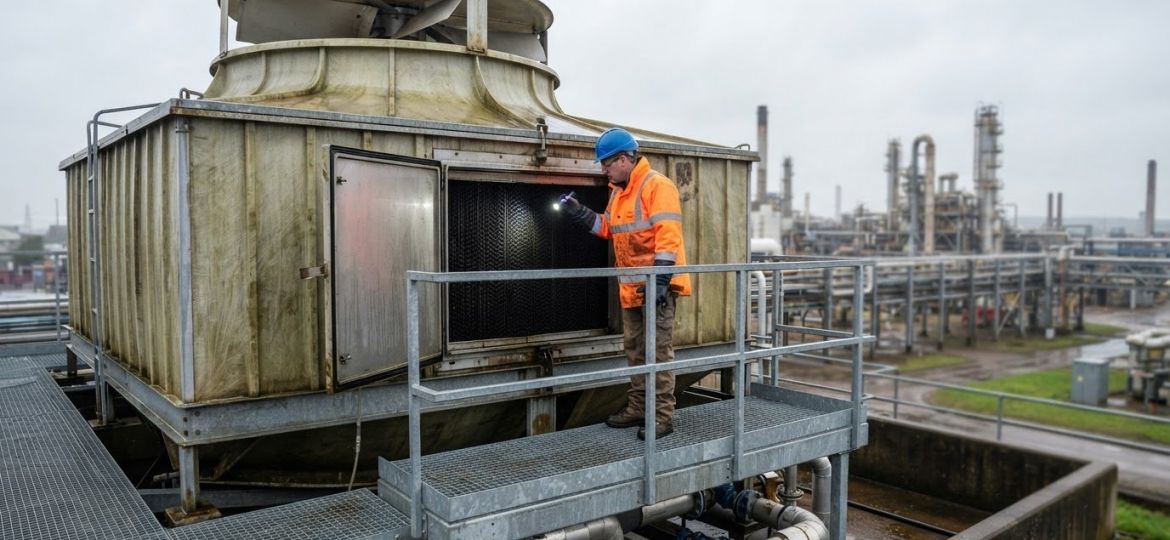
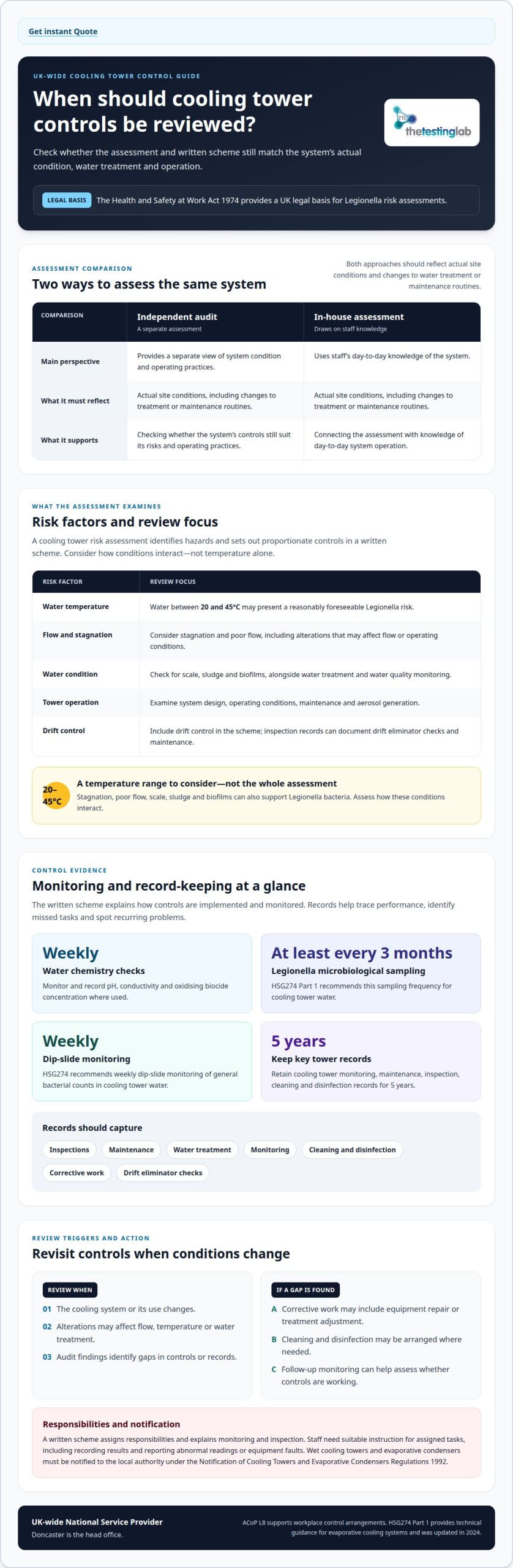
A cooling tower risk assessment identifies hazards and sets out proportionate controls in a written scheme. It may examine system design, operating conditions, water treatment, maintenance, aerosol generation and drift control. The scheme records how controls are monitored and maintained. An independent cooling tower audit provides a separate assessment of system condition and operating practices, while an in-house assessment draws on staff’s day-to-day knowledge. Both should reflect actual site conditions, including changes to water treatment or maintenance routines.
Temperature is one factor: water between 20 and 45°C may present a reasonably foreseeable Legionella risk. Stagnation, poor flow, scale, sludge and biofilms can also support Legionella bacteria. An assessment considers how these conditions interact, rather than treating temperature as the only indicator.
The Duty to Assess Legionella Risk
In the UK, UK legislation identifies the Health and Safety at Work Act 1974 as a legal basis for Legionella risk assessments. Employers and people controlling premises have a duty to understand and manage workplace risks. The assessment should identify foreseeable hazards and establish whether existing control measures are suitable. That makes accurate information about the system and its operation important to the assessment.
All UK water systems require a Legionella risk assessment, although a low-risk system with effective controls may need no elaborate measures. A review is appropriate when the system or its use changes, such as after alterations that affect flow, temperature or water treatment. Legionella risk assessments can help establish the hazards and the controls needed for a commercial or industrial site.
Written schemes of control and compliance records
A written scheme translates assessment findings into operating controls for each cooling tower. Across the UK, inspection, water treatment and drift-control records help show whether those measures were implemented.
Maintenance Records and Control Measures
Records should capture inspections, maintenance, water treatment, monitoring, cleaning and disinfection, alongside any corrective work. Keep cooling tower monitoring, maintenance, inspection, cleaning and disinfection records for 5 years. Water chemistry checks, including pH, conductivity and oxidising biocide concentration where used, should be monitored and recorded weekly. This evidence helps trace control performance and spot missed tasks or recurring problems.
Drift control should also feature in the scheme. Inspection records can document checks on drift eliminators and any maintenance carried out. If an audit identifies poor condition or ineffective treatment, corrective action may include repairing equipment, adjusting treatment, or arranging cleaning and disinfection. Follow-up monitoring can then help assess whether controls are working.
Employer and Premises-controller Duties
Employers and people in control of UK premises must understand and manage Legionella risks. A written scheme assigns responsibilities, defines control measures and makes clear how monitoring and inspection are carried out. Staff need suitable instruction for their assigned tasks, including how to record results and report an abnormal reading or equipment fault. Clear responsibilities reduce the chance of missed controls that could support bacterial growth.
For Middlesbrough businesses, retain the scheme, inspection and maintenance logs, water-treatment and monitoring results, and records of cleaning, disinfection and remedial work. If Legionella is detected, promptly inform the site’s Responsible Person and follow the scheme’s response procedure. Wet cooling towers and evaporative condensers must be notified to the local authority under the Notification of Cooling Towers and Evaporative Condensers Regulations 1992; this is a separate notification requirement, not a detection-specific rule. A professional review can help interpret findings and define corrective priorities. Request a Legionella review when audit findings identify gaps in controls or records.
ACoP L8, HSG274 and BS 8580-1:2019 guidance
Across the UK, these references help frame Legionella control in practical and technical terms. Each supports a different part of assessment, monitoring and health and safety management.
ACoP L8 Guidance
ACoP L8 is the Approved Code of Practice for controlling Legionella risks in the workplace. It helps duty holders interpret their health and safety responsibilities and organise proportionate legionella control. For a cooling tower, that means connecting identified hazards with clear controls, assigned responsibilities and appropriate records. A written scheme should reflect how the system actually operates, including its water treatment and maintenance arrangements.
Use ACoP L8 alongside the site’s risk assessment, not as a substitute for examining the equipment. A tower’s condition, operating pattern and drift controls affect which precautions are suitable.
HSG274 Part 1 Guidance
HSG274 Part 1 provides technical guidance for managing Legionella risks in evaporative cooling systems. Its monitoring recommendations can help operators identify changes in water quality before they undermine the control regime. Cooling tower water should undergo Legionella microbiological sampling at least every three months. HSG274 also recommends weekly dip-slide monitoring of general bacterial counts in cooling tower water.
HSG274 Part 1 was updated in 2024. For an audit, current guidance provides a reference point for examining sampling, operating controls and records. Results need to be interpreted with system conditions, rather than in isolation.
BS 8580-1:2019 Guidance
BS 8580-1:2019 sets out a framework for Legionella risk assessments. Assessments carried out in line with this standard can help ensure the review follows a systematic method, from identifying hazards to evaluating controls. This supports consistent decisions across complex industrial water systems.
For a Middlesbrough cooling tower, an assessment should relate its findings to the equipment and site operation. Combining that structured assessment with ACoP L8 and HSG274 helps make control decisions traceable. Arrange a Legionella risk assessment to review how these standards apply to your system.
The Testing Lab PLC
The Testing Lab PLC is a UK-wide national service provider with its head office in Doncaster. Its Quick Legionella Risk Assessments and Fast Legionella Testing can help clarify system risks and inform decisions when controls, equipment or operating conditions change.
This support is relevant when an audit identifies gaps, monitoring results need investigation, or an assessment no longer reflects the system in operation. Risk assessments and testing provide evidence for reviewing controls and deciding what needs attention. They complement the site’s written scheme and ongoing management, but do not replace the duty holder’s responsibility to manage risks.
Contact The Testing Lab PLC to discuss Legionella assessment or testing for your site.
Turn audit findings into a clear next step
Use a review to connect technical findings with decisions that support responsible site operation. For industrial sites in Middlesbrough, a commercial cooling tower Legionella audit can identify control issues and inform a proportionate response. Findings can also help teams plan follow-up around the system’s condition.
The Testing Lab PLC offers Quick Water Testing, Quick Legionella Risk Assessments and Fast Legionella Testing. Its LCA-registered Legionella risk assessment services and testing can support decisions about managing system risks across commercial and industrial sites.
Contact The Testing Lab PLC to discuss your site’s Legionella requirements. A considered next step can help keep decisions grounded in evidence.
Frequently Asked Questions
How often should control measures be reviewed?
Review controls regularly and whenever a change could affect Legionella risk. Examples include alterations to cooling equipment, water treatment, operating patterns or maintenance arrangements. Changed monitoring results or a fault affecting water flow can also prompt reassessment. Establish whether existing measures remain suitable and whether the written scheme or operational controls need updating.
Where abouts do your Legionella services cover?
The Testing Lab PLC provides UK-wide Legionella services, including in Middlesbrough, with its head office in Doncaster. Its coverage includes Yorkshire & Humberside; North East & North West; East Anglia & East Midlands; London; South East & South West; West Midlands; Scotland & Wales. This coverage supports businesses seeking LCA-registered risk assessments and Legionella testing for commercial and industrial water systems.
Who is Responsible?
The employer or person in control of premises is responsible for managing Legionella risks. They may appoint a Responsible Person to oversee the control scheme, monitoring and maintenance, but assigning tasks does not remove the duty holder’s responsibility. For example, a site should clearly assign responsibility for reviewing water-treatment records and escalating abnormal results so that necessary action is not missed.
What does a commercial cooling tower Legionella audit include?
A commercial cooling tower audit examines whether the system’s design, condition and operation are reflected in its risk controls. It may consider water treatment, aerosol generation, drift control, maintenance and monitoring. For example, an auditor may compare the observed equipment condition with maintenance records and the written scheme. The findings help identify control gaps and prioritise suitable remedial measures.
What UK laws and HSE guidance apply to Legionella risk assessments for cooling towers?
Relevant UK requirements and guidance include the Health and Safety at Work Act 1974, COSHH regulations, HSE guidance ACOP L8 and HSG274, and BS 8580-1:2019 for risk assessment. Wet cooling towers and evaporative condensers must also be notified to the local authority under the Notification of Cooling Towers and Evaporative Condensers Regulations 1992. Together, these references inform assessment, control and record-keeping.

Article by
P J F Thomas
CEO and Founder of TTL plc.
Disclaimer
This guide gives general information only and is not legal advice. For advice on your site or samples, contact The Testing Lab PLC.