
A single oversight during asbestos removal can lead to HSE fines exceeding £100,000, yet 15% of UK wide remediation projects still face avoidable delays because of technical misunderstandings. You likely feel the constant pressure of balancing tight construction deadlines with the absolute necessity of keeping your building occupants safe. It’s a high-stakes environment where the margin for error is zero, and the anxiety over a failed inspection is entirely justified. This is why mastering the Four Stage Clearance process isn’t just a legal checkbox; it’s your primary defence against litigation and long-term health risks.
We know that complying with the Control of Asbestos Regulations 2012 often feels like a minefield of potential failures and complex paperwork. This definitive guide provides the engineering precision you need to secure a valid Certificate of Reoccupation and ensure your premises are 100% safe for return. We’ll examine the specific responsibilities of the UKAS-accredited analyst and the rigorous site standards required to keep your project on track throughout 2026. By the end of this article, you’ll have the technical confidence to manage your site with total transparency and expert oversight.
Key Takeaways
- Understand how the Control of Asbestos Regulations 2012 (CAR 2012) mandates strict legal compliance for reoccupying commercial and residential premises UK wide.
- Master the technical requirements of the Four Stage Clearance process to ensure your site is scientifically verified as safe and free from hazardous fibres.
- Learn why analyst independence is vital to avoid conflicts of interest, ensuring the integrity of your safety certification and protecting building occupants.
- Access a practical site management checklist designed to prevent common Stage 2 failures and streamline the path to successful project completion.
- Discover how a precision-led, UKAS accredited laboratory approach provides the strategic partnership needed to manage environmental risks with total confidence.
Understanding Four Stage Clearance and UK Legislation
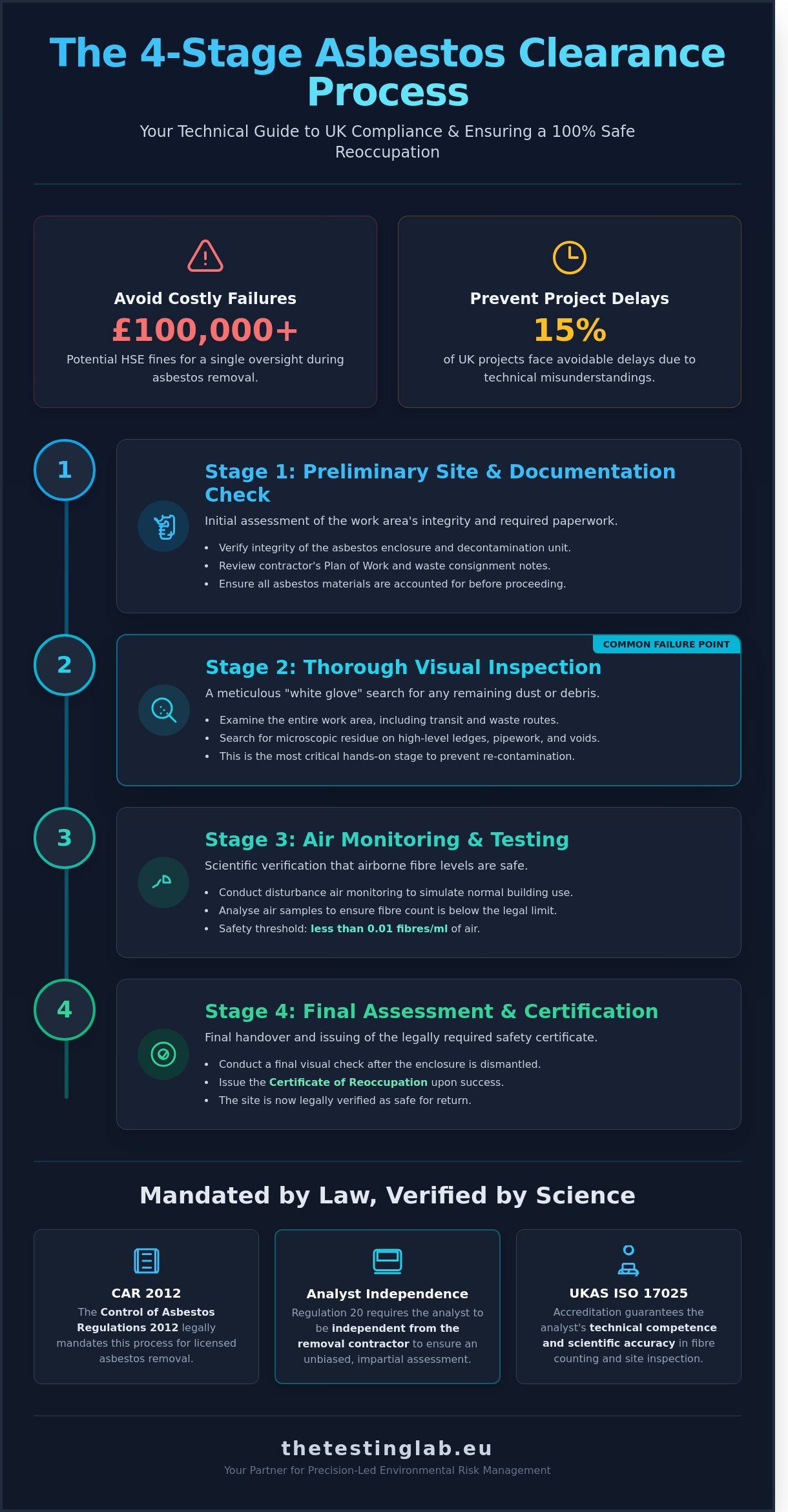
A Four Stage Clearance is the rigorous, mandatory inspection protocol required UK wide following the removal of high-risk asbestos-containing materials. It’s not a mere formality; it’s a technical validation that ensures a building is safe for human reoccupation. While a contractor might leave a site looking clean, microscopic asbestos fibres can remain suspended in the air or settled on surfaces long after the physical boards or insulation are gone. These invisible hazards are why the Control of Asbestos Regulations 2012 (CAR 2012) mandates a systematic four-part process before a Certificate of Reoccupation is issued.
The Duty Holder, typically the building owner or employer, carries the legal weight of this process. They’re responsible for appointing an independent analyst to verify the work. Precision is paramount here. At The Testing Lab, we view this not just as a compliance checkbox, but as a critical engineering phase where data-driven results protect lives. Relying on visual cleanliness alone fails to meet UK health and safety standards because it doesn’t account for respirable fibres. Without this clearance, a site remains legally contaminated, preventing any further renovation or occupancy.
CAR 2012 and the Legal Necessity
Under CAR 2012, any work involving licensed asbestos materials requires a formal Four Stage Clearance. Failing to secure a Certificate of Reoccupation can lead to HSE interventions, significant fines, or legal action if exposure occurs later. While non-licensed work doesn’t always mandate the full four stages by law, many UK wide organisations adopt it as a best-practice protocol to mitigate risk. Regulation 20 of CAR 2012 requires that the organisation performing the clearance must be independent of the contractor carrying out the removal to ensure an unbiased assessment.
The Role of UKAS and ISO 17025
Accreditation isn’t optional for asbestos air monitoring. The United Kingdom Accreditation Service (UKAS) assesses laboratories against the ISO 17025 standard to ensure technical competence. This accreditation guarantees that fibre counting and site inspections are performed with scientific accuracy. Choosing a specialist asbestos consultancy provides more than just a testing house approach; it offers a strategic partnership where technical expertise identifies risks that a standard checklist might miss. This level of precision is the only way to confirm that air quality meets the stringent limit of 0.01 fibres per millilitre (f/ml), which is the threshold for safe re-entry in the UK.
The Four Stages of Asbestos Clearance Explained
The Four Stage Clearance is a rigorous, legally mandated process under HSG248 guidelines. It ensures a building is safe for reoccupation after licensed asbestos removal. This isn’t just a tick-box exercise; it’s a scientific validation of the work area’s safety. Each stage serves as a critical gatekeeper, preventing the release of hazardous fibres into the wider environment. At The Testing Lab, we treat this process with a laboratory level of precision, ensuring every site we certify meets the highest safety benchmarks UK wide.
Stage 1 & 2: The Physical Inspection
Stage 1 begins with a preliminary check of the site condition and the removal contractor’s documentation. The analyst reviews the Plan of Work and waste consignment notes to ensure all asbestos materials have been accounted for. We also verify the integrity of the enclosure and the decontamination unit. If the setup doesn’t meet the required 2026 safety standards, the process stops immediately.
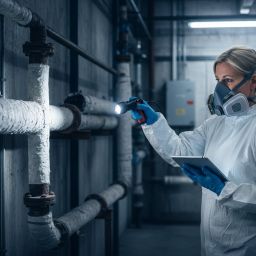
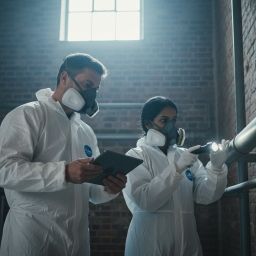
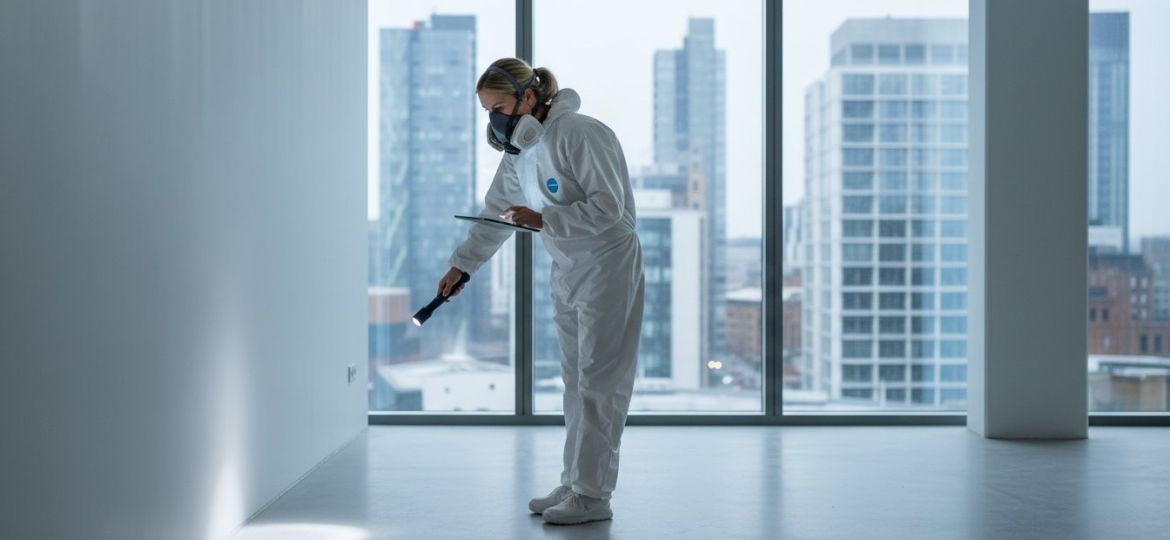
Stage 2 is where we apply what we call the “white glove” approach. This is a meticulous visual inspection of the entire work area. Analysts search for microscopic dust and debris in difficult-to-reach spots like pipe brackets, high-level ledges, and floor voids. We don’t just look at the immediate removal zone; we examine the transit and waste routes to ensure no contamination leaked during the project. Research into the effectiveness of witnessed four-stage clearances highlights how vital this independent oversight is for maintaining safety standards across the industry.
Stage 3 & 4: Air Testing and Final Handover
Stage 3 shifts the focus to the science of airborne fibre detection. Once the area passes the visual check, we conduct disturbance air monitoring. We don’t simply set up pumps in a still room. We use brushes or fans to agitate the air, simulating normal building activity like walking or moving furniture. This ensures that any hidden, respirable fibres become airborne and detectable by our equipment. To pass, the air concentration must be below the 0.01 f/ml (fibres per millilitre) threshold. This limit is the absolute baseline for safety; anything higher requires a complete reclean of the enclosure.
Stage 4 is the final assessment post-enclosure dismantling. After the analyst issues the Stage 3 pass, the contractor removes the polythene sheeting and timber frames. The analyst then performs a final walk-through of the entire area. This ensures no debris was trapped behind the plastic or released during the dismantling process. Only after this final check do we issue the Certificate for Reoccupation. If you’re managing a complex site, our asbestos consultancy services provide the technical oversight needed to keep your project compliant and your occupants safe.
The Critical Importance of Analyst Independence
The Four Stage Clearance represents the final barrier between a hazardous work site and a safe, reoccupied environment. Independence in this process isn’t just a recommendation; it’s a structural necessity for risk management. When a removal contractor appoints their own analyst, the fundamental checks and balances of the process fail. This “self-certification” creates a direct conflict of interest that puts building occupants at risk and leaves owners vulnerable to legal challenges. According to the Control of Asbestos Regulations 2012, the duty holder should ideally employ the analyst directly to ensure impartial results. This separation ensures that the person verifying the cleanliness of the area has no financial or professional incentive to overlook minor failings or rush the process.
Contractor vs. Analyst: A Necessary Divide
A “cosy” relationship between contractors and testing firms often leads to a decline in the thoroughness of stage two visual inspections. In 2023, a review of 50 UK wide remedial projects showed that independent analysts identified residual dust or debris in 12% of enclosures that had already been declared “ready” by the removal team. Independence forces the contractor to maintain higher standards from the start. They understand that the clearance won’t be signed off unless the work meets the exact specification. In one anonymised case from a Birmingham office refurbishment, a third-party audit caught a failure in the air monitoring stage that saved the client an estimated £15,000 in potential decontamination costs that would’ve been triggered if occupants had returned to a contaminated space.
Selecting a Strategic Partner for UK Wide Projects
Managing large portfolios across the country requires a laboratory partner with the capacity for high-volume site visits and rapid response times. You need a partner who can coordinate 10 or more site visits daily without compromising on the precision of the testing. Transparent reporting is vital for maintaining a robust health and safety file. Modern compliance demands digital certificates that are issued immediately upon completion of the Four Stage Clearance, providing a timestamped audit trail. By engaging professional Asbestos Consultancy Services, you move beyond simple compliance. You gain a strategic partner who treats testing as a scientific discipline, ensuring that every certificate of reoccupation is backed by rigorous data and engineering-grade accuracy. This approach removes the burden of quality assurance from your shoulders and places it in the hands of specialists who prioritise safety over speed.
- Independent testing provides a robust defence against future liability claims.
- Directly hired analysts act as the client’s “eyes and ears” on site.
- Digital reporting ensures data integrity and immediate access to safety records.
- Third-party audits verify that the removal contractor has delivered the agreed-upon scope of work.
Practical Site Management: Preparing for a Successful Clearance
A successful Four Stage Clearance depends on the synergy between the Licensed Asbestos Removal Contractor (LARC) and the independent analyst. It’s not merely a final check; it’s a rigorous audit of the entire removal process. Site managers across the UK wide landscape often see delays because they treat the analyst’s arrival as the start of the cleaning process rather than the final verification. To avoid costly standby charges, the site must be fully prepared before the analyst steps into the airlock.
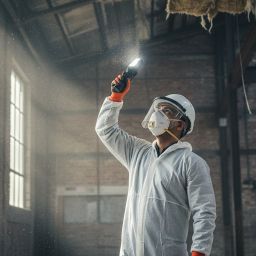
Lighting is the most frequent technical oversight. Analysts require a minimum of 500 lux to perform a valid Stage 2 visual inspection. If the mains power is isolated, site managers must provide sufficient 110v task lighting that reaches every corner, including high-level voids and behind pipework. Without adequate visibility, the analyst cannot legally sign off the area. Similarly, the transit and waste routes require strict management. These paths must be cleared of all skip bags and debris. Any contamination found on a transit route during the inspection will result in an immediate failure for the entire site.
What Happens if a Stage Fails?
If a Stage 2 visual inspection fails, the LARC must re-clean the entire enclosure immediately. The analyst will pinpoint the specific areas of concern, but the contractor’s responsibility covers the whole work zone. When a Stage 3 air test fails, the protocol is more intensive. The enclosure stays sealed while the air settles; usually for at least 24 hours; followed by a thorough damp-wipe of all surfaces and a repeat of the 45-minute sampling period. We recommend communicating these failures to stakeholders by focusing on the technical precision of the safety barrier. It’s a sign that the system works to protect the building’s future occupants.
Site Readiness Checklist
- Verify that every ACM listed in the initial scope of work is physically removed and the substrate is clean.
- Confirm the enclosure is completely dry; damp surfaces can mask fine fibres and lead to Stage 3 failures.
- Ensure all sealant spray or “lock-down” procedures are delayed until after the Stage 2 visual pass.
- Check that the Negative Pressure Unit (NPU) pre-filters are clean to maintain correct airflow during the test.
- Remove all non-essential equipment and waste bags from the enclosure to allow for a full floor-to-ceiling inspection.
- Ensure all monitoring equipment, especially NPU pressure gauges, is accurately calibrated. For reference on the types of industrial gauges required, resources like cps.nz can be helpful even for those outside of NZ.
The ‘dust-free’ standard requires that every surface within the enclosure is entirely free from any visible dust, debris, or residues, regardless of whether those materials are suspected to contain asbestos. Achieving this level of cleanliness requires a methodical, engineering-led approach to site hygiene.
Our team provides the technical oversight needed to ensure your project meets these stringent UK standards without unnecessary delays. If you need expert guidance on site preparation or independent verification, explore our professional asbestos consultancy services to keep your project on track.
Expert Four Stage Clearance in Doncaster and UK Wide
The Testing Lab PLC operates as a UKAS accredited laboratory from its headquarters in Doncaster, providing a scientific and precise approach to every Four Stage Clearance project. Our engineers don’t just tick boxes; they ensure your site meets the stringent requirements of HSG248 through a rigorous engineering-led methodology. By deploying on-site mobile laboratory units, we eliminate the standard 24-hour wait for results common with off-site testing. This allows for a fast-track Certificate of Reoccupation, often issued the same day the final air test concludes, reducing project downtime by approximately 15%.
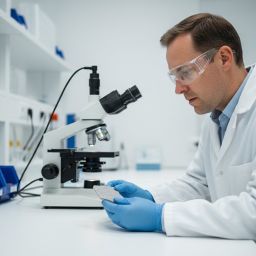
Mobile laboratory capabilities represent a significant shift in how we manage asbestos risks in 2026. These units are equipped with high-specification Phase Contrast Microscopy (PCM) technology, allowing our analysts to provide immediate feedback during the stage three air monitoring phase. This level of technical magistery ensures that any potential issues are identified and rectified while the licensed contractor is still on-site. We provide this high-precision service for residential, commercial, and industrial sectors across the UK wide landscape.
Beyond the Enclosure: Soils and Water Safety
Contamination risks don’t always stop at the enclosure’s edge. Asbestos fibres often migrate to surrounding grounds during demolition or waste transit. We address these hidden hazards through professional Asbestos in Soils Testing, ensuring every square metre of your site is safe for future use. Our team applies a laboratory-grade precision to ground investigations, identifying microscopic fragments that standard visual inspections might miss.
Managing environmental safety requires a holistic view of the site. We link asbestos compliance with other critical safety standards, including Legionella risk management. This integrated compliance model simplifies your health and safety obligations by providing a single point of contact for multiple environmental hazards. Whether you’re managing a single building in Doncaster or a national portfolio, our commitment to UK wide safety standards remains unwavering.
Get Started with The Testing Lab PLC
Doncaster serves as our central hub, enabling a rapid national response to any site requiring a Four Stage Clearance. Our logistics network ensures that we can reach most UK locations within a 4-hour window for emergency call-outs. We believe in transparency and precision, which is why we offer a clear, technical breakdown of all costs associated with the reoccupation process.
You can request a fixed-fee quote for asbestos clearance through our streamlined online portal. Our team handles the technical complexity of the clearance process so you can focus on your core operations. Ensure your project is safe, legal, and ready for reoccupation today by partnering with a laboratory that values quality as much as you do.
Securing Safe Reoccupation for Your UK Wide Projects
Navigating UK asbestos legislation requires more than basic compliance. It demands a commitment to the highest safety standards. The Four Stage Clearance process, as defined by HSG248 regulations, ensures every square inch of your site meets the strict air quality thresholds necessary for safe reoccupation. By prioritising analyst independence and adhering to ISO 17025 standards, you eliminate the risks of inadequate inspections. Our Doncaster based team brings precision to every project. We ensure your site is handed back without delays or safety compromises.
The physical demands of construction and remediation work also highlight the importance of personal strength and conditioning. For professionals dedicated to maintaining their fitness for such demanding roles, you can visit Team Industry UK to find apparel designed for strength training.
Once your site is certified safe, the next phase of refurbishment can begin with confidence. This commitment to high standards should extend to selecting new building materials. When upgrading a property’s exterior, for instance, specialist suppliers are essential for ensuring long-term performance. In the realm of high-quality fenestration, manufacturers such as Grabex Windows Ltd offer bespoke timber and aluminium windows and doors that meet modern safety and energy efficiency standards.
Don’t leave your project’s safety to chance when you can partner with a UKAS accredited laboratory. We provide the technical expertise and transparent reporting required to keep your workforce protected and your legal obligations met. Whether you’re managing a single site or a UK wide portfolio, our expert analysts deliver the rigorous testing your project deserves. It’s about protecting lives and your reputation through scientific accuracy.
Secure your UKAS accredited Four Stage Clearance from The Testing Lab PLC
We’re ready to help you achieve a seamless and compliant site handover today.
Frequently Asked Questions
Is a four stage clearance legally required for all asbestos removal?
A four stage clearance is legally mandatory for all high-risk asbestos removal projects involving licensed materials as defined under the Control of Asbestos Regulations 2012. This requirement applies UK-wide for any work conducted inside a weather-proof enclosure. While non-licensed work doesn’t strictly require all four stages, the HSE recommends a thorough visual inspection and air test to ensure the area’s safety for reoccupation.
How long does a full four stage clearance typically take to complete?
A standard four stage clearance typically requires 4 to 8 hours to complete for a single enclosure on a domestic or commercial site. Small residential projects might finish in 4 hours, whereas large industrial sites often take over 10 hours. The duration depends on the enclosure size and the volume of air that needs filtering during the mandatory 2-hour air monitoring phase.
Can my asbestos removal contractor choose the analyst for the clearance?
You should hire the UKAS-accredited analyst independently from your removal contractor to avoid any conflict of interest. Guidance in HSG248 (Edition 2, 2021) strongly recommends that the property owner or employer appoints the analyst directly. This independence ensures the final check remains impartial and maintains the integrity of the Four Stage Clearance process across all UK-wide projects.
What is the pass/fail limit for the asbestos air monitoring stage?
The clearance limit for asbestos air monitoring is set at 0.01 fibres per millilitre (f/ml) of air. This threshold is the lowest detectable limit using Phase Contrast Microscopy (PCM) according to current UK regulations. If the laboratory analysis shows a result higher than 0.01 f/ml, the area fails the test and requires further cleaning followed by a complete re-test of the site.
What documents are included in a Certificate of Reoccupation?
A Certificate of Reoccupation includes the full clearance report, photographic evidence of the cleaned area, and the air monitoring results. It also features site logs, the analyst’s UKAS accreditation number, and a signed declaration that the area is safe. Since the 2021 updates to HSG248, UK regulations require at least 10 to 20 photographs documenting every specific stage of the inspection process.
What happens if the work area fails the visual inspection stage?
If the analyst finds any visible dust or debris during Stage Two, the removal contractor must reclean the entire area immediately. The Four Stage Clearance can’t proceed to air monitoring until the visual inspection is passed. This failure is recorded in the final report, and the analyst will perform a new inspection only after the contractor confirms the area is completely dust-free.
Do I need a four stage clearance for non-licensed asbestos work?
You aren’t legally required to conduct a full four stage process for non-licensed work, but you must still perform a thorough visual inspection. For Notifiable Non-Licensed Work (NNLW), many UK duty holders opt for a simplified clearance to verify the area’s safety. Professional labs suggest at least a Stage Two visual check and a Stage Three air test to manage your legal liability.
How much does a four stage clearance cost for a standard UK site?
A standard four stage clearance for a single enclosure costs between £450 and £750 UK-wide. Prices vary based on the project’s location and the number of air samples required for the site’s specific volume. Large-scale commercial clearances or weekend call-outs can increase these costs to over £1,000 per day for a dedicated analyst to remain on-site throughout the process.