
Effective Stress Triaxial Testing: Deeper Strength Data for Confident Design
Effective stress testing is an advanced form of triaxial testing that goes beyond a routine Quick Undrained (UU/UUT) test. It’s used when engineers need a clearer picture of how soils will behave under realistic loading and drainage conditions—particularly where pore water pressure and consolidation influence stability and settlement.
Effective stress triaxial testing is typically carried out as either:
- Consolidated Drained (CD) – drainage is allowed during shearing, so pore water pressure does not build up and strength is assessed under drained conditions.
- Consolidated Undrained (CU) – drainage is closed during shearing, allowing pore pressure to develop; pore pressure is measured so effective stress parameters can still be derived.
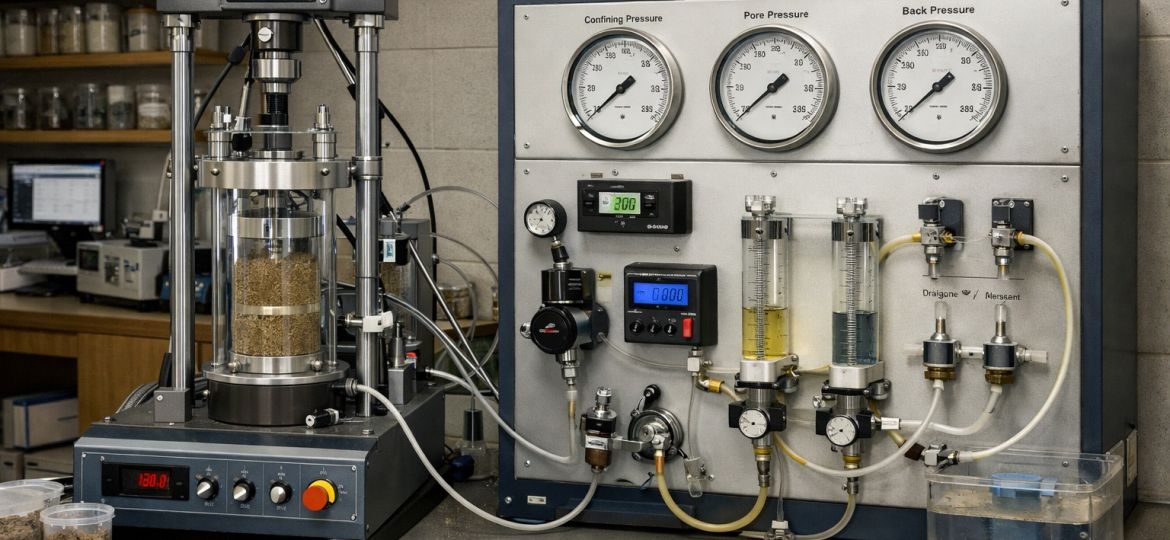
Before loading, specimens are saturated and consolidated to restore conditions closer to the in-situ state. During the test, measurements may include axial strain, applied load, volume change, and pore water pressure (depending on test type and scope). Testing can be run as a single stage, as a multi-stage programme, or as a set of tests on separate specimens to define behaviour across different effective stresses.
What you get from the results
The key outputs are the soil strength parameters cohesion (c′) and friction angle (φ′) derived from effective stress (and supported by total stress data).
Where it’s used
Effective stress triaxial data supports design and assessment for:
- slope and embankment stability
- tunnelling and excavations
- foundations and retaining walls
- consolidation and settlement behaviour
Why choose The Testing Lab PLC?
At The Testing Lab PLC, we combine careful sample preparation with clear, decision-ready reporting and practical interpretation—helping you apply effective stress parameters confidently in design.
Need CD/CU triaxial testing? Contact The Testing Lab PLC to discuss your project requirements and turnaround.